
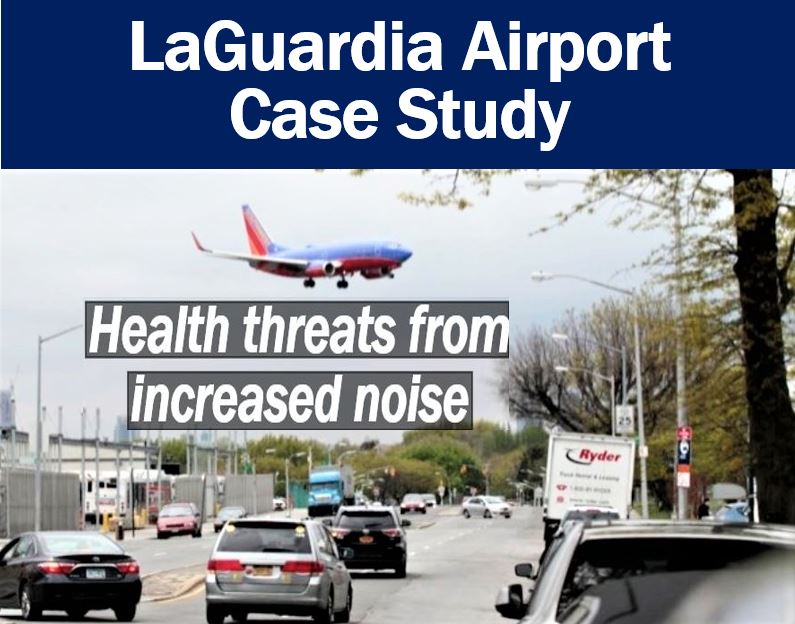
Optimizing airport flight patterns may reduce flight times, but the health costs may outweigh the benefits. Researchers from Columbia University’s Mailman School of Public Health and Queens Quiet Skies carried out a case study of LaGuardia Airport. The researchers found that greater noise levels can pose health threats such as cardiovascular disease to nearby residents.
Peter Muennig, MD, and colleagues wrote about their study in the International Journal of Environmental Research and Public Health (citation below). Muennig is a Professor of Health Policy and Management at the Mailman School.
The authors used flights patterns from LaGuardia airport. Specifically, flights that have historically flown over the US Tennis Center in Queens and Flushing Meadows. People in the business refer to it as the TNNIS route.
Optimizing flight patterns -health consequences
The researchers wanted to explore the trade-offs between optimizing flight patterns, i.e., faster plane routes, and suffering on the ground.
Prof. Muennig said:
“Airports in the U.S. have gradually been transitioning to automated flight systems. These systems generate new flight paths over populated areas.”
“While they can improve flight efficiency, the increased noise associated with these novel flight patterns potentially pose serious health threats to nearby communities – including cardiovascular disease and anxiety disorder as consequences of noise.”
Flight automation in New York City led to the year-round use of ‘TNNIS Climb’ at La Guardia, which was implemented in 2012. Nobody had carried out an environmental assessment or environmental impact statement on the route.
Heavy airplane traffic
Prof. Muennig, who also leads Global Research Analytics for Population Health at Columbia, said:
“Flights from LaGuardia airport have historically flown over Flushing Meadows in Queens.”
“During U.S. Open tennis matches, the residents of certain neighborhoods in Queens had to endure heavy airplane traffic over their homes, but it only lasted a few weeks. Now, they have to contend with it year-round.”
The authors compared the costs and QALYs gained associated with reverting to pre-2012 flight patterns that existed before the year-round use of TNNIS. QALYs stands for Quality-Adjusted Life Years.
The TNNIS climb pushed airplane noise to more than 60 decibels over some of the city’s most densely populated areas.
Prof. Muennig said:
“Our study focuses on health and economic impacts of a single flight route as a result of flight automation, however, our analysis uses inputs that may be generalizable to other settings.”
“The results point to the strong need for careful study of public health impacts of such changes before they are implemented.”
In an Abstract that precedes the main article in the journal, the authors wrote:
“Despite increases in efficiency, flight automation systems without a careful assessment of noise might generate flight paths over densely populated areas and cause serious health conditions for the overflown communities.”
Citation
“The Trade-Off between Optimizing Flight Patterns and Human Health: A Case Study of Aircraft Noise in Queens, NY, USA,” Zafar Zafari, Boshen Jiao, Brian Will, Shukai Li, and Peter Alexander Muennig. Int. J. Environ. Res. Public Health 2018, 15(8), 1753; https://doi.org/10.3390/ijerph15081753.
