
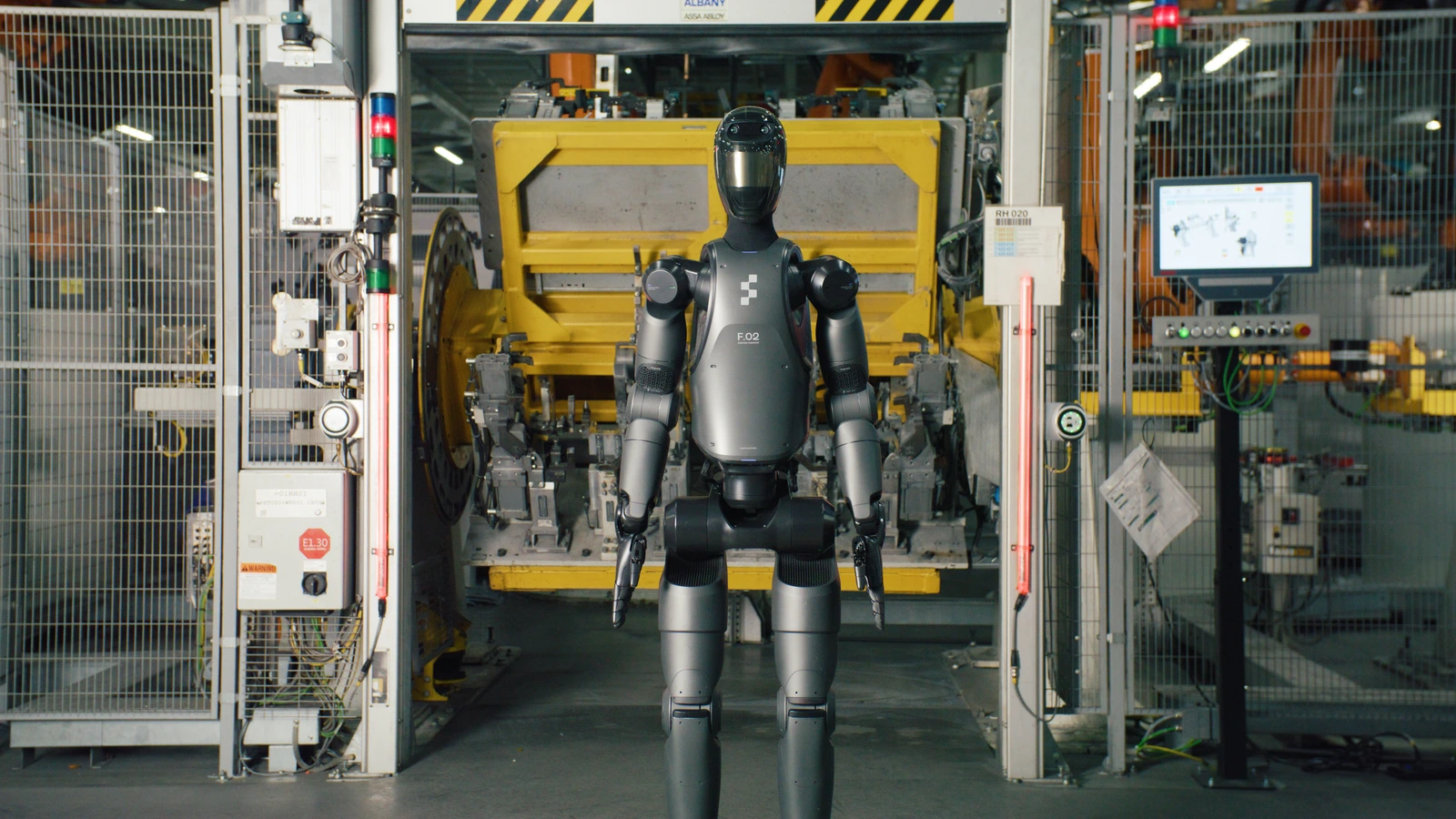
Figure says its humanoid robots completed 56% of trials involving household tasks in 30 unfamiliar homes, compared with 9% for a model trained without its human-behaviour dataset. The results show progress in adapting robots to new surroundings, but leave a substantial gap between demonstrations and dependable household work.
The California company’s Helix 2.5 results, published on 17 September, cover tidying living rooms, folding towels and making beds. Figure required completion of the whole task for a successful trial.
The work is part of the development of physical AI: artificial intelligence that enables machines to perceive their surroundings, decide what to do and act in the physical world.
It extends automation beyond fixed routines. A robot handling unfamiliar bedding or objects must adjust its movements to what it encounters, rather than rely entirely on a task programmed for one location.
Factories provide an established market
Industrial robotics already operates at considerable scale. The International Federation of Robotics reported on 24 September that five million industrial robots were operating worldwide in 2025, up 9%. Annual installations rose 11% to more than 600,000.
Those totals cover industrial robots generally. They are not a count of humanoids or machines using the latest AI models.
BMW provides a narrower example of humanoid deployment. The carmaker says Figure 02 assisted in producing more than 30,000 BMW X3 vehicles during a ten-month pilot at its Spartanburg plant in South Carolina in 2025.
The robot retrieved and positioned sheet-metal parts for welding, moving more than 90,000 components over approximately 1,250 operating hours. BMW’s account of the pilot also describes additional safety barriers and partitions, and improvements to the factory’s 5G coverage.
AI suppliers are investing in tools for this market. NVIDIA announced robotics models and simulation software in March, including systems for training and testing machines before deployment. Its partners include industrial robot makers and humanoid developers.
Home robots still need training and human help
Figure’s trials tested whether learned behaviour transferred to new homes and objects. The robots had received task-specific training elsewhere, but were not trained or fine-tuned in the 30 evaluation homes. The company calls this zero-shot generalisation.
The reported improvement came from pretraining on Index, Figure’s dataset of human behaviour. The company held the task-specific data and other training conditions constant in its comparison.
A 56% completion rate remains insufficient for consistently handling everyday chores. Figure itself cautions that general humanoid robotics has not been solved.
Rival 1X is accepting pre-orders for its NEO home robot. Its current order page advertises a $20,000 early-access purchase, a $499 monthly subscription option and a refundable $200 deposit. It says US deliveries start in 2026.
The company’s launch announcement says subscription deliveries will follow later and expansion to other markets is planned from 2027. These are company plans, rather than evidence of widespread household deployment.
NEO will arrive with basic autonomy, according to 1X. Owners can schedule remote expert supervision for unfamiliar or more complicated tasks. An early-access purchase therefore includes a system still developing its abilities, with human assistance available.
Remote operation also makes access to household information relevant. Buyers need to understand when an operator connects, what the robot records and how those records are used.
Care applications require separate evidence
Robots are also being studied for support in later life. A 2025 systematic review in Geriatric Nursing examined 41 studies covering emotional support, communication and physical assistance, and health management.
The researchers reported benefits for depression and quality of life, alongside concerns about usability and safety. These findings cover different types of care robot and do not establish that the humanoids now being marketed for homes can safely provide personal care.
As we reported in our earlier coverage of hands-on jobs, work involving movement and unpredictable surroundings presents difficulties beyond generating an answer on a screen.
For employers and households, purchase price is only part of the calculation. Maintenance, supervision and the time spent correcting failures also affect the cost of getting a task done. A scheduled remote operator may help complete a chore, but their involvement must be counted when assessing the robot’s autonomy and economics.
