

The smallest machine ever, just a few billionths of a metre in size, called ANT (actuating nano-transducer), has been created by a team of scientists from the Universities of Cambridge and Bath in England, who say its future applications in nanorobotics are virtually endless.
The ultra-small machine uses light to power itself, the scientists explained in the journal Proceedings of the National Academy of Sciences (PNAS) (citation below). It could form the basis of future nano-machines that can navigate in water and sense the environment around them.
Nanorobotics (nano-robotics) – also known as nanobots, nanomachines, or nanomites – has many potential applications, including 3-D printing, medicine, nanophotonics to produce light more efficiently, national defence, space travel, and the creation of microscopic computer circuits for the production of incredibly-small processors and chips, to name just a few.
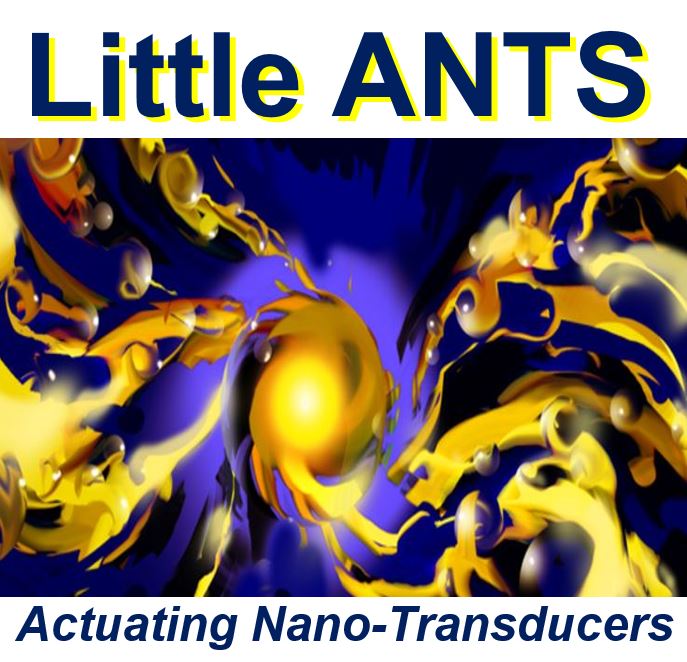 The world’s smallest machines. Expanding polymer-coated gold nanoparticles. (Image: University of Cambridge. Credit: Yi Ju)
American, British, Israeli and other countries’ defense departments are carrying out research into using nanotechnology for use in military applications such as unmanned droned air surveillance.
Made of microscopic gold particles
This latest experimental device is made of minuscule particles of gold that are bound together with temperature-responsive polymers in the form of a gel. Polymers are substances which have molecular structures built up chiefly or completely from a large number of similar units bonded together.
When a laser heats the nano-engine to a certain temperature, it stores huge amounts of elastic energy in a fraction of a second, as the polymer coatings get rid of all the water from the gel and collapse.
This effectively forces the gold nanoparticles to bind together into tight clusters.
However, when the device is cooled down, the polymers absorb water and expand, and the gold nanoparticles are strongly and rapidly pushed apart, like a coil.
First author, Dr. Tao Ding, who works at Cambridge’s Cavendish Laboratory, said:
“It’s like an explosion. We have hundreds of gold balls flying apart in a millionth of a second when water molecules inflate the polymers around them.”
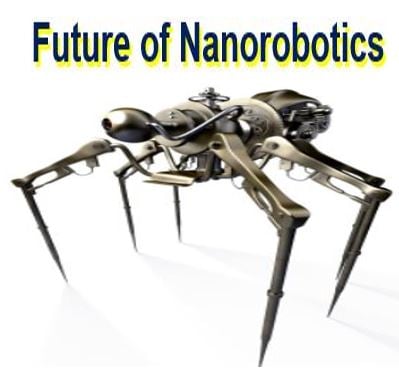 Virtually every industry, from electronics, construction, security, defence, space travel to bio-medicine is interested in the potential applications of nanorobotics. (Image: futureforall.org)
Powered by light
Co-author Dr. Ventsislav Valev, from the University of Bath, said:
“We know that light can heat up water to power steam engines. But now we can use light to power a piston engine at the nanoscale.”
Nano-machines that can get into virtually every environment and carry out essential work are the dreams of scientists and public alike.
The problem has been to make them move – a challenge that has kept them in the realm of science fiction, that is, until now.
Cambridge researchers say that the new method, which they developed, is astonishingly simple but can be very fast and exert large forces.
The forces exerted by these microscopic devices are several times greater than anything produced before. They have a force per unit weight almost 100 times better than any motor.
The authors say the devices are cost-effective to manufacture, fast to respond, energy efficient and also bio-compatible.
ANTS – Actuating Nano-Transducers
Study leader, Professor Jeremy Baumberg, who works at the Cavendish Laboratory, has named the devices ‘ANTs’, or actuating nano-transducers.
Prof. Baumberg said: “Like real ants, they produce large forces for their weight. The challenge we now face is how to control that force for nano-machinery applications.”
In this latest study, the scientists suggest how to turn Van de Walls energy – the attraction of molecules and atoms – into elastic energy of polymers and release it rapidly.
Prof. Baumberg said:
“The whole process is like a nano-spring. The smart part here is we make use of Van de Waals attraction of heavy metal particles to set the springs (polymers) and water molecules to release them, which is very reversible and reproducible.”
Prof. Baumberg and colleagues are now working with Cambridge University’s commercialisation arm – Cambridge Enterprise – and a number of other firms with the aim of commercialising this technology.
The research was partly funded by the UK Engineering and Physical Sciences Research Council (EPSRC) and the European Research Council (ERC).
According to WhatIs.com, a nanorobot is:
“A tiny machine designed to perform a specific task or tasks repeatedly and with precision at nanoscale dimensions, that is, dimensions of a few nanometers (nm) or less, where 1 nm = 10-9 meter.”
Citation: “Light-induced actuating nanotransducers,” Tao Ding, Ventsislav K. Valev, Andrew R. Salmon, Chris J. Forman, Stoyan K. Smoukov, Oren A. Scherman, Daan Frenkel, and Jeremy J. Baumberg. Proceedings of the National Academy of Sciences (PNAS). 2 May 2016. DOI: 10.1073/pnas.1524209113.
Video – Nanotechnology military air force applications
Whichever defense department in the world wins the nanotechnology research & development race, could probably win any non-nuclear battle.
