
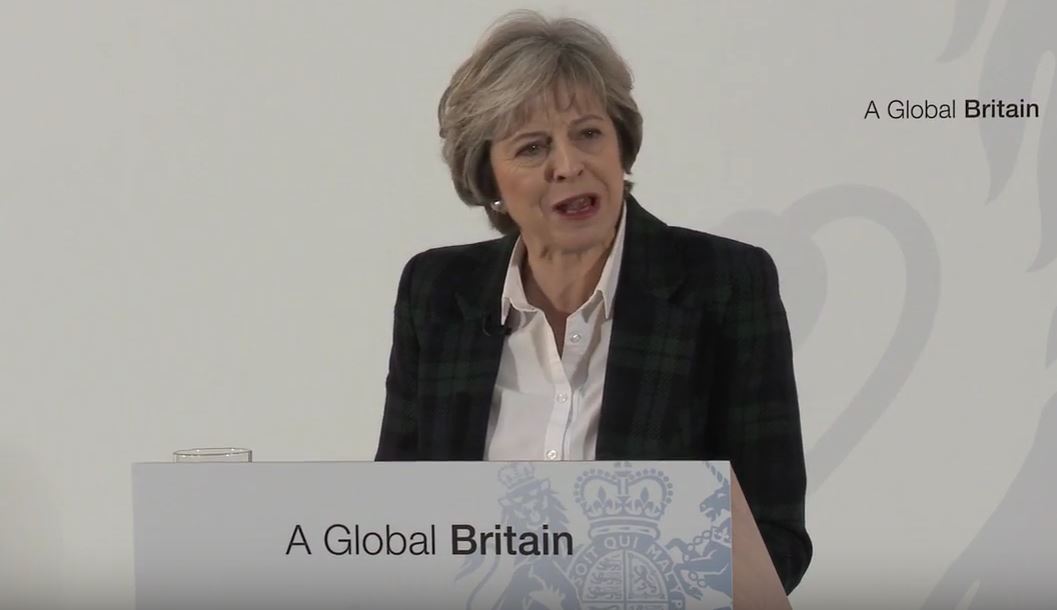
Yesterday, United Kingdom Prime Minister Theresa May delivered her Brexit speech, outlining the long-awaited plan for leaving the European Union.
While the Brexit speech did not explain what the plan means for small and medium enterprises (SMEs), the reaction of some groups is essentially pragmatic: we welcome the pro-business negotiating stance, but in the end, ‘it’s achievement that matters.’ This message was especially strong in regard to the transition out of the single market to a free trade agreement.
 In her long-awaited Brexit speech about the negotiation plan for leaving the EU, Theresa May confirmed that the aim is for the UK to leave the single market.
SMEs want to see the ‘bold and ambitious free trade agreement’
In outlining her “Plan for Britain” and the 12 negotiating priorities for leaving the EU, the Prime Minister confirmed the aim is for the UK to leave the single market and put in place a free trade agreement with Europe.
May said: “we do not seek membership of the single market. Instead we seek the greatest possible access to it through a new, comprehensive, bold and ambitious free trade agreement.”
Mike Cherry, National Chairman of the Federation of Small Businesses (FSB), which represents around 200,000 small businesses from around the UK, was at the speech. He describes it as a “starting point for a pro-business Brexit.”
However, Cherry says small businesses “now want to see concerted action to address trade, talent and transitional arrangements.”
He says the vast majority (93 percent) of FSB members who export do so directly to the single market and they want to see this “bold and ambitious free trade agreement” so they can continue to operate within European markets.
Cherry says the FSB will be pushing for guarantees that the transition is seamless – with “no cliff edge or gap in trade.”
‘It is what you achieve, not what you bid for, that matters’
The desire to see action is also reflected in the response of Adam Marshall, Director General of the British Chambers of Commerce (BCC), which represents around 100,000 companies across the UK.
Marshall says the Brexit process is no different to a business negotiation in the sense that, it is what you achieve, not what you bid for, that really matters. He notes:
“While businesses now have a clearer sense of the Prime Minister’s top-line priorities, they will come away from her speech knowing little more about the likely outcome of the Brexit negotiations than they did yesterday.”
The BCC expressed no surprise about the intention to leave the single market.
Marshall says many businesses facing the immediate effects of leaving the EU have already “been preparing for the eventuality that the UK would leave both the single market and the customs union, with some sort of free trade deal to follow.”
He says now that May has confirmed this, other businesses will be likely be doing the same.
‘The pressure is now on to deliver’
The Confederation of British Industries (CBI) – whose members include SMEs and employ around a third of the UK private sector-employed workforce – also emphasize the need for the government to press on and now deliver the plan outlined in the Brexit speech.
CBI Director-General Carolyn Fairbairn says the Prime Minister has now “changed the landscape,” and that coming out of the single market will reduce options for having barrier-free trading with the EU.
“But,” says Fairbairn, “businesses will welcome the greater clarity and the ambition to create a more prosperous, open and global Britain, with the freest possible trade between the UK and the EU.”
“The pressure is now on to deliver these objectives and achieve a smooth and orderly exit,” she adds.
Video of Prime Minister’s speech
The following YouTube video – posted by 10 Downing Street – shows Prime Minister Theresa May delivering her Brexit speech at Lancaster House, London, on 17 January 2017.
