

Researchers describe a process to make norbornene sustainable plastics – bioplastic polymers that don’t need fresh water or land. Fresh water and land are scarce resources in many parts of the world today.
Polymers are materials that are made of long, repeating chains of molecules. Polymers like thermoplastic polymer are materials that are made of long, repeating chains of molecules.
The researchers from Tel Aviv University, say that the polymer comes from microorganisms that eat seaweed. It produces no toxic waste at all and recycles into organic waste. It is also biodegradable.
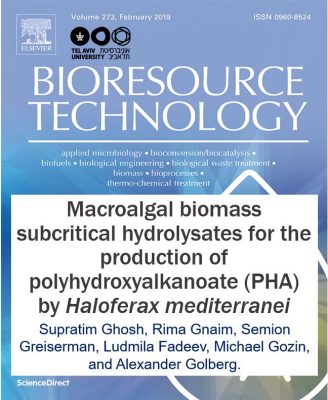
The researchers wrote about their work in the journal Bioresource Technology (citation below). The authors, all from Tel Aviv University, were Supratim Ghosh, Alexander Golberg, Rima Gnaim, Semion Greiserman, Ludmila Fadeev, and Michael Gozin.
The United Nations says that ninety percent of all the pollutants in our oceans consist of plastics. However, there are few alternatives to plastic that are comparable and environmentally friendly. In other words, creating sustainable plastics that we can use on a large scale has been extremely difficult.
Sustainable plastics produced from marine microorganisms
Alexander Goldberg said:
“Plastics take hundreds of years to decay. So bottles, packaging and bags create plastic ‘continents’ in the oceans, endanger animals and pollute the environment. Plastic is also produced from petroleum products, which has an industrial process that releases chemical contaminants as a byproduct.
“A partial solution to the plastic epidemic is bioplastics, which don’t use petroleum and degrade quickly. But bioplastics also have an environmental price: To grow the plants or the bacteria to make the plastic requires fertile soil and fresh water, which many countries, including Israel, don’t have.”
“Our new process produces ‘plastic’ from marine microorganisms that completely recycle into organic waste.”
Dr. Golberg is a Senior Lecturer (Assistant Professor) at Tel Aviv’s Porter School of Environmental and Earth Sciences.
Microorganisms that feed on seaweed to produce a polymer
The research team harnessed microorganisms that eat seaweed to produce PHA. PHA stands for polyhydroxyalkanoate – a polymer.
Dr. Golberg said:
“Our raw material was multicellular seaweed, cultivated in the sea. These algae were eaten by single-celled microorganisms, which also grow in very salty water and produce a polymer that can be used to make bioplastic.”
“There are already factories that produce this type of bioplastic in commercial quantities, but they use plants that require agricultural land and fresh water.”
“The process we propose will enable countries with a shortage of fresh water, such as Israel, China and India, to switch from petroleum-derived plastics to biodegradable plastics.”
Cleaning our oceans without using fresh water or arable land
Dr. Golberg believes that this new study could revolutionize current global efforts to clean our oceans without using fresh water or affecting arable land.
Dr. Golberg said:
“Plastic from fossil sources is one of the most polluting factors in the oceans. We have proved it is possible to produce bioplastic completely based on marine resources in a process that is friendly both to the environment and to its residents.”
The researchers are currently conducting basic research to find the best algae and bacteria for producing polymers. Specifically, polymers for bioplastics with different properties.
Definition of sustainable and sustainable plastics
Sustainable means ‘able to continue over a long period.’ It can also mean, when referring to something, that it causes little or no damage to the environment. Therefore, we can continue using it for a long time.
Sustainable growth, for example, means growth that continues for a long time and does not damage our environment.
Sustainable plastics are plastics that do not harm the environment, so we can continue using them for a long time.
Citation
“Macroalgal biomass subcritical hydrolysates for the production of polyhydroxyalkanoate (PHA) by Haloferax mediterranei,” Supratim Ghosh, Rima Gnaim, Semion Greiserman, Ludmila Fadeev, Michael Gozin, and Alexander Golberg. Bioresource Technology, Volume 271, January 2019, Pages 166-173. DOI: https://doi.org/10.1016/j.biortech.2018.09.108.
