
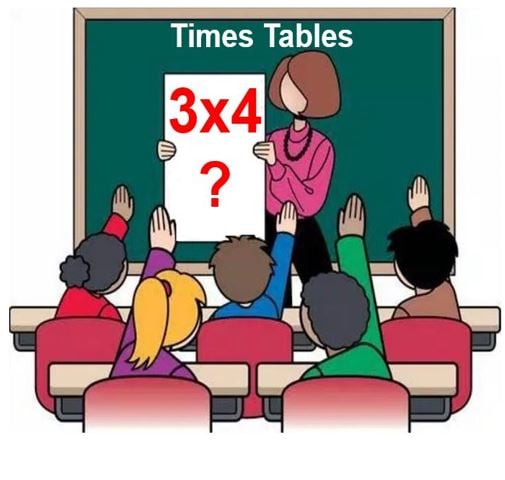
There will be times tables tests before children leave primary school at the age of 11 in England, says the Government. By the time they finish primary school, every English pupil should know his or her times tables up to 12 times 12 off by heart, the DoE (Department of Education) said.
The on-screen check will be piloted this summer to eighty primary schools, i.e. about three thousand children, says the DoE. It will then be rolled out across the country in 2017.
In order to secure a good primary education, maths is non-negotiable, said Nicky Morgan, Education Secretary. The plan is part of the Government’s “war on innumeracy and illiteracy”.
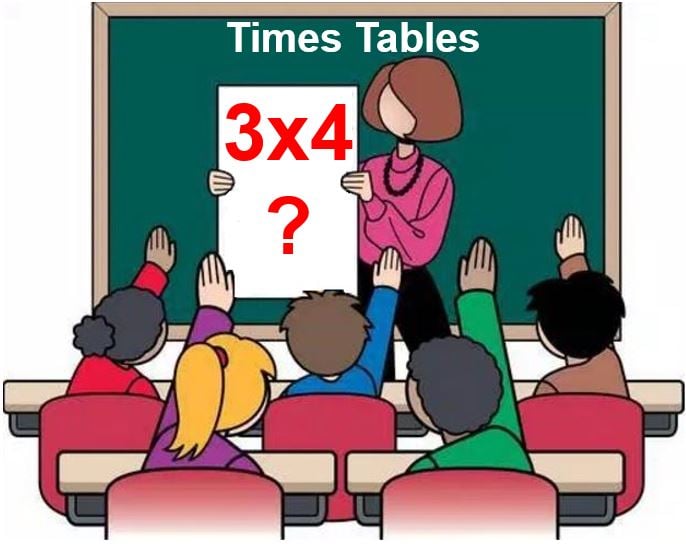 The government believes that learning the times tables up to 12 x 12 by heart is a vital part of maths education.
Time-sensitive times table tests
According to the Department of Education, on-screen technology will be used for the first time in National Curriculum tests for assessing 11-year olds on their times tables. The tests will be time-sensitive, i.e. children will be scored against the clock. They will know their results instantly.
Ms. Morgan said:
“Since 2010, we’ve seen record numbers of 11 year olds start secondary school with a good grasp of the three Rs. But some continue to struggle.”
“That is why, as part of our commitment to extend opportunity and deliver educational excellence everywhere we are introducing a new check to ensure that all pupils know their times tables by age 11.”
“They will help teachers recognise those pupils at risk of falling behind and allow us to target those areas where children aren’t being given a fair shot to succeed.”
Eighty percent of Year Six children reached Level 4 in maths, reading and writing in 2015, compared to 78% in 2014.
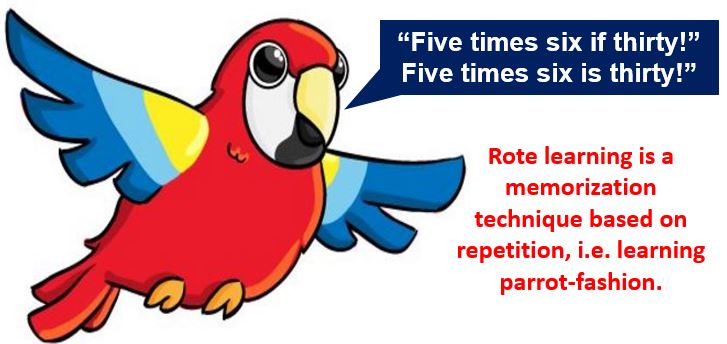 Is telling children – “learning numbers parrot fashion means you are good at maths” – sending the right message? Mike Bell, of the Evidence Based Teacher Network, says rote learning has a place in the classroom (see video below).
Undue pressure on teachers and pupils, say unions
Labour, however, says a shortage of teachers threatens to undermine standards. Teaching unions have often commented on additional tests, suggesting they place excessive pressure on children and their teachers.
According to Ms. Morgan, the tests are part of a campaign to prevent the estimated 74,000 children who currently leave primary school every year in England without meeting the expected standard in maths, and to make sure teachers focus on key skills.
Schools where a large proportion of children score poorly will be monitored closely. Ms. Morgan had previously called for children who failed maths and English tests at primary schools to be made to do them again at secondary school.
 Maths anxiety is a recognized problem that affects millions of people in the UK. Experts believe it is acquired at school and affects maths performance. Will testing children against the clock exacerbate this problem?
Ms. Morgan said she is concerned that pupils who do badly in primary school find it extremely difficult to catch up at secondary school, and subsequently have weak GCSE results.
Times tables tests create ‘huge damage’
Last year, Jo Boaler, professor of maths education at Stanford University in California, USA, said at a conference in London that giving kids time tables tests is creating ‘huge damage’.
Prof. Boaler said:
“I have never memorised my times tables. I still have not memorised my times tables. It has never held me back, even though I work with maths every day.”
“It is not terrible to remember maths facts; what is terrible is sending kids away to memorise them and giving them tests on them which will set up this maths anxiety.”
Some children have no problem with timed tests and sail through them, others, however, are not. Prof. Boaler said it is wrong to send the message to kids that learning things parrot fashion, such as times tables, means you are good at maths.
In an interview with TES (Times Educational Supplement), Prof. Boaler said:
“What we know now is that when you give things to kids like a timed multiplication test, about a third of them develop anxiety. For those kids the working memory which holds maths facts is blocked and they can’t access it.”
“Governments saying everybody has to memorise their times tables to 12 times 12 is absolutely disastrous. We will be setting up nations of maths-anxious kids – we are doing that now.”
“Some kids aren’t fast memorisers,” she said, “and they decide from an early age that they can’t do maths because of the timed maths tests. Other kids may be OK but see maths as a shallow subject which is about recall of facts and disengage. So [these cause] huge damage. The US is moving away from them. The UK is moving into them.”
Video – The value of rote learning
Rote learning has a place in the classroom, sais Mike Bell, of the Evidence-Based Teacher Network.

Comments are closed.