
Customers who try customizing a product may be more likely to choose customization again, according to research combining retail transaction records with controlled experiments.
The finding offers retailers a reason to pay attention to the first experience of configuring a product, not just the immediate sale. It also suggests a way to investigate why some shoppers use customization tools while others choose ready-made options.
The study in the November 2026 issue of the Journal of Marketing, first published online in 2025, was conducted by Suh Yeon Kim, Rebecca W. Hamilton, TI Tongil Kim and Michael V. Lewis.
What customization means
Product customization lets a customer take part in the design of an item by choosing features or options. For example, a shopper might select colors or materials before ordering a product. A ready-made alternative is chosen from products that have already been designed.
Customization can offer a closer fit to a customer’s preferences, but it can also take time. A shopper may be unsure which options work together, whether the finished item will meet expectations, or how long it will take to arrive.
What the researchers found
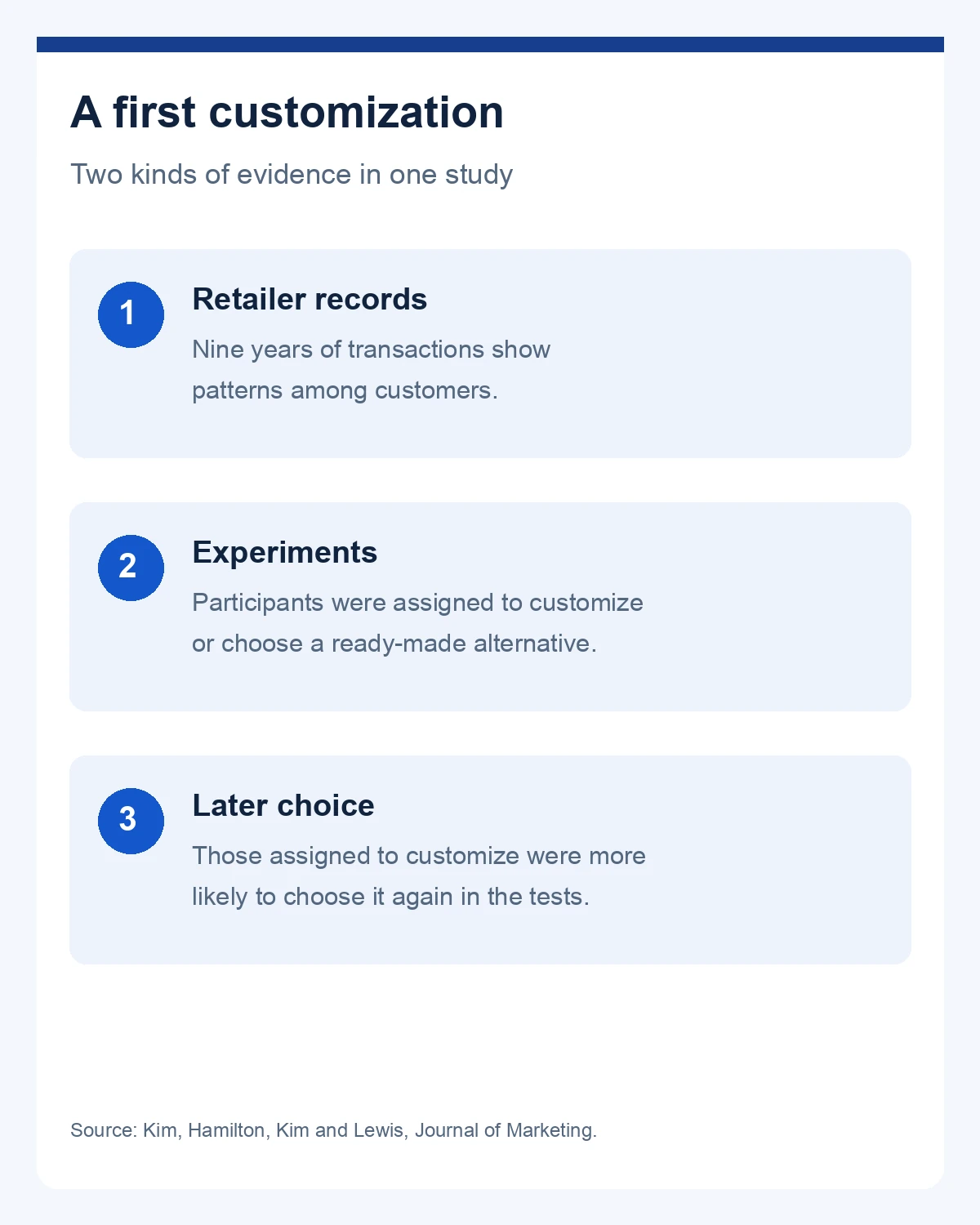
The researchers examined nine years of transaction data from one retailer. Customers who customized at least once were more likely to do so again. They also visited more often, bought more items and spent more than customers who had never customized.
Those records show an association. People who choose customization may already be different from other customers, perhaps because they are more engaged with the retailer or particularly interested in its products. The transaction data alone cannot establish that customization caused all of the differences in spending or visits.
The researchers also conducted longitudinal experiments, assigning some participants to customize and others to choose from a matched set of ready-made products. That approach helped separate the experience of customizing from a pre-existing preference for doing so.
In the experiments, an initial customization experience increased the likelihood that participants would customize later. This supports a narrower conclusion than a promise of higher sales: trying the process can affect later choices in the settings studied.
Make the first decision easier
A retailer considering a customization tool could start by identifying the decision customers actually value. A few meaningful choices may be easier to understand than a long sequence of options. Clear prices, delivery estimates, a preview and a way to reverse a choice can help shoppers judge whether the extra effort is worthwhile.
Those are practical design suggestions, not individual interventions tested by this study. They should be evaluated with customers rather than assumed to work for every product.
A business can compare the share of customers who start and finish configuring, the time required, returns and later purchases. If it tests a new design, assigning comparable customers to versions of the experience can help distinguish an effect of the tool from differences between the people who chose to use it.
Repeat use is only one measure
More customization is not automatically better for shoppers. Customers may prefer a ready-made product, or the available options may not justify a higher price or longer wait. A retailer should also consider production costs, mistakes and whether custom items can be returned.
Positive feedback needs context too. Separate MBN reporting on customer co-creation describes research in which participants sometimes spoke positively about a product they helped create after a disappointing result. That is a different study and should not be treated as a finding of the customization paper.
The evidence comes from one retailer’s records and experiments, so the size and durability of any effect may differ elsewhere. The useful question for a business is whether customization helps its own customers make a better choice, and whether they want to use it again.
