

New ultra-light gloves let users ‘touch’ and ‘grasp’ virtual objects, says a team of Swiss researchers. The gloves also let the user manipulate virtual objects. The scientists say that users feel they are really touching something in the real world.
The new ultra-light gloves weigh less than 8 grams (2.8 oz) per finger. They also provide feedback that is incredibly realistic, say the researchers.
The gloves can generate up to forty Newtons of holding force per finger. All they need for that force is 200 volts and a few milliwatts of power. They could run on a very small battery, the researchers said.
All that together, plus the ultra-light gloves’ low form factor – just 2 mm thick – translates into a level of freedom of movement and precision that is unprecedented.
Ultra-light gloves – no exoskeleton or thick cables
Herbert Shea said:
“We wanted to develop a lightweight device that – unlike existing virtual-reality gloves – doesn’t require a bulky exoskeleton, pumps or very thick cables.”
Shea is a Professor at the EPFL in Switzerland. EPFL stands for École Polytechnique Fédérale de Lausanne (Federal Institute of Technology in Lausanne). He is also Head of EPFL’s Soft Transducers Laboratory (LMTS).
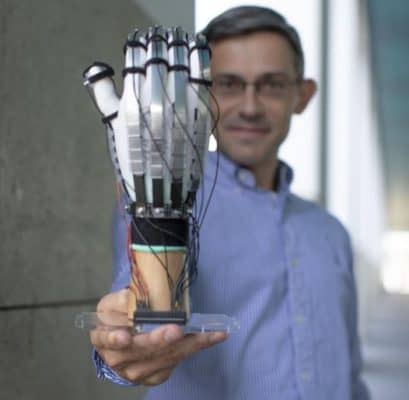
The ultra-light gloves have a name – DextrES. Researchers have successfully tested them on volunteers in Zurich. They are presenting their achievements at the upcoming ACM Symposium on User Interface Software and Technology (UIST).
Metal strips, fabric, and electricity
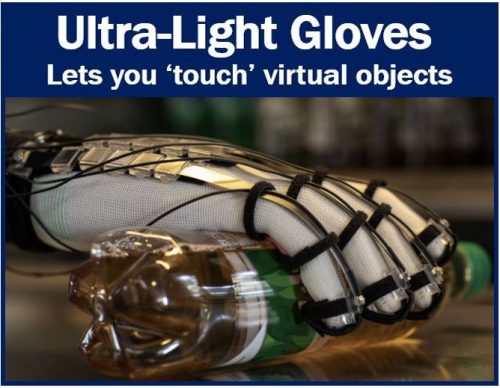
The ultra-light gloves are made of nylon. There are thin elastic metal strips than run over the fingers. A thin insulator separates the strips.
When the user’s fingers ‘touch’ a virtual object, a controller applies a voltage difference between the metal strips. The resulting electrostatic attraction makes them stick together. This subsequently produces a braking force that blocks the movement of the fingers or thumb(s).
The metal strips glide smoothly as soon as the voltage is removed. The user can then move his or her fingers freely once again.
Tricking the user’s brain
At the moment, a very thin electrical cable powers the ultra-light gloves. However, it would be possible to fit a small battery. The battery would be very small because of the gloves’ low voltage and power requirements.
Prof. Shea said:
“The system’s low power requirement is due to the fact that it doesn’t create a movement, but blocks one.”
The scientists say they need to determine just how closely they have to simulate real conditions to give the user a realistic experience. For this, they will need to conduct tests.
Otmar Hilliges said:
“The human sensory system is highly developed and highly complex. We have many different kinds of receptors at a very high density in the joints of our fingers and embedded in the skin.”
“As a result, rendering realistic feedback when interacting with virtual objects is a very demanding problem and is currently unsolved. Our work goes one step in this direction, focusing particularly on kinesthetic feedback.”
Hilliges is an Assistant Professor of Computer Science at the Advanced Interactive Technologies Lab, ETH Zürich. ETH stands for Eidgenössische Technische Hochschule (Swiss Federal Institute of Technology). He is also Head of the ETH’s Advanced Interactive Technologies Lab.
Who made the ultra-light gloves?
EPFL made the hardware at its Microcity campus in Neuchâtel in Switzerland. ETH Zurich created the virtual reality system and also carried out user tests. Hardware, in this article, refers to the physical components of the gloves.
Regarding this project partnership, Hilliges said:
“Our partnership with the EPFL lab is a very good match. It allows us to tackle some of the longstanding challenges in virtual reality at a pace and depth that would otherwise not be possible.”
The researchers plan to scale up the device and apply it to other parts of the human body using conductive fabric.
Prof. Shea said:
“Gamers are currently the biggest market, but there are many other potential applications – especially in healthcare, such as for training surgeons. The technology could also be applied in augmented reality.”
Augmented reality gives you information about things in your field of vision. If you point your smartphone, for example, at the street in front of you, the screen will tell you where cafes, restaurants, doctors, dentists, etc. are.
