
The US Corporate tax system keeps money abroad, according to a new Council on Foreign Relations (CFR) Scorecard. Corporate tax, also called corporate income tax, is what companies pay governments on their profits.
Nearly thirty years after the US’ last major tax overhaul, there is bipartisan agreement that reducing the corporate tax rate and taxing overseas profits differently would help move the tax system in the right direction.
Other rich nations, such as the UK, have much lower corporate tax rates but collect proportionally much more money from corporate tax than the US government does, even as American company profits have reached record highs, according to a new scorecard and progress report from the Council on Foreign Relations’ Renewing America initiative.
Several US multinationals have been buying companies abroad so that they can move their headquarters and pay less tax. Pfizer, the largest pharmaceutical company in the world, is trying to buy Britain’s second largest drugmaker AstraZeneca so that it can move its HQ to London and save over $1 billion per year in corporate tax.
If the Pfizer-AstraZeneca deal goes through, the US government will see another case of a major company moving abroad and receiving even less tax money because of its high rates.
In June 2014, Minnesota-based Medtronic announced it had reached a $42.9bn cash-and-shares deal to acquire Covidien, based in Dublin in Ireland. The combined company will be called Medtronic PLC and will be based in Ireland, which has a corporate tax rate of 12.5%.
If the US is serious about being the leader of the free market it needs to change its tax system. Over the past forty years foreigners’ have seen the US turn from a free-market, streamlined low-taxed, free-market economy into a high-taxing bureaucratic giant.
US Corporate tax system has fallen behind other countries’
Renewing America director Edward Alden and associate director Rebecca Strauss:
“While the U.S. government has stood still on corporate tax reform, most advanced countries have been lowering corporate tax rates, reducing tax breaks, and changing how they tax foreign profits.”
The US has the highest rate of corporate tax in the developed world, at 39.1%. In the UK it stands at 21% and there is talk of reducing that to 20%. US corporate tax rates have remained virtually unchanged since the mid-1980s.
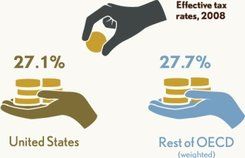
Tax breaks and taxes deferred on foreign profits tend to stay abroad in the US, because of the hefty taxes incurred when repatriating money. Consequently, the US government receives progressively less money from companies. The effective tax paid by US corporations was just 27.1% in 2008 compared to 27.7 among the rest of OECD nations.
US companies keeping their money abroad
The largest tax break is for overseas profits, which have been rising progressively as a share of company profits.
The US handles foreign profits differently from other advanced economies. In practice, US companies are only liable for taxes if they repatriate their foreign-earned profits. Consequently, most US companies keep their overseas profits abroad, estimated to be as much as $2 trillion.
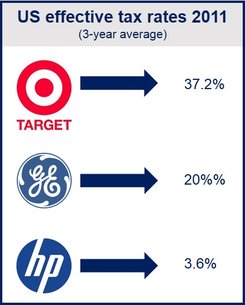
Furthermore, companies pay uneven tax rates, depending on whether they qualify for certain tax breaks. For example, domestic retailers pay much higher taxes than research-intensive multinationals.
Call for US corporate tax system overhaul
A growing number of Americans are in favor of a tax code overhaul. In 2005, forty-six percent supported changes to the tax system compared to 72% in 2013, according to Pew, and lawmakers have taken notice.
So far, President Barack Obama, former Democratic senator Max Baucus, former chairman of the Senate Finance Committee, and Republican Rep. Dave Camp, chairman of the House Ways and Means Committee, have put forward proposals for tax reform.
Comprehensive tax reform may only be considered after the 2014 elections, say Congressional leaders. The overall contours of a new tax system have been defined. They include:
- taxing foreign profits differently
- evening out effective rates
- reducing corporate rates
