

US May job creation at 217,000 was less than analysts had expected. In April, employers had added 282,000 jobs. The unemployment rate remained unchanged at 6.3% in May after falling by 0.4 percentage point in April, according to figures published by the Bureau of Labor Statistics today.
The number of unemployed Americans in May remained unchanged at 9.8 million. Compared to May 2013, unemployment fell by 1.2 percentage points or 1.9 million individuals.
Job creation in May compared to April was especially strong in:
- Transportation & warehousing: 16,000 additional jobs,
- Food services & drinking places: 32,000 additional jobs,
- Health Care & Social assistance: 55,000 additional jobs,
- Professional & business services: 55,000 additional jobs.
Manufacturing employment, which was little changed, increased by 105,000 compared to May 2013.
Below are details of unemployment rates according to major worker groups:
- Adult males: 5.9%,
- Adult females: 5.7%,
- Teenagers: 19.2%,
- Whites: 5.4%,
- Blacks: 11.5%,
- Hispanics: 7.7%,
- Asians: 5.3%.
There were 218,000 fewer unemployed people who lost jobs or completed temporary jobs in May compared to April. There were 237,000 more unemployed reentrants, which partially offset the large decline in April. (Reentrants are people who previously had jobs but were not in the labor force before beginning their current job search.)
Long-term unemployment
The number of people out of work for at least 27 weeks was virtually unchanged at 3.4 million in May.
Long-term unemployed Americans make up 34.6% of the total unemployed. There were 979,000 fewer long-term unemployed individuals in May 2014 compared to May 2013.
According to a study published by the Brookings Institution, only 11% of long-term jobless Americans manage to regain meaningful and sustainable jobs.
Size of the US workforce
At 62.8%, the civilian labor force participation was the same in May as in April, and has fallen by 0.6 percentage point since May 2013.
The unemployment-population ratio was 58.9% in May, about the same as in May 2013.
The number of involuntary part-time workers, people employed part-time for economic reasons, was 7.3 million in May, virtually the same as in April. Involuntary part-time workers were working part time either because their hours had been reduced or because they could not find full-time employment.
A total of 2.1 million people were marginally attached to the labor force in May, virtually the same as in May 2013. These people are not included in the labor force, over the past 12 months they wanted and were available for work at some time. They are not added to the unemployment total because they had not been looking for work in the 4 weeks leading up to the survey.
Nearly one-third (697,000) of people who were marginally attached to the labor force were discouraged workers in May 2014, about the same as in May 2013. Discouraged workers are not currently seeking employment because they have given up, i.e. they believe there are no jobs available to them.
The remaining 1.4 people marginally attached to the labor force had not sought employment because they were doing a course (school attendance) or had family responsibilities.
Working hours and pay per hour
The average employee in non-farm payrolls worked 34.5 hours per week, the same as in April.
In manufacturing, workers worked 41.1 hours each week, 0.2 hour more than in April. Factory overtime at 3.5 hours was unchanged.
For production and non-supervisory employees the working week was unchanged at 33.7 hours.
Average earnings per hour in May increased to $24.38 compared to $24.33 in April. Compared to one year ago hourly earnings increased by 2.1%.
Average hourly pay for private-sector production and non-supervisory workers rose by 3 cents to $20.54 in May compared to April.
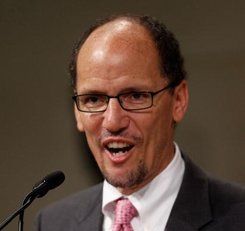
U.S. Secretary of Labor Thomas E. Perez said regarding the May 2014 employment situation:
“The economy in May continued its steady recovery from the Great Recession, and we have now added 9.4 million new private-sector jobs over 51 consecutive months. The economy generated 217,000 new jobs in May – the fourth consecutive month exceeding 200,000 new jobs – and the unemployment rate held steady at 6.3 percent.”
“We must take steps to help those individuals who are still feeling the lasting effects of the recession. 3.4 million people experiencing long-term unemployment.”
