
With so much anger, unfairness, and frustration felt by large sections of the US public, is the country on the verge of a mass uprising? With a President as controversial as Donald Trump, some people wonder why there is not more civic unrest across the country.
Séamus Power carried out a study and wrote about it in the journal Current Anthropology (citation below).
US closer to uprising than we realize
He illustrates how the tipping point at which the tolerance of injustice and hardship turns into civic discontent, i.e., a mass uprising. He also warns that the US may be closer to this point than many people realize.
Dr. Power is a Postdoctoral Fellow in the Department of Comparative Human Development at the University of Chicago.
Dr. Power describes how the people of Ireland tolerated economic hardship after the collapse of the Great Recession. They also counterintuitively started protesting during an unequally-felt recovery following the introduction of a new tax on water. However, there is nothing especially Irish regarding the Irish case.
The Great Recession was the longest period of economic decline in modern history since the Great Depression of the 1930s. Many countries’ GDPs contracted from 2007/8 to the end of 2009.
According to Prof. Danny Dorling of Oxford University, denigrated, ignored, or suppressed voices breed frustration and build disgruntlement. Symbols can embody injustices, says Prof. Brady Wagoner of Aalborg University. Dr. Michael Jindra, a visiting scholar at Boston University, says that technology can spread these images.
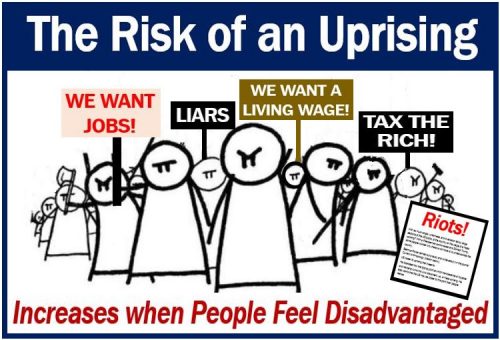
Feeling disadvantaged can lead to protests
However, the possibility of protest may be the result of people comparing their individual lot in life with those of other groups. An uprising is more likely if people perceive that they are disadvantaged. In other words, if they feel relatively worse off.
This finding helps explain why, on Irish streets, there were mass protests during an economic upturn. People had expected to share in the economic recovery. However, it was the rich who disproportionately benefited from the upturn rather than the rest of the population.
To add insult to injury, the Irish Government introduced a new water tax.
Serena Hegarty and Prof. Mike Norton, from Harvard Business School, explained:
“While periods of austerity may cause hardship, heightened awareness of inequality in the restoration period–and the shifting reference points that recovery engenders–can lead to the strongest reactions from citizens.”
How close is US to tipping point?
The lessons for the US are stark. The risk of an uprising grows as more people believe that their country’s economic growth only favors others. Trump targeted workers in the Rust Belt by focusing on their feelings of injustice. Rust Belt workers felt left behind during Barack Obama’s economic recovery.
Millions of blue-collar workers voted for Trump because they expected to benefit from America’s economic growth. However, manufacturing plants have continued to close, and more manufacturing jobs have subsequently vanished. A blue-collar worker is a manual worker.
As blue-collar workers see Trump’s economic promises being broken, disgruntlement is growing. Disgruntlement, frustration, and bitterness are very close to the tipping point of civic discontent and a serious a mass uprising.
People’s subjective understanding of economic conditions matter more than objective economic conditions. In other words, it is all about how people perceive things rather than how things, in fact, are. This may seem paradoxical. However, human history is full of such paradoxes.
A mass uprising becomes a starker reality when the gap between people’s expectations and the realities they live become too great.
The fact that, as in Ireland, no mass uprising has occurred in the US, does not mean that the tinder is not ready to ignite.
Citation
“The Deprivation-Protest Paradox: How the Perception of Unfair Economic Inequality Leads to Civic Unrest,” Séamus A. Power. Current Anthology, December 13, 2018. DOI: https://doi.org/10.1086/700679.
