
VEIR has closed a $110 million Series C funding round to expand manufacturing and prepare commercial deployments of superconducting power-delivery systems for AI data centers. The financing brings its total capital raised to $225 million.
Matter Venture Partners and Tyche Partners co-led the round, announced on October 8. Participants included LG Technology Ventures, Gates Frontier, Sabanci Climate Ventures and Hui Capital, alongside existing investors.
The Woburn, Massachusetts company is targeting an electrical constraint inside computing facilities. Installing more servers also requires cables and equipment capable of supplying power to increasingly dense concentrations of hardware.
The equipment moves power rather than generating it
VEIR combines superconducting cables with cryogenic cooling, controls, connection equipment and monitoring. Superconductors can carry electricity without electrical resistance when maintained under suitable conditions; keeping the system cold requires its own equipment.
The company says its architecture can deliver more power through a smaller footprint than conventional copper systems. Its financing announcement does not give independently verified customer savings or disclose a valuation for the round.
For an operator, the purchase decision concerns the whole installation. Cable size is one consideration, alongside cooling, reliability, maintenance, installation work and compatibility with the facility’s electrical design.
A more compact power route would not create additional electricity or automatically secure a grid connection. We examined the separate issue of making better use of existing power networks in earlier coverage.
Demonstration comes before repeatable deployment
In a November 2025 demonstration, VEIR reported delivering three megawatts through a single low-voltage cable in a simulated data-center environment. A megawatt is one million watts of power.
The new money funds the move from validation toward manufacturing and commercial installations. VEIR says it is working with customers and industry partners on reference designs, plans showing how its systems would fit into AI facilities.
The announcement describes preparation for initial deployments. It does not establish that a large installed fleet is already operating or disclose revenue from the systems.
Growing demand gives power suppliers a market
The International Energy Agency’s Energy and AI report projects global data-center electricity consumption of around 945 terawatt-hours in 2030 in its base case, compared with an estimated 415 in 2024. A terawatt-hour measures energy consumed over time, rather than instantaneous power.
The forecast depends on AI adoption, equipment efficiency and infrastructure constraints. The IEA also notes that data-center demand is concentrated in particular locations, creating local delivery problems even when its global share is comparatively modest.
VEIR’s commercial task is to turn its demonstrated power transfer into installations customers can operate and maintain. The round pays for manufacturing and deployment capabilities needed to make those installations repeatable.
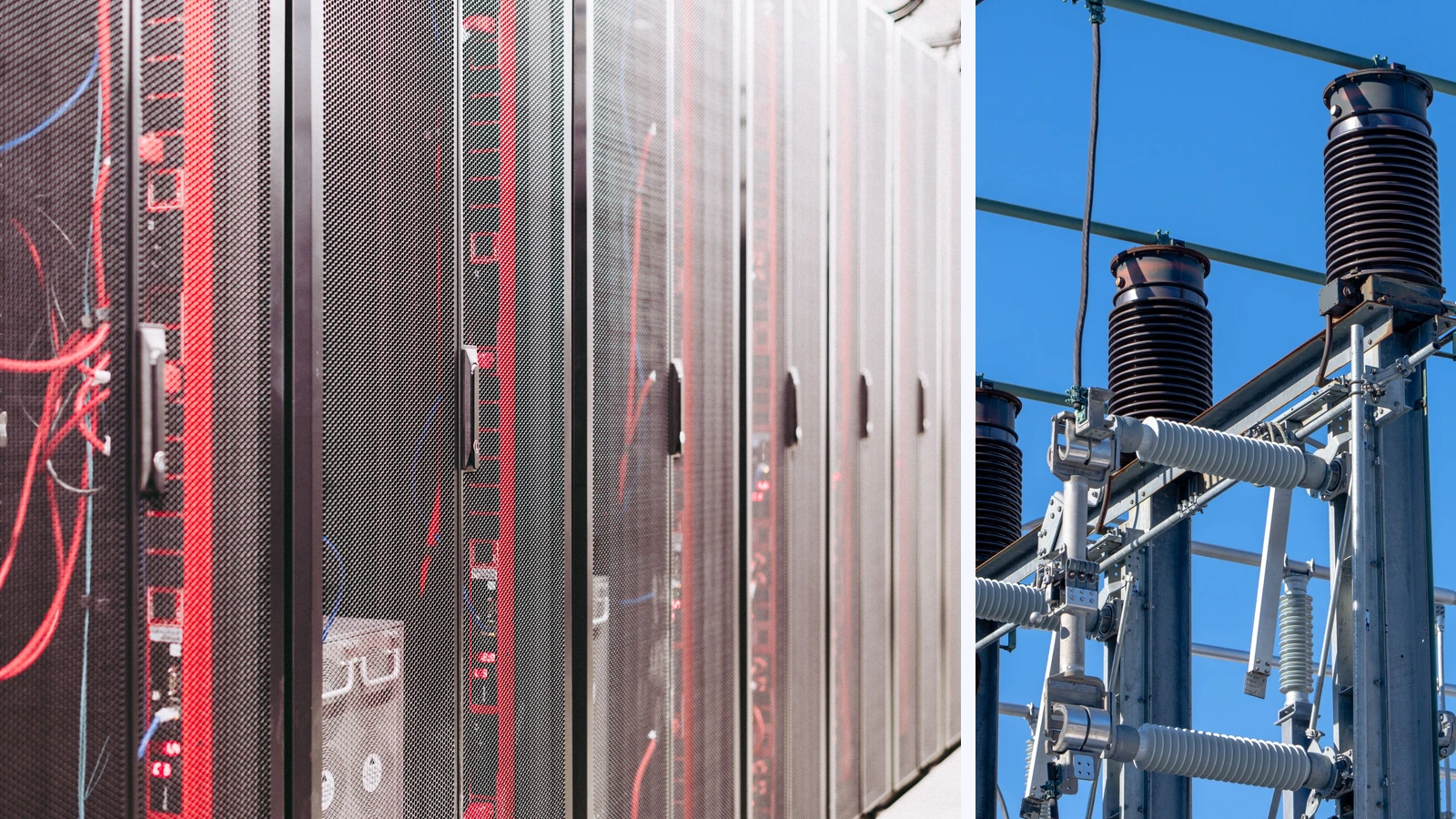
Cover: Representative server racks and Somerville substation equipment in separate panels. Neither photograph shows VEIR technology or a customer installation. Photographs: Brett Sayles, Phil Evenden. Source (Pexels License). Source (Pexels License). Cropped and combined by Market Business News.
