
The European Commission has selected 46 additional raw-materials projects across 16 EU countries, expanding its effort to secure supplies for batteries, industrial equipment and other strategic technologies. Recycling accounts for 19 of the projects, more than either extraction or processing alone.
The October 9 announcement covers 15 of the 17 strategic raw materials identified under the Critical Raw Materials Act. Selection gives projects access to faster permitting procedures and assistance with financing. It does not establish that the facilities are operating.
For manufacturers, the value of the program will depend on whether those projects eventually deliver material in the quantities, quality and processing form their factories require.
Supply security extends beyond opening mines
The new portfolio includes eight extraction projects and 11 processing projects. Another eight combine stages of production, alongside the 19 dedicated recycling projects.
The allocation reflects a problem we examined in our earlier coverage of the rare earth bottleneck after mining. Access to a mineral deposit is only part of a supply chain. Material still needs to be separated, refined and converted into something a manufacturer can use.
Recycling provides another route to supplies. Discarded equipment and production scrap can contain materials already extracted from the ground, although collection, separation and recovery still require investment.
Europe has separate targets for each stage
The Act’s 2030 benchmarks call for EU extraction capacity equivalent to at least 10% of annual consumption of strategic raw materials. The processing benchmark is 40%, and recycling is 25%.
A separate diversification benchmark limits dependence on a single non-EU country to 65% of annual consumption at a relevant processing stage. The policy is intended to spread supply risk, not eliminate international trade.
Strategic projects benefit from permitting timeframes of 27 months for extraction and 15 months for processing and recycling, subject to the legislation’s conditions. Faster administration can shorten a project’s development process, but it cannot supply missing customers, equipment or capital.
Permits and production remain different milestones
The new selection follows 47 EU projects and 13 projects outside the bloc selected in 2025. The Commission says 25 projects from the earlier group have completed environmental impact assessments and 17 have obtained construction permits.
Those figures show progress through development stages. A construction permit still leaves a facility to be financed, built, commissioned and operated.
Manufacturers considering future supply contracts will need to assess delivery dates and technical specifications alongside a project’s strategic designation. A diversified list of proposed facilities reduces dependence only when it becomes a diversified source of usable material.
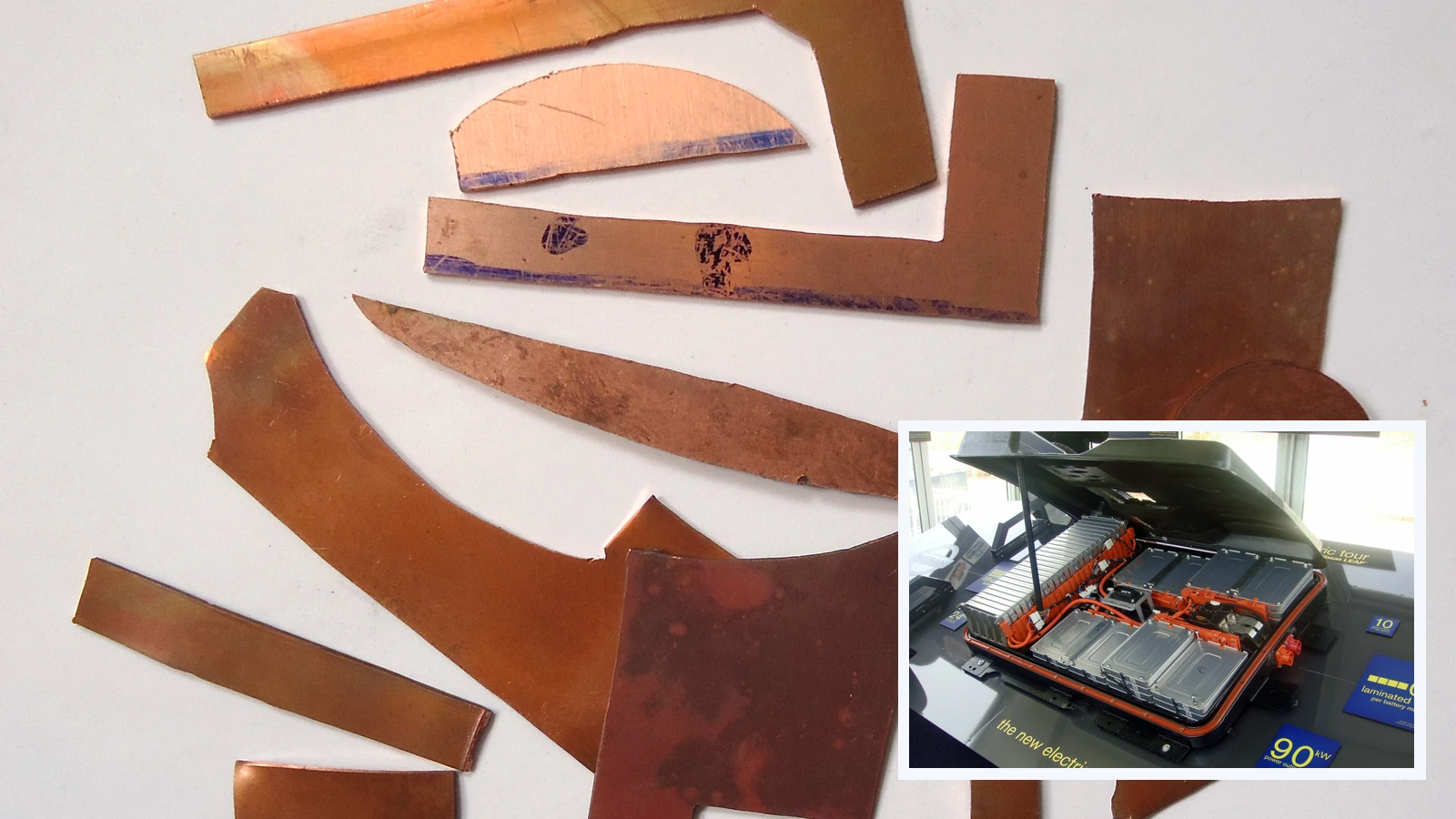
Cover: Representative copper scraps and a historical Nissan Leaf battery display, shown separately. Neither photograph depicts a selected EU project. Photographs: Mauro Cateb, Mario Roberto Duran Ortiz (Mariordo). Source (CC BY-SA 3.0). Source (CC BY-SA 3.0). Cropped and combined by Market Business News. Adapted image licensed CC BY-SA 3.0.
