

Not since the death of Lehman Brothers in 2008 has Wall Street had such a bad year. Experts say 2015 is set to be the worst year since 2008.
What started as a bull market eventually took a U-turn as news about turbulence in China, plummeting crude oil prices, unclear Federal Reserve policy, and the dramatic slowing of earnings growth scared away more and more investors.
Since the beginning of 2015, the value of the S&P 500 has declined by 6%.
According to a couple of polls, including one conducted by CNN Money, pundits believe things will pick up slightly at the end of this year, which may hopefully prevent a bear market from taking hold.
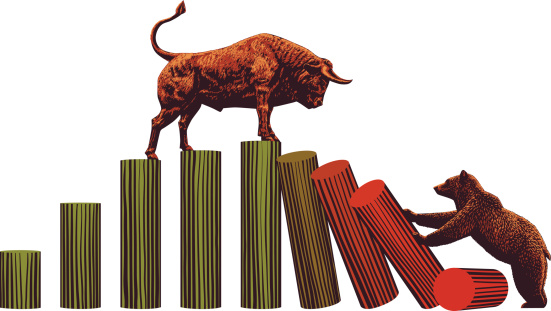 Will 2015 go down in history as the year of the bear?
Matt Egan writes in CNN Money that even if one includes a recovery at the end of this year, the market will still end 2% lower than it was on January 1st, which would make 2015 the worst year since 2008 for the S&P 500.
Stock market strategists often make embarrassingly inaccurate predictions. At the beginning of this year they gleaned from their crystal balls that Wall Street would rise by approximately 8% in 2015 – this was clearly an overly-optimistic forecast.
Adam Shell, of USA Today, says experts are now predicting a gain of about 5% for 2015 “Which while lower than the initial projection at the start of the year would still add up to a decent return, considering the benchmark Standard & Poor’s 500 stock index is down about 7% for the year after Thursday’s down session.”
With disappointing job figures, the US Federal Reserve is unlikely to raise interest rates until 2016, which in turn will give stock prices a boost. American non-farm payrolls report for September showed that during the last 3-month period growth had slowed down considerably.
Reuters quoted Mohannad Aama, managing director, Beam Capital Management in New York, who said:
“September was the best time to raise rates and now it looks like it was the only time they could raise rates.”
The IMF has warned this week that super-high debts in the emerging economies, weak international trade, plus China’s economic slowdown mean that the risk of another global financial crisis has increased considerably this year.
