
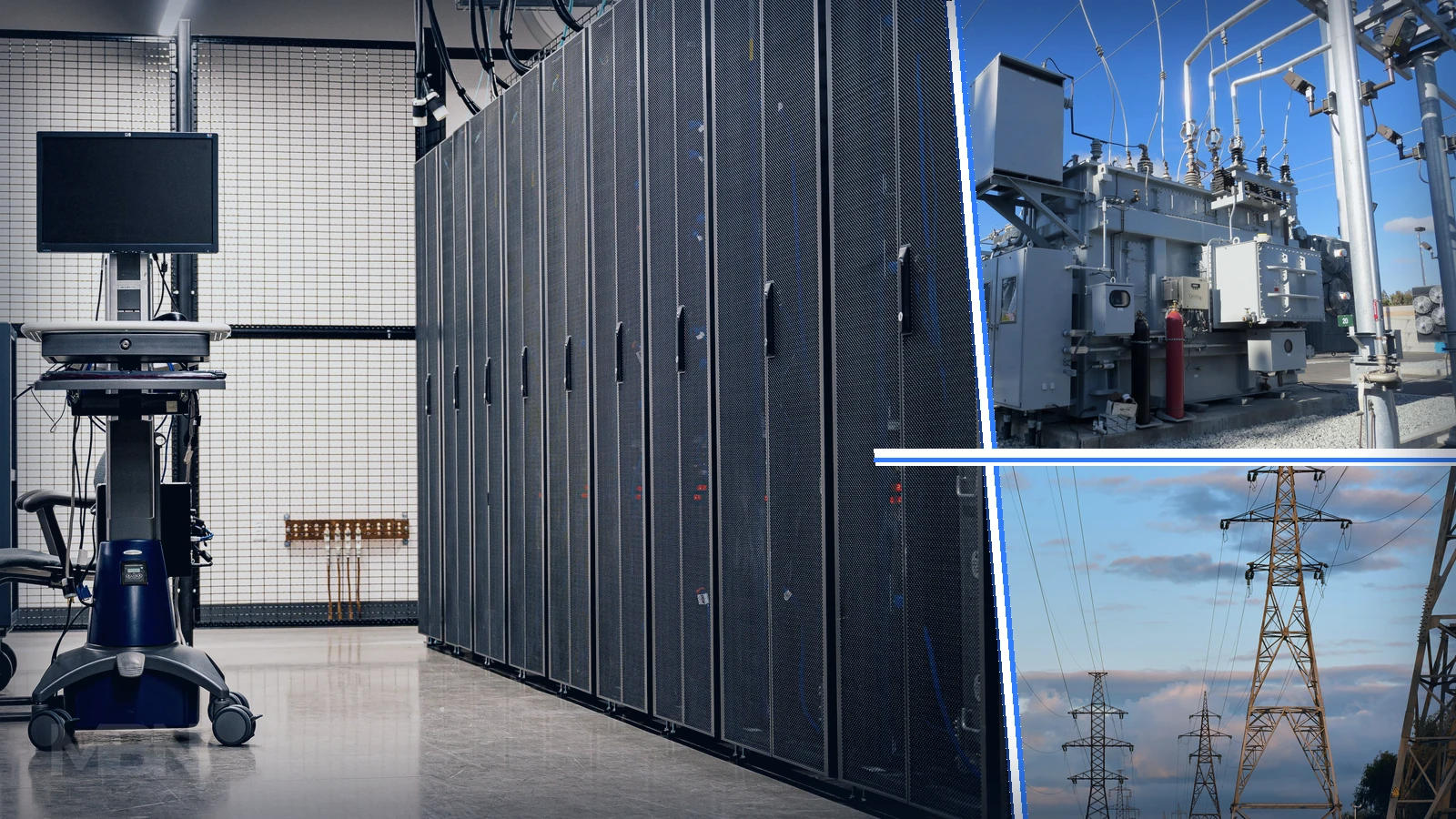
A data center can take one to three years to build, but the grid infrastructure needed to power it may take five to 15 years. That difference helps explain why access to electricity, rather than land or computer chips, is delaying some projects.
Artificial intelligence runs on physical equipment. Servers process the data, cooling systems remove the heat, and backup systems help keep the facility operating when something fails. Every part needs electricity.
The amount required is growing quickly. The International Energy Agency expects global data-center electricity consumption to rise from about 485 terawatt-hours in 2025 to roughly 950 terawatt-hours in 2030. A terawatt-hour is a unit of energy equal to one terawatt used continuously for one hour.
The effect is more concentrated than the global number suggests. Data centers are often built in clusters, so a local network may face a large increase in demand even when the national electricity system has enough generation overall.
In the United States, a June 2026 update from Lawrence Berkeley National Laboratory estimated that data centers could use 11.8% of the country’s electricity in 2030 under its reference case. Its wider range was 9.5% to 15.3%, reflecting uncertainty over future computing demand and equipment efficiency.
Why the building can be ready before the grid
In the electricity industry, a load is a customer or device that consumes power. A large data center is an industrial-scale load, not the equivalent of another office building.
Before connecting one, the utility or grid operator needs to know whether nearby lines, substations and transformers can carry the additional power safely. An interconnection study examines the proposed load, identifies equipment that may need to be added or upgraded, and estimates the cost.
The study can show that the data center needs a new substation or a stronger transmission connection. Building that equipment may require permits, land rights, engineering work and long-lead components such as large transformers.
This is where the two industries work on different clocks. The IEA’s Electricity 2026 analysis says data centers can be constructed in one to three years, while new grid infrastructure can require five to 15 years. It also says prices for important grid components have nearly doubled over the past five years.
A finished data-center building therefore cannot simply switch on every server. The connection and the wider network must be ready first.
The queue is not a simple waiting list
More than 2,500 gigawatts of projects are stalled in grid-connection queues worldwide, according to the IEA. This is not a data-center total. It includes renewable-power projects, batteries and other large electricity users as well as data centers.
Nor does a connection queue work like a line at a shop. Each project can affect the network differently, so engineers must study what would happen if it connected and which upgrades would be needed.
Some proposed projects will also be delayed, moved or cancelled. A developer may examine several possible sites even though it intends to build only one facility. If every early request is treated as firm demand, utilities can overestimate how much new infrastructure is needed. If they discount too many requests, genuine projects may wait longer for power.
Lawrence Berkeley National Laboratory’s Speed to Power report sets out more than 40 possible responses. They cover better demand forecasts, faster connection studies, electricity procurement, grid operations and decisions about who pays for upgrades. The report presents a menu of options rather than one plan that will work everywhere.
Earlier access may come with conditions
One possible way to connect some projects sooner is a non-firm connection. Under this arrangement, a customer receives grid access but agrees that its electricity use may be limited at specified times when the network is congested.
The IEA estimates that conditional connections could unlock 750 to 900 gigawatts across advanced projects currently in global grid queues. That estimate covers several types of electricity supply, storage and demand projects, not just data centers.
Whether the arrangement works for a data center depends on what it does. Some computing jobs can be delayed or moved to another facility. Batteries may cover short periods, while on-site generation can provide additional support where it is permitted and economical.
Other workloads need to run continuously. AI processors are also expensive, so an operator usually wants them working rather than sitting idle. A faster connection may be less useful if the restrictions frequently prevent the facility from serving its customers.
Regulators must also decide how to protect other electricity users. In June 2026, the US Federal Energy Regulatory Commission ordered the six regional grid operators under its jurisdiction to defend or change their rules for connecting large loads. It asked them to address study delays, flexible service and the risk that upgrade costs could be shifted unfairly to existing customers.
Power availability is changing site selection
Data-center developers have traditionally compared land prices, fiber connections, taxes, cooling conditions and proximity to customers. Available electricity capacity is becoming another central test.
A cheap site may be poor value if a new transmission line will take seven years. A more expensive location with spare grid capacity could allow the company to start earning revenue much sooner.
The IEA estimates that grid constraints could delay about 20% of the data-center capacity planned worldwide through 2030. Better forecasting, conditional connections and more flexible computing can reduce some delays. They do not remove the need for new lines, substations and transformers.
That is the practical limit behind the digital boom. Servers can be ordered and buildings can be completed relatively quickly. The electricity network that makes them useful often cannot expand at the same speed.
