

Describing a product as having “90% remaining” rather than “10% lost” can change how consumers judge the relationship between price and quality, even though the two figures are mathematically identical. Experimental research suggests the positive version can make a higher-priced option appear better value.
Imagine choosing between two used electric vehicles.
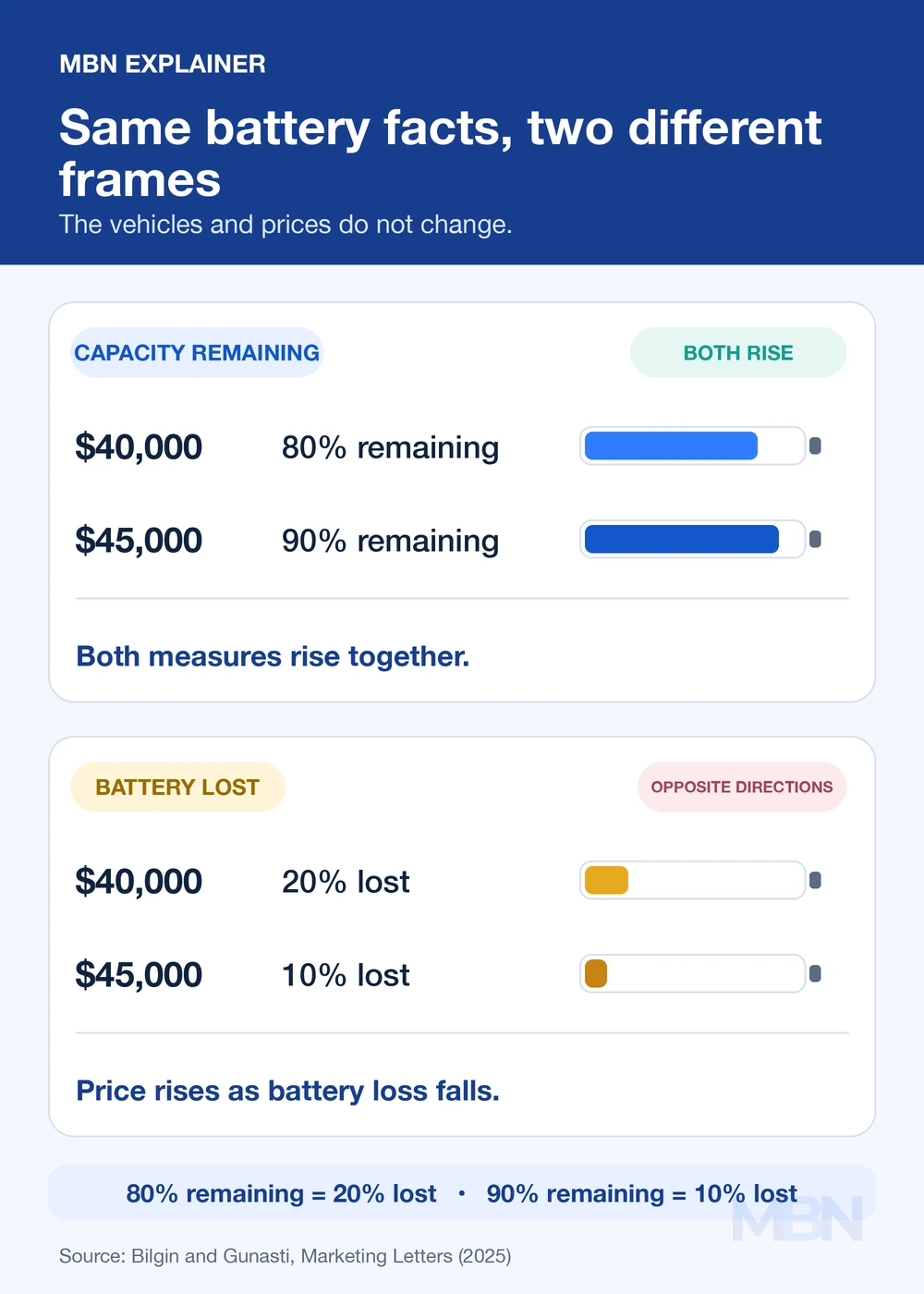
One costs $40,000 and has 80% of its original battery capacity remaining. The other costs $45,000 and has 90% remaining.
Now express the same information differently. The cheaper vehicle has lost 20% of its battery capacity, while the more expensive one has lost 10%.
Nothing about the vehicles, their prices or their batteries has changed. Yet the wording can affect which one people prefer.
Baler Bilgin of Koç University and Kunter Gunasti of Washington State University call this effect relationship-sign framing. Their peer-reviewed study, published in Marketing Letters in August 2025, examined how people judge a price-quality trade-off when two attributes appear to move in the same direction or in opposite directions.
The same numbers can create a different relationship
When battery condition is expressed as capacity remaining, price and quality appear to rise together:
Higher price, higher remaining battery capacity.
When the same condition is expressed as battery degradation, they appear to move in opposite directions:
Higher price, lower battery degradation.
The researchers found that participants perceived the positive relationship as stronger than the equivalent negative one. That stronger perceived connection increased preference for the higher-priced vehicle by making each dollar appear to buy more battery capacity.
“In simple terms, when price and product attributes are described as moving together, each extra dollar feels like it buys more benefit,” Gunasti said in Washington State University’s account of the research.
The researchers also tested the idea with bicycle helmets. One description stated the percentage of impact absorbed, while the equivalent version stated the percentage transmitted to the head. In the experiments reported by WSU, positive framing increased preference for the higher-quality, higher-priced option.
That is a result from controlled product-choice scenarios, not proof that any particular wording will make every shopper spend more in a real store.
This is more than saying something positively
Attribute framing has influenced consumer judgments in earlier research.
In a well-known 1988 experiment, Irwin Levin and Gary Gaeth described ground beef as either “75% lean” or “25% fat.” Consumers evaluated it more favorably when it was described as 75% lean. The effect became weaker after participants tasted the product, suggesting that direct experience diluted the influence of the wording.
The University of Iowa’s record of the study describes both statements as equivalent information about the same attribute.
Bilgin and Gunasti examine a narrower issue. Their question is not simply whether “90% remaining” sounds more appealing than “10% degraded.” They focus on how the description affects the perceived relationship between price and another product attribute.
“More money buys more of a desirable feature” can look like a clearer value equation than “more money buys less of an undesirable feature,” even when both descriptions represent the same numbers.
Why the premium can feel easier to justify
Shopping often requires comparisons between unlike things. Is a laptop that weighs less worth another $300? How much extra should somebody pay for longer battery life? Is a costlier helmet worth buying if it absorbs more impact?
Consumers rarely calculate these trade-offs with complete precision. They use comparisons and impressions to decide how much additional quality an additional dollar appears to buy.
In the study, a positive relationship appeared larger in magnitude than its negative equivalent. When price and performance rose together, the more expensive option therefore appeared to offer more of the desirable attribute per dollar.
The effect was stronger when a purchase was framed as hedonic, meaning bought mainly for pleasure or enjoyment, rather than utilitarian, meaning bought mainly to perform a practical task.
The researchers argue that people evaluating a pleasure-oriented purchase may focus more on the benefit received for each dollar. For a practical purchase, they may focus more on how many dollars must be paid for each unit of benefit.
This does not mean that every luxury or leisure purchase is unusually susceptible to the effect. It identifies a condition that strengthened the effect in the researchers’ experiments.
Premium and budget brands may frame the same facts differently
A premium brand has an incentive to make the price-quality connection easy to see. If the expensive version offers more of a desirable attribute, the seller can emphasize that upward progression: more storage, more protection, greater efficiency or longer useful life.
A lower-priced competitor may prefer to describe how much of an undesirable attribute has been lost, removed or avoided. That negative relationship can make the connection between paying more and receiving more appear weaker.
Two companies can therefore present mathematically equivalent information while directing attention to different sides of the comparison. Neither statement is necessarily false.
However, literal accuracy is not the only legal test for advertising. The Federal Trade Commission says US advertising must be truthful, non-deceptive and supported by evidence. The agency considers the overall impression created by the words and images, including important information that has been omitted.
A numerically correct statement could still be misleading if the complete advertisement gives consumers a false impression about a material feature of the product.
A simple defense is to reverse the description
Consumers do not need advanced mathematics to check the frame. They can translate the description into its equivalent opposite before deciding.
If a seller says a battery retains 90% of its original capacity, consider the 10% it has lost. If a helmet absorbs 85% of an impact in a stated test, consider the 15% it transmits under the same test conditions. Then compare the options again.
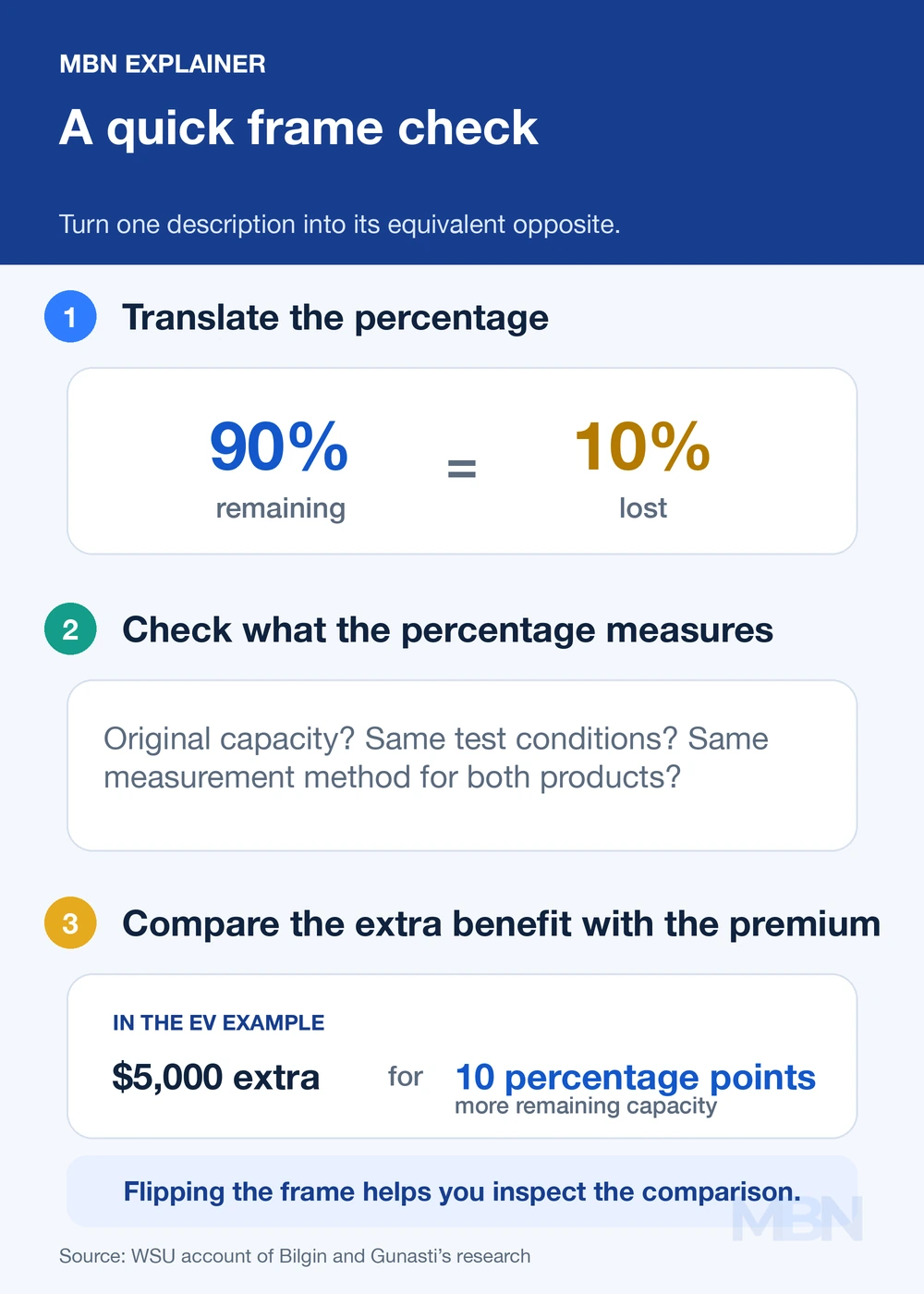
Gunasti recommends looking at both versions. This will not identify every weakness in a product comparison, and buyers still need to check how the attribute was measured. It does, however, separate the numbers from the seller’s chosen presentation.
The study does not establish that the premium product is a poor choice. Paying more may genuinely provide better quality. Its narrower finding is that equivalent descriptions can change how strongly consumers perceive the connection between the extra money and the additional benefit.
When a product says “90% remaining,” translating it to “10% lost” takes only a moment. The mathematics stays the same. The perceived value may not.
