
Sensor-guided irrigation cut water use by about 15% in processing-tomato fields in southern Italy while producing higher total and marketable yields than farmer-managed plots, a two-year study has found. In table grapes, the same broad approach reduced irrigation by 8% to 15% and was associated with steadier plant water status.
The study in Plants, People, Planet compared precision-agriculture management with the growers’ usual approach at two sites in Puglia during the 2023 and 2024 seasons. Researchers at the University of Bari Aldo Moro combined soil-water sensors, automated irrigation decisions, drone surveys and near-infrared spectroscopy.
Agriculture accounts for 72% of global freshwater withdrawals, according to the UN Food and Agriculture Organization. Water savings that look modest on a field can add up where irrigation is widespread and supplies are under pressure.
Soil measurements controlled the irrigation
Precision agriculture in the study meant that irrigation responded to measurements from the soil, not just a grower’s estimate of crop needs. Sensors recorded conditions every ten minutes and triggered irrigation at pre-set thresholds. In the tomato plots, sensors at a depth of 30 centimeters monitored volumetric soil-water content continuously.
The system began irrigation when the measured soil-water potential fell below minus 30 kilopascals and closed the valve once it returned to minus 10 kilopascals. A kilopascal is a unit of pressure. In this setting, the reading gave the team a way to set repeatable irrigation rules from the water held in the root zone.
The comparison was not between technology and no farming knowledge. The farmer-managed plots were run under the local grower’s normal approach, which used observation of plant conditions and established irrigation practice. The researchers were testing whether continuous soil measurements improved on that management in these particular fields.
Tomato plots used less water and produced more saleable fruit
Tomato irrigation under the precision system totaled about 350 millimeters in 2023, against about 410 millimeters in the farmer-managed treatment. In 2024, the comparison was roughly 400 millimeters and 470 millimeters. Across the two seasons, the sensor-guided plots used about 15% less irrigation water.
The yield result went in the opposite direction from what a grower might fear from applying less water. Average total yield was 138.6 tonnes per hectare in the precision treatment and 102.9 tonnes per hectare in the farmer-managed plots. Average marketable yield, fruit suitable for sale to a processor, was 111.2 tonnes per hectare compared with 72.7 tonnes per hectare.
The precision plots also had less discarded fruit, 27.4 tonnes per hectare on average compared with 30.2 tonnes per hectare. Weather, soil, variety, plot size and management all affect those outcomes. The figures describe this trial’s two seasons, not a guaranteed percentage gain for every tomato farm that buys sensors.
Both years gave the researchers different conditions. A wet spring delayed tomato transplanting and irrigation in 2023 before temperatures rose above 40°C later in the season. The following winter and spring were drier, and irrigation allocations were more restricted. That variation makes the comparison more informative than a one-season test, although two years at one location still leave plenty to learn elsewhere.
Drones showed a less stressed canopy
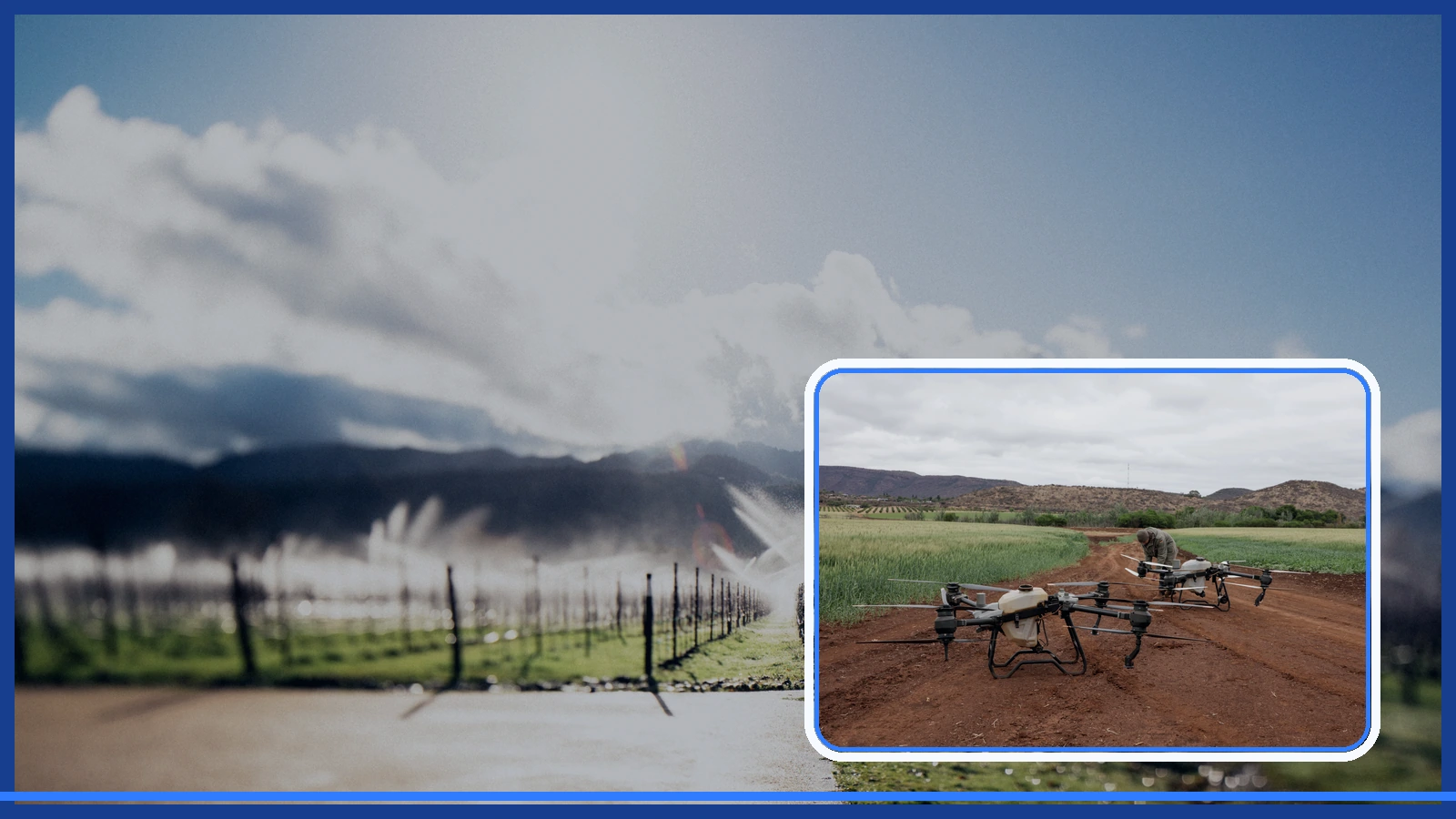
The team used drones above the tomato field to map vegetation and canopy temperature. Plants cool themselves as water evaporates through their leaves. When water stress restricts that process, canopy temperatures can rise.
During an August 2024 flight, 52.08% of the precision-managed canopy was below 29°C, compared with 20.94% of the farmer-managed canopy. The authors linked the hotter and more uneven temperatures in the comparison treatment to greater water stress and less uniform water distribution.
A soil sensor and a drone answer different questions. The former measures conditions at a point in the root zone. The aerial survey can show whether parts of a field are behaving differently from the rest. Combining the two may help a grower find an irrigation problem before it becomes visible across an entire crop.
Grapevines showed a smaller, but consistent, water saving
The table-grape trial used Allison vines in Rutigliano, near Bari. The precision plots used 14.5% less irrigation water in 2023 and 8.2% less in 2024. The researchers reported more stable stem water potential, a measure commonly used to assess how much water stress a vine is experiencing, alongside higher chlorophyll readings and some stronger measures of photosynthetic performance.
Grape yields did not differ statistically between treatments in 2023. In 2024, the precision-managed vines produced more. That year-to-year difference is a reminder that a water-saving system is not a fixed yield formula. Its result depends on rainfall, heat, the soil, the variety and the timing of water across the growing season.
Our earlier coverage of El Niño’s risks for food prices, power and trade examined how weather can affect farm output and costs through several channels. Field-level irrigation control cannot remove those wider risks, but it can give growers more information when weather patterns become harder to manage.
Spectroscopy could alter harvest and payment decisions
The research also tested near-infrared spectroscopy, known as NIR, to estimate fruit characteristics without destroying samples. The technique shines near-infrared light on a fruit and analyses the reflected signal. Statistical models can then be trained against laboratory measurements of qualities such as grape sugar content or tomato dry matter.
Three of the four models tested performed at a level the authors considered suitable for later practical use. The strongest tomato result concerned dry matter. For processors, dry matter is commercially relevant because a tonne of tomatoes with more solids can produce more paste or concentrate than a tonne containing more water.
The study did not test a new payment system or show that growers will receive more money for higher dry matter. It points to a possible future use: quicker measurements in the field could give growers and processors earlier information when deciding when to harvest or how to value a crop.
Connectivity and cost will decide how widely systems spread
Digital tools require more than a sensor in the ground. Farmers need installation, maintenance, software, power, communications and the confidence to act on the resulting data. Small holdings may find the initial cost hard to absorb without shared equipment, technical services or financial support.
Rural connectivity is another constraint. A European Commission study published in July drew on a survey of 147 stakeholders and found that weak coverage, unreliable connections and dead zones were still limiting the routine use of connected farm equipment in some areas.
The Puglia trials do not settle the business case for every farm. They show what can happen when soil measurements, irrigation hardware and crop monitoring work together in contrasting seasons. For growers facing constrained water allocations, producing more marketable fruit from each cubic metre may become as consequential as lifting output per hectare.
