
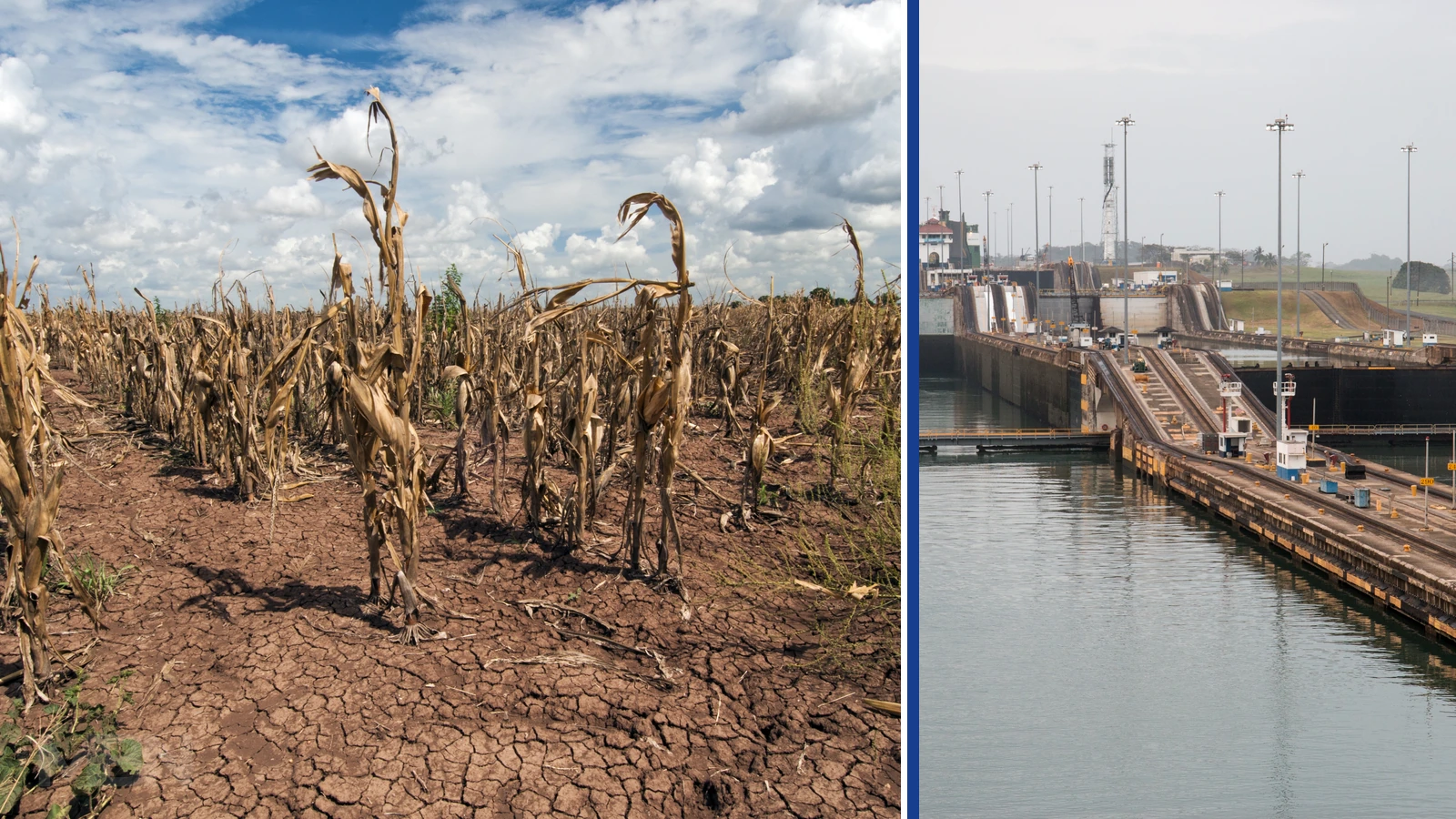
El Niño is established in the tropical Pacific and is expected to become very strong, the World Meteorological Organization said on September 3. Its forecasts put the probability of the event continuing through February 2027 at nearly 100%, extending the period of weather risk for farming, electricity supplies and international trade.
The WMO update expects the event to peak toward the end of 2026. Its strength describes conditions in the Pacific, not the severity of every drought or flood that may follow. Local effects depend on the season, geography and other ocean and atmospheric conditions.
The Panama Canal has announced changes to September transit-slot availability after below-average rainfall reduced water flowing into its watershed.
How Pacific warming changes weather elsewhere
El Niño is the warm phase of the El Niño-Southern Oscillation, or ENSO, a recurring interaction between the tropical Pacific Ocean and the atmosphere.
Normally, trade winds push warm surface water west toward Asia. Colder water rises from below near South America, bringing nutrients that sustain marine life. During El Niño, the winds weaken and warm water spreads farther east.
As NOAA explains, rainfall follows that warmer water. Changes in where warm, moist air rises then alter atmospheric circulation well beyond the Pacific. Indonesia and Australia can become drier, while parts of Peru receive much heavier rain. Reduced supplies of nutrient-rich water can also hurt fisheries off South America.
El Niño is a natural pattern operating within a warming climate. The long-term rise in temperatures adds heat to the background conditions in which it develops, while scientists continue to investigate how warming affects ENSO itself.
Food production and electricity share a water risk
The economic damage often begins with a shortage of water at the wrong time. Crops lose yield, pasture deteriorates and livestock owners face higher feed costs. Reservoirs supplying hydroelectric dams can also receive less water, reducing electricity generation.
FAO, the UN Food and Agriculture Organization, published an agricultural risk assessment in June based on 41 years of satellite observations. It identified exposure across the Sahel, southern Africa, South and Southeast Asia, Central America’s Dry Corridor and the Caribbean.
Some crop and pasture areas showed agricultural drought probabilities above 50%. The assessment identifies localized exposure and should be read alongside newer local forecasts and observations.
Rain-fed farming is particularly exposed because growers cannot readily replace missing rainfall with irrigation. In households that depend on livestock, losing pasture can force the sale of animals, reducing both current income and the assets available for recovery.
Electricity suppliers may need more fuel-fired generation when hydropower falls. Heat can simultaneously raise cooling demand. Where flooding replaces drought, damage to roads, power lines and farmland creates a different set of production and repair costs.
The Panama Canal is already adjusting bookings
The canal’s August 20 shipping advisory reported rainfall 34% below its historical average during the hydrological year to that point, beginning in May. Water flowing into the watershed was 44% below average.
For booking dates beginning September 4, the advisory set daily availability at nine slots in the larger Neopanamax locks and 25 in the original Panamax locks, totaling 34. Panamax availability is scheduled to fall to 23 for September 15 booking dates, bringing the combined total to 32.
These are announced booking-slot totals, not a count of ships that have actually passed through. The canal authority warned that vessels arriving without reservations could face longer waits.
Canal locks use freshwater to raise and lower ships. When water becomes scarce, conserving it can limit the capacity available to shipping companies. Delays tie up vessels and cargo; taking another route may add fuel and sailing time. A rainfall deficit can therefore reach businesses that are nowhere near the affected watershed.
Higher prices do not mean every country loses
Economic research points to uneven results. A 2016 IMF summary of research covering 21 countries and regions found short-lived declines in activity in Australia, India, Indonesia, New Zealand, Peru and South Africa following an El Niño shock. Argentina, Canada, Mexico and the United States could benefit directly or through trading partners.
The researchers estimated that an El Niño shock raised nonfuel commodity prices by about 5.5% over a year. Inflation effects across their sample ranged from 0.1 to one percentage point, with greater exposure where food made up more of consumer spending. These are historical model estimates, not forecasts for inflation in 2026 or 2027.
Our latest coverage of global food prices reported that FAO’s benchmark rose 1.9% in August, led by sugar. That provides a starting point for watching commodity costs, rather than evidence that El Niño caused the month’s increase.
A change in international commodity prices also takes time to reach shops. Exchange rates, inventories, processing and transport costs influence how much consumers eventually pay. Households spending a large share of their income on food have less room to absorb an increase.
Lost income can outlast the weather event
Christopher Callahan and Justin Mankin examined longer-term effects in a 2023 study published in Science. Their model attributed $4.1 trillion in lost global income to the 1982–83 El Niño by 1988, and $5.7 trillion to the 1997–98 event by 2003.
Those figures compare observed economic activity with an estimated path without the events. They include growth that failed to materialize, not simply damaged buildings, ruined crops or insurance payments. The uncertainty is substantial: the study’s reported interval for the latter estimate ran from $2.3 trillion to $9.2 trillion.
A separate Nature Communications study also found losses continuing after El Niño, using a different model and time horizon. Neither study supplies a ready-made bill for the current event.
Recovery spending can displace other investment. A government rebuilding damaged infrastructure has less money available for new projects, while farmers replacing lost animals may take years to restore their earning capacity.
Regional forecasts will determine the response
Preparation depends on where water shortages or excess rainfall are expected and when they coincide with planting, harvesting or peak electricity demand. FAO identifies early measures such as securing livestock feed, storing water and choosing drought-tolerant or faster-maturing crops.
The same Pacific event can bring damaging drought to one producer and helpful rainfall to another. Crop conditions, reservoir inflows and transport capacity will show how far weather risks are becoming economic losses.
NOAA’s Climate Prediction Center scheduled its next ENSO diagnostic discussion for September 10. The Panama Canal’s next announced reduction in booking slots follows on September 15.
