
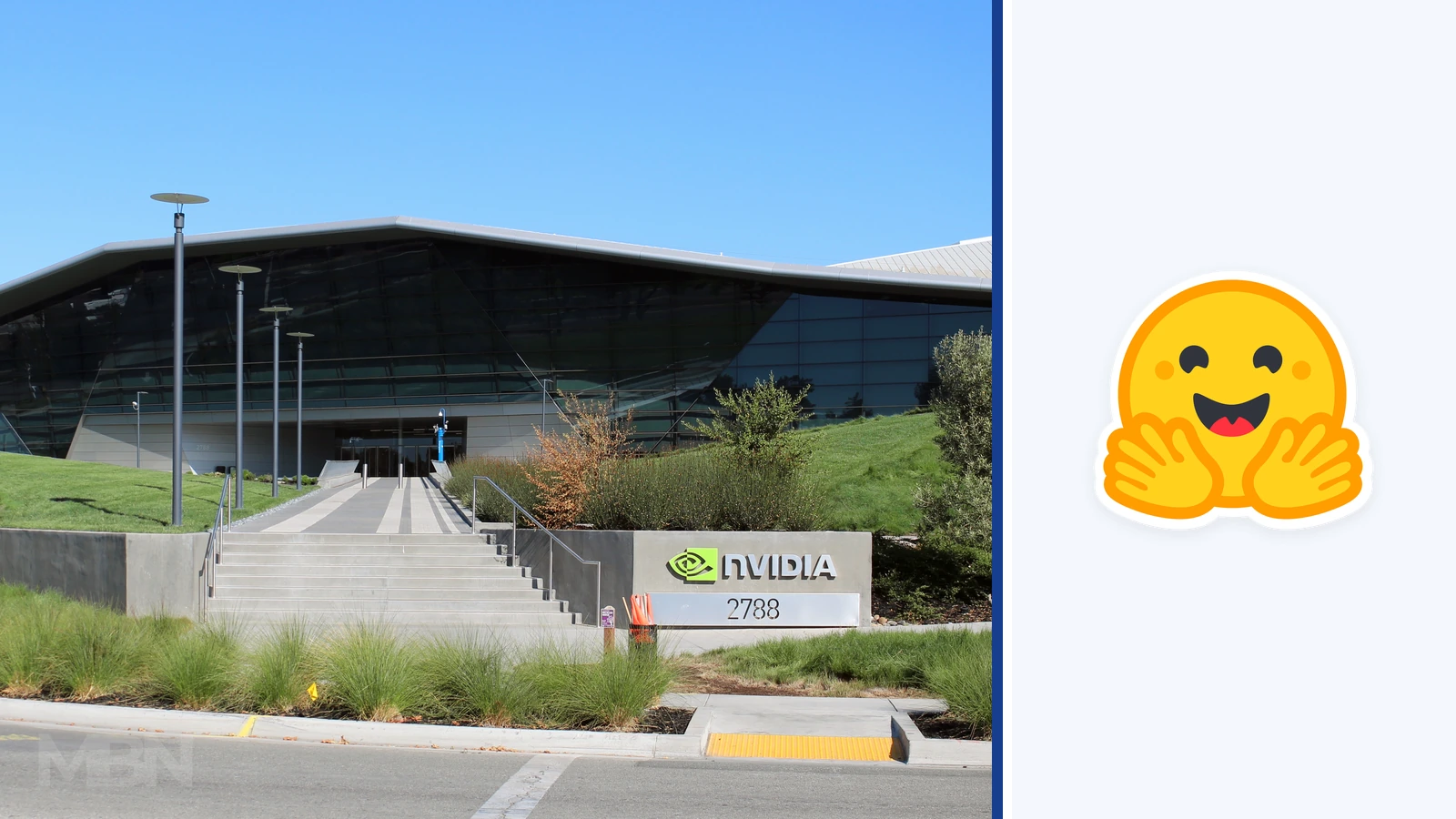
Nvidia has agreed to acquire Hugging Face for $12.93 billion, expanding its reach into the platform businesses and developers use to find, share and adapt artificial intelligence models.
The September 3 announcement comes with a promise to preserve users’ choice of computing suppliers. Nvidia CEO Jensen Huang said developers would remain free to choose their models, cloud providers and hardware.
“NVIDIA compute will not be required to build on or deploy through Hugging Face,” Huang wrote in the company’s announcement.
Nvidia said Hugging Face is used by more than 18 million developers, researchers and creators, and more than 200,000 companies. Those are company-reported platform figures, not a count of paying customers.
A platform for building business applications
Hugging Face brings together AI models, the data used to develop or evaluate them, and applications that demonstrate their capabilities. Its Hub documentation describes tools for sharing files, tracking revisions and testing models, alongside private collaboration features for organizations.
For a company developing an AI product, that provides a place to compare existing systems before choosing one to adapt. Models can handle tasks involving text, images or audio. Documentation attached to a model can explain its intended uses, evaluation results and limitations.
Hugging Face also connects developers with services that run models. Running a trained model to produce an answer or other output is called inference, and it creates an ongoing computing cost after development is finished.
Existing models already underpin commercial products. As we reported in August, Thomson Reuters spent $40 million on talent and computing to develop its proprietary Thomson model from an existing open-source foundation.
Thomson Reuters said the system would initially be used for document review in CoCounsel Legal. It also announced a smaller open-weight version on Hugging Face for academic and non-commercial use. Open weights are the numerical parameters learned during training, which developers can obtain and work with subject to the model’s license.
Nvidia’s expansion beyond hardware
Nvidia says it plans to strengthen Hugging Face’s infrastructure and improve reliability, model evaluation and deployment. The platform would put Nvidia closer to developers while they select and test the software that eventually needs computing capacity.
Argent Capital’s Jed Ellerbroek told Axios that greater competition among models could benefit Nvidia’s chip business.
The acquisition agreement follows another sharp increase in Nvidia’s sales. Its latest financial results showed revenue of $96.2 billion for the second quarter of fiscal 2027, which ended July 26, 2026. That was 106% higher than a year earlier.
Data Center revenue reached $89 billion, up 117%. As our earlier earnings coverage explained, that business accounts for most of Nvidia’s sales.
Open access comes with separate licensing terms
Nvidia’s hardware-choice pledge concerns how developers will use the platform. Permission to adapt or sell products built with a particular model depends on that model’s license.
Hugging Face’s licensing guidance tells users to check each project’s terms. Its supported licenses include permissive software licenses, non-commercial terms and model-specific agreements. Businesses still need to establish whether their intended use is allowed before building a product around a download.
Thomson Reuters’ smaller release illustrates the point: its stated academic and non-commercial scope differs from permission to use it in a paid business service.
The acquisition announcement did not specify a closing date or a revised pricing schedule for Hugging Face.
