
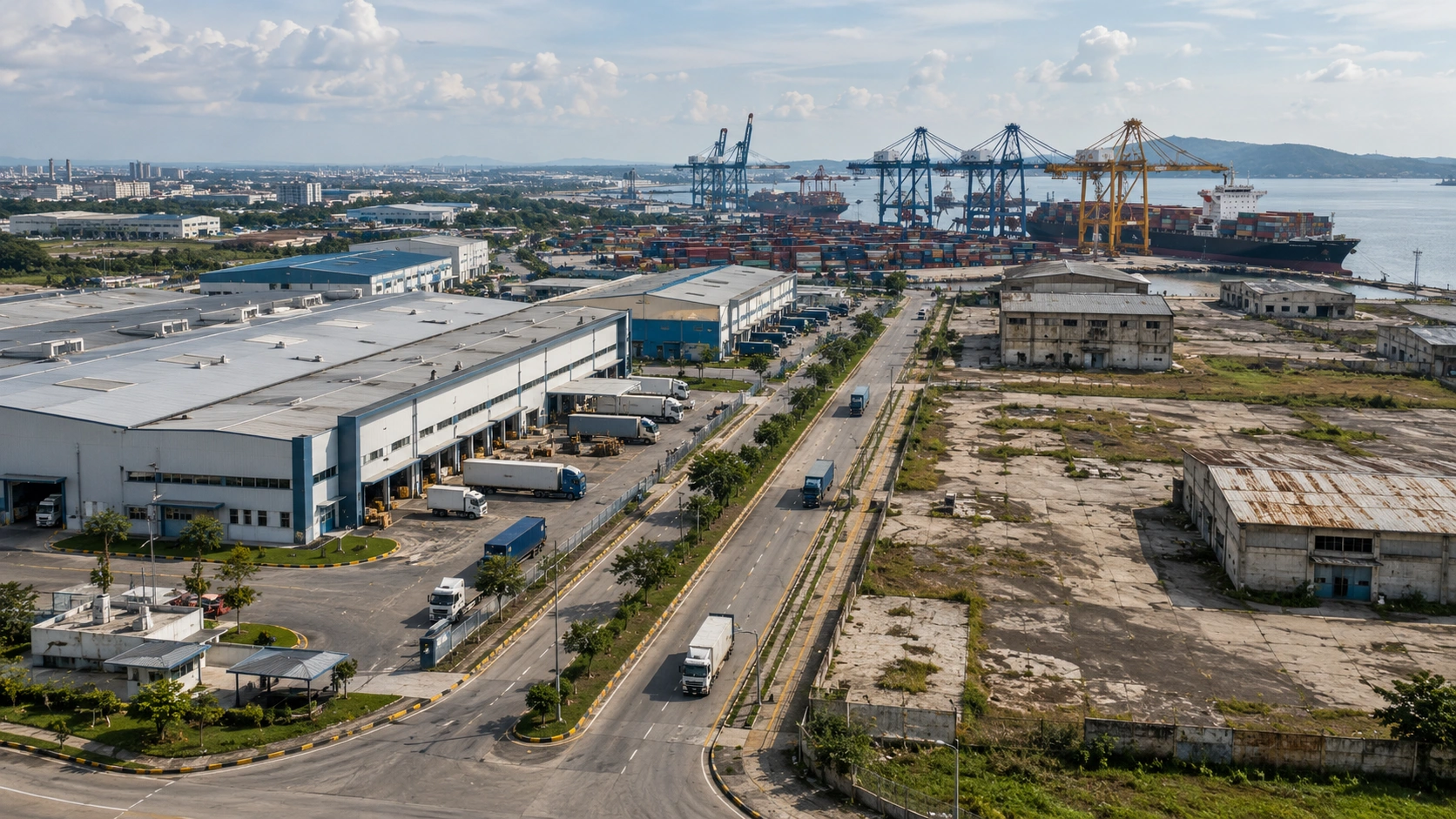
Governments often present industrial parks as a straightforward way to attract factories, increase investment and create jobs.
New research from Vietnam suggests that the results are far less predictable. Location matters, but so do implementation, access to trade and the types of companies a park attracts.
A working paper released by the National Bureau of Economic Research estimates that establishing an industrial zone increased private formal-sector employment by about 2,000 workers seven years later, on average.
However, that average hides enormous differences. A small number of highly successful zones generated most of the additional employment, while many others produced little or no job growth.
What the researchers studied
The researchers examined the expansion of industrial zones across Vietnam. These planned manufacturing areas are also commonly called industrial parks.
Their database shows that the number of industrial zones in Vietnam increased from 64 in 2000 to close to 450 in 2023.
For the employment analysis, the researchers used firm-level data from Vietnam’s annual enterprise surveys covering 2000 to 2019. These surveys include information about formally registered private companies, including their location, ownership and number of employees.
The team matched this information with the location and official establishment date of each industrial zone.
They then used an event-study approach to compare wards that established an industrial zone with nearby wards that did not. A ward is a local administrative area in Vietnam.
This allowed the researchers to estimate how employment and the number of businesses changed following the establishment of a zone.
The study was observational rather than a randomized experiment. Its estimates therefore depend on whether the researchers successfully accounted for other differences between the locations being compared.
The 2,000-job figure does not describe every park
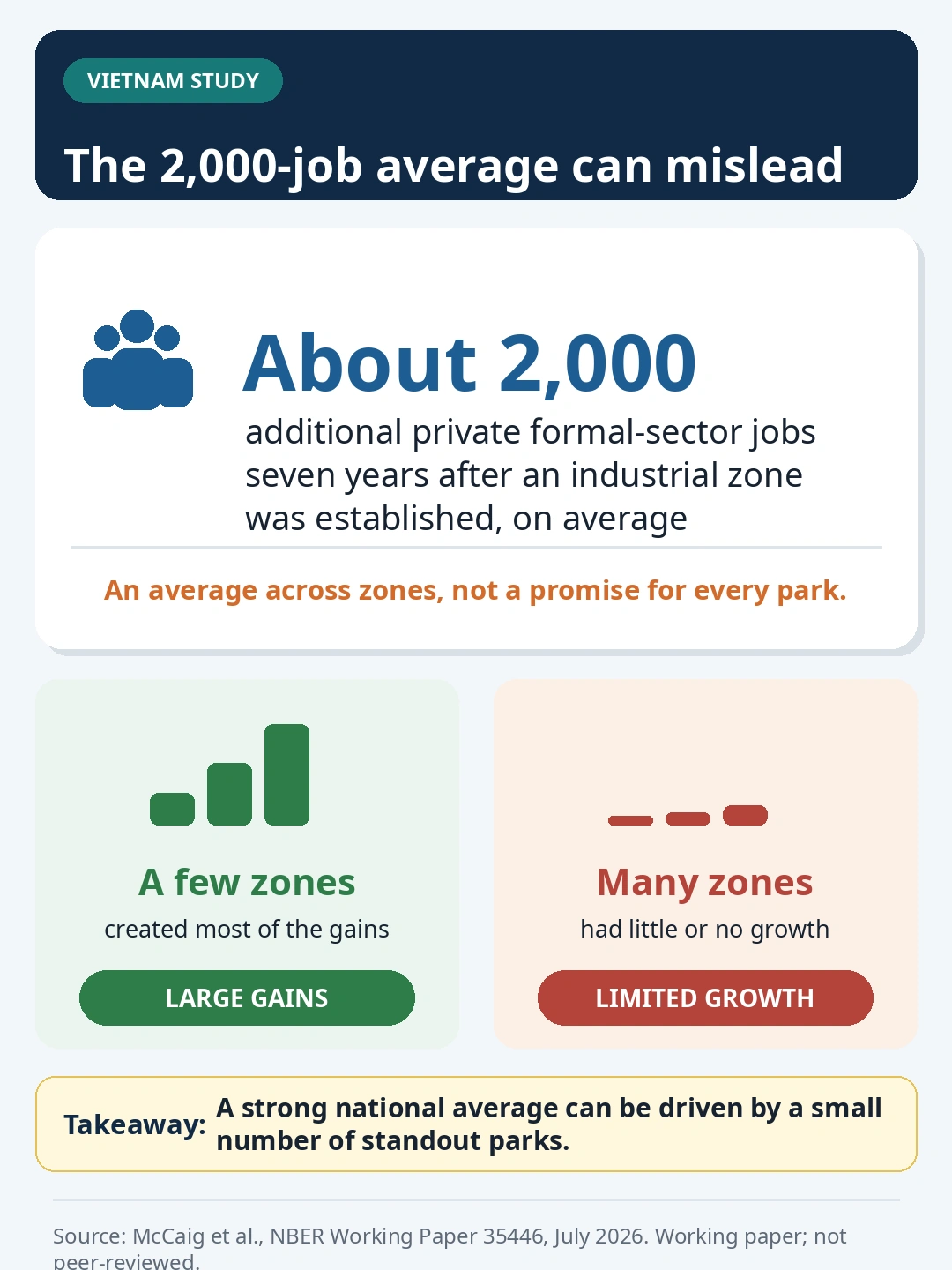
The researchers estimated that private formal-sector employment was about 2,000 workers higher seven years after an industrial zone was established than it otherwise would have been.
This figure describes the estimated employment level at the seven-year point. It is not a cumulative count of every person hired during the seven years.
It also does not mean that most industrial parks created approximately 2,000 jobs.
The results were extremely uneven. Some zones attracted major factories and created thousands of jobs. Many others attracted few businesses and generated almost no employment growth.
This is an important distinction for governments and investors. A strong national average can be driven by a small number of outstanding projects, even when most individual parks perform poorly.
Access to major ports made a large difference
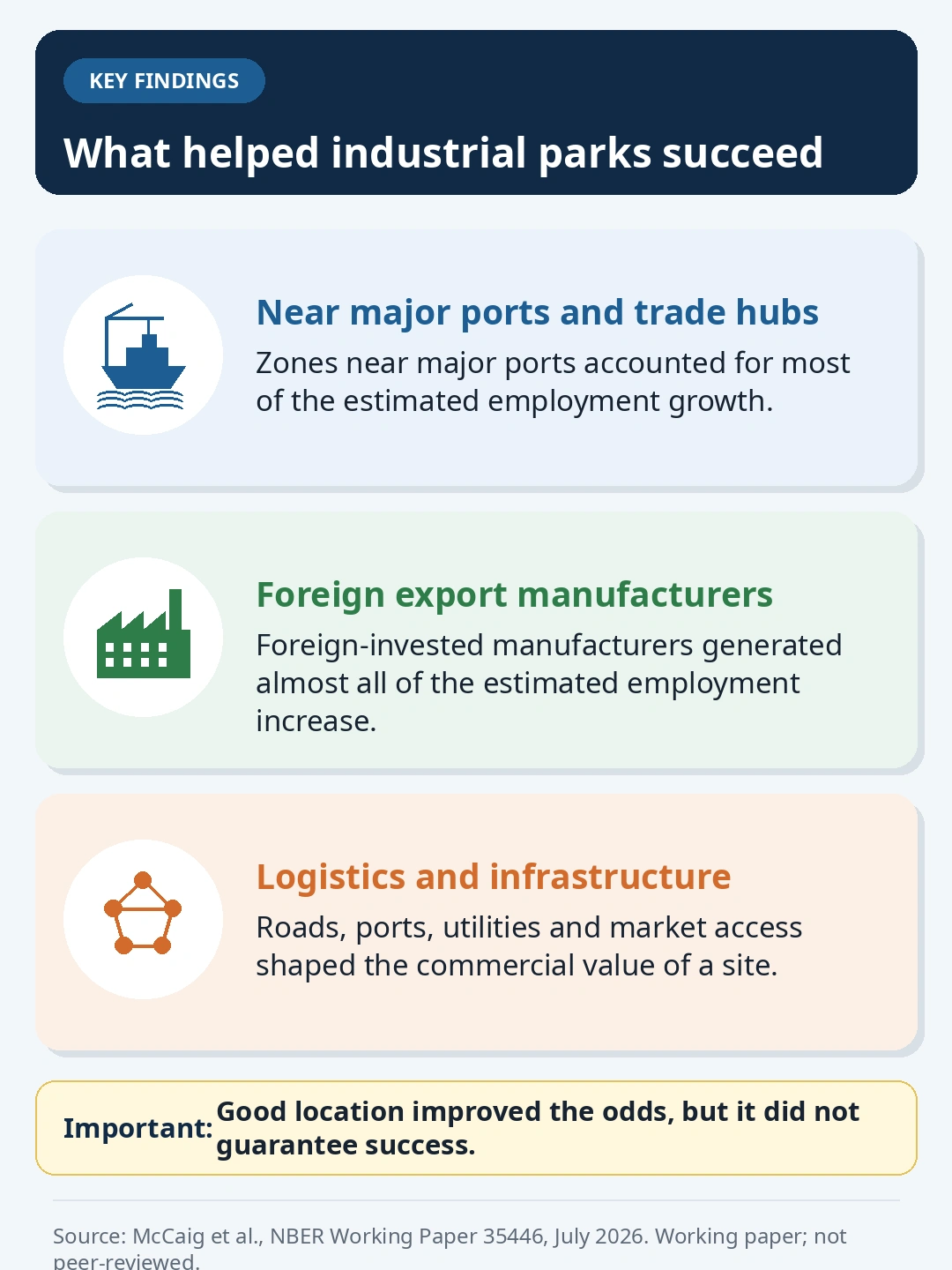
Industrial zones near major ports produced most of the estimated employment growth.
The researchers found that zones near major ports generated approximately 3,000 additional workers seven years after establishment. Zones farther away showed minimal employment effects.
This finding is consistent with the needs of export manufacturers. Factories must move components, raw materials and finished goods between suppliers, production sites and international markets.
A distant or poorly connected location can increase transportation time, delivery uncertainty and logistics costs.
However, access to ports was not a guarantee of success. The researchers found considerable variation even among industrial zones located close to one another.
Good geography therefore appears to improve a park’s chances, but it does not ensure that factories and jobs will follow.
Foreign manufacturers created most of the jobs
The increase in employment was almost entirely accounted for by foreign-invested manufacturing companies, particularly export-oriented manufacturers.
The number of private domestic companies also increased after industrial zones were established. However, those companies made a relatively small contribution to the overall employment gain.
This reveals an important difference between attracting companies and creating jobs.
An industrial park may report more registered businesses without experiencing a similarly large increase in employment. Governments evaluating a park may therefore need to examine how many active jobs its tenants have created, rather than focusing only on business registrations or announced investments.
Nearby domestic businesses did not always benefit
Industrial parks are often expected to support surrounding businesses through new orders, local purchasing and shared suppliers.
The study found a more complicated pattern.
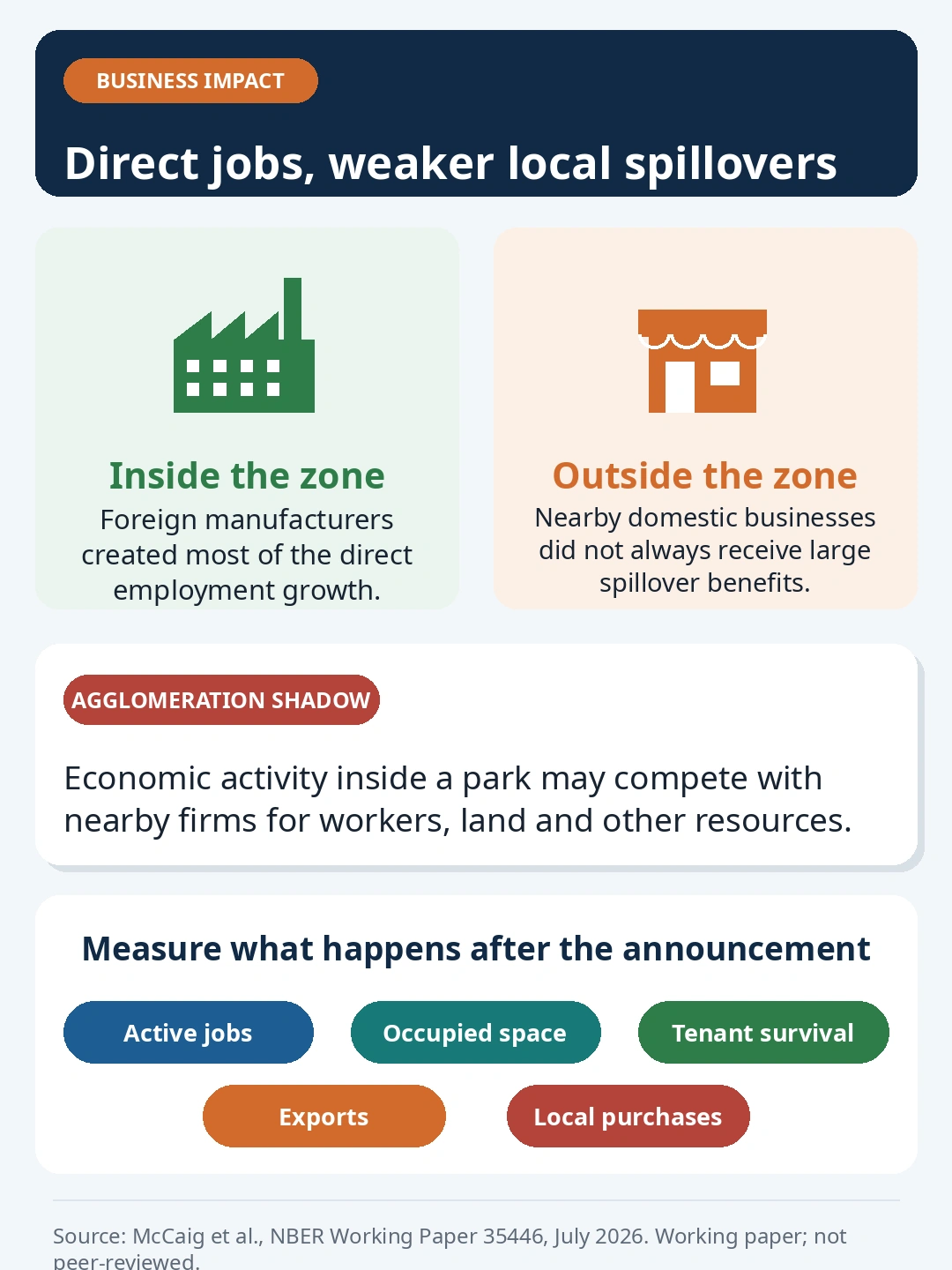
Domestic companies located very close to industrial zones sometimes experienced what the researchers called an “agglomeration shadow.” This means that the concentration of economic activity inside a zone may disadvantage some businesses immediately outside it.
The pattern is consistent with increased competition for resources such as workers, land and local customers, although the study did not isolate the exact contribution of each possible cause.
Domestic firms located farther from the zones experienced more positive effects.
Foreign manufacturers, meanwhile, appeared to operate largely as enclaves. They created jobs inside the industrial zones but formed relatively few connections with nearby domestic businesses.
A foreign-owned factory can therefore generate substantial direct employment without automatically creating a large network of local suppliers.
Without stronger supplier connections, the wider benefits for domestic businesses may remain limited even when the zone itself creates thousands of jobs.
What the findings could mean for businesses
The paper did not directly test development strategies such as securing anchor tenants, building industrial parks in phases or creating supplier-support programs.
The following points are business implications drawn from the findings rather than strategies measured directly by the researchers.
Cheap land can still become an expensive location
Companies selecting a factory site often compare land prices, rents, tax benefits and government incentives.
However, a less expensive site can still carry a higher total operating cost if it is far from ports, suppliers, workers or major customers.
A factory in a poorly connected location may spend more on transportation, hold additional inventory and allow more time for deliveries. Those recurring costs can eventually outweigh upfront land savings or temporary incentives.
The broader business lesson is that companies should evaluate the total cost of operating at a site, not simply the initial price of entering it.
Industrial parks need real demand, not just available land
The uneven results suggest that designating land for industry does not create its own market.
A government or developer can build roads, divide the land into plots and install utilities. That does not necessarily mean manufacturers will choose to operate there.
One practical way to reduce this risk may be to obtain serious commitments from potential tenants before completing an entire development.
Another approach could be to build the park in stages. Later sections would be developed only after the first part attracts active businesses and demonstrates genuine demand.
These approaches would not guarantee success, but they could reduce the cost of constructing large amounts of industrial infrastructure that remain unused.
Hosting a factory is not the same as building an industrial ecosystem
The weak connections between foreign manufacturers and nearby domestic companies point to another business lesson.
Attracting an international manufacturer may be only the first stage of local economic development.
The study did not establish every reason why local linkages were weak. One possible explanation is that some domestic businesses may not yet meet the technical, quality or delivery requirements of multinational customers. Foreign companies may also rely on established international suppliers.
Industrial park operators and governments could try to close these gaps through supplier introductions, training, shared testing services or assistance with quality standards.
However, such programs would need to be evaluated separately. The working paper did not test whether any particular supplier-development policy would succeed.
The important distinction is between hosting individual factories and creating a connected network of manufacturers, suppliers and service providers.
Park operators provide more than real estate
The findings also suggest that the commercial value of an industrial park depends heavily on the wider network around it.
Tenants need reliable electricity, transportation, customs services, workers, maintenance providers and access to suppliers and customers.
An industrial park operator is therefore doing more than leasing factory land. It is helping businesses connect with the services and infrastructure required to operate efficiently.
A park that solves everyday operating problems may be more attractive to manufacturers than one that offers inexpensive land but weak connections.
Success should be measured after the announcement
Industrial projects are often promoted using the size of the site, the value of promised investment or the number of companies that have expressed interest.
Those figures do not necessarily show whether factories have opened or whether substantial employment has been created.
When job creation is the objective, governments, investors and lenders may obtain a clearer picture by tracking active employment, occupied factory space, tenant survival, production, exports and purchases from domestic suppliers.
These measures help distinguish a functioning industrial center from a completed property development with few active businesses.
Improving existing parks may sometimes be more valuable
The findings also raise a question about whether governments should continue opening new industrial parks or improve the strongest existing ones.
If location and connectivity are important, additional investment in a well-positioned park may sometimes produce better results than building a new site elsewhere.
Better roads, port connections, electricity supplies, drainage, employee transportation and customs services could increase the usefulness of land that has already been developed.
This may offer a stronger return than opening additional sites without clear evidence of tenant demand, developer capacity or implementation readiness.
This is a practical implication of the study rather than a policy directly tested by the researchers.
The study has important limitations
The research focused on Vietnam, an export-oriented manufacturing economy with its own geography, institutions and development strategy.
The exact employment figures should not be assumed to apply to industrial parks in other countries.
The analysis also concentrated on formally registered private businesses. It did not capture every possible effect on informal employment, household income, government revenue or public services.
The study was observational. Although the researchers compared zones with nearby areas and used statistical controls, unmeasured differences between locations could still have influenced the estimates.
Location was important, but it was not the only factor. The researchers found considerable variation among industrial zones in similar areas, suggesting that local implementation and other park-specific conditions also mattered.
The study is also an NBER working paper. NBER working papers report preliminary research and have not been peer-reviewed.
The broader lesson
The research does not show that industrial parks are ineffective. Some zones in Vietnam created large numbers of formal jobs and attracted major export manufacturers.
It does show that success is far from automatic.
Industrial parks should be treated as long-term commercial systems rather than simple construction projects. Factory buildings and serviced land are only the visible parts.
Location, logistics, tenant demand, infrastructure, workforce availability and supplier connections may ultimately determine whether a park creates thousands of jobs or remains largely empty.
The central lesson for governments and businesses is simple: setting aside land for industry is only the beginning. A credible business case must explain why manufacturers will choose that particular location and how they will operate successfully once they arrive.
Source: Brian McCaig, Margaret S. McMillan, Marina Mavungu Ngoma and Anh T. Pham, The Uneven Impact of Industrial Zones on Formal Job Creation in Vietnam, NBER Working Paper No. 35446, July 2026.
