

Business organization N-56 says that North Sea oil reserves over the next three decades are six times higher than the predictions made by the Office for Budget Responsibility (OBR), the UK’s economic watchdog. N-56 describes itself as an “apolitical business organization.”
In a report published today – “Oil and Gas – A Pivotal Moment” – Scotland’s oil reserves are much greater than UK authorities have led people to believe. The report is part of the N-56’s Scotland Means Business Part 2.
The report was written for N-56 by BiGGAR Economics and Tulloch Energy.
Scotland’s great future
According to N-56, Scotland is set to become one of the five richest nations on earth.
The authors describe the OBR forecasts as “woefully pessimistic” on barrel price and oil & gas reserves. They add that the OBR has a history of very inaccurate forecasts.
According to the OBR, between 2014 and 2040, the North Sea’s oil & gas reserves will be worth only £57 billion.
The new report’s authors, on the other hand, say North Sea reserves may be worth as much as £365 billion, i.e. more than six times OBR’s estimate. Scotland’s share of the UK’s offshore revenue would be about 90%.
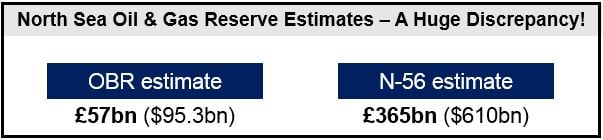
Whose estimate is right?
N-56 has made the following recommendations:
- The UK Government’s oil & gas taxation/regulation policymakers should be moved to Aberdeen from London, regardless of whether Scotland becomes independent.
- A comprehensive review of the taxation system is needed. One that would create a more competitive tax regime for the North Sea.
- A Hydrocarbon Investment Bank should be created to bolster investment in the sector.
- A long-term industrial development plan for the oil & gas sector should be launched to foster economic growth.
- Exploration should be encouraged to make sure recoverable oil & gas resources are exploited in the UK. This should include taxation incentives.
- Make sure oil companies maximize economy recovery from the fields they hold licenses for.
- Resources, rather than being developed by individual field, should be developed on a regional basis, in order to get the best value for money.
- There should be increased investment in prolonging the life of current infrastructure to process oil & gas resources.
From public sector deficits to surpluses
If these higher figures are true, Scotland’s public finances will have a surplus as high as 7% of GDP (over £12 billion per year) by the end of this decade. During the next decade, surpluses will be around £9 billion to £11 billion annually, and £5 billion in the 2030s.
The OBR, on the other hand, has forecast that UK public finances will return to deficit, even if the current target of eliminating the current deficit by 2018-2019 is achieved.
Graeme Blackett from BiGGAR Economics, said:
“Since 1970 over £1 trillion in oil and gas revenues have been produced by the North Sea and at least as much value remains to be produced as already has been, presenting a tremendous opportunity for the sector and for Scotland’s public finances.”
“Scotland is a net contributor to the UK public finances, in part due to our geographic share of oil and gas revenues, and this ensures that our finances are typically healthier than the UK public finances as whole.”
“The OBR puts forward incredibly pessimistic forecasts on both barrel price and reserves, largely discredited by industry experts. What is clear is these natural resources can be maximized through implementing the recommendations put forward both by ourselves and the Wood Review, delivering considerable surpluses that we would recommend are used to invest in an oil fund to benefit future generations.”
In September the Scottish people vote on whether to become an independent nation or remain part of the United Kingdom. Of concern to most Scots is whether they will be able to keep the pound and stay inside the European Union.
