
A recent report suggests that the aerospace robotics market is expected to reach US$4.54 billion by 2022. Given that the market stood at US$1.81 billion in 2016, this represents a compound annual growth rate (CAGR) in excess of 16 percent.
The 160-page report from Markets and Markets suggests that the aerospace robotics market is driven by a number of factors, the main ones being the pressure to improve production efficiency and the need to tackle huge backlogs in aircraft orders.
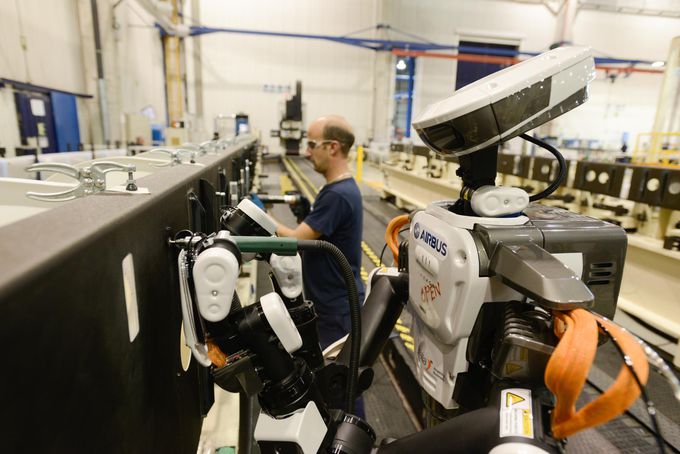
 The Airbus plant in Spain is piloting the use of two-arm robots to work alongside humans.
Image: Airbus
The report also suggests that the growth of the aerospace robotics market may be somewhat constrained by the fact that there is a shortage of skilled robot operators.
Robots in manufacturing and assembly of aircraft
Aircraft manufacturers such as Airbus in France and Boeing and Lockheed Martin in the United States are using robots to manufacture and assemble aircraft.
These companies – and others – are using robotics in a range of applications, such as to increase accuracy and speed of manufacturing and to release workers from repetitive, predictable tasks and free them up for other tasks or more skilled work.
For example, in line with their “factory of the future” strategy, Airbus and Airbus helicopters are introducing “computerized co-workers” that are capable of working safely alongside human ones.
Airbus are planning to release aerospace robotics applications every year or so. They have identified 7 areas in which they hope to introduce robotics to optimize their manufacturing by 2020.
The company is already using robotics to cut the time it takes to identify and diagnose faults on the production line. And they plan to bring in lightweight robots to handle specific tasks.
A huge area that can benefit from robotics is the painting and testing of fuselages, a painstaking and meticulous task for humans.
At their Puerto Real plant in Cádiz, Airbus are already piloting the use of two-arm humanoid robots that can work alongside their human co-workers.
They also plan to use a single-arm robot that can move by itself inside an aircraft to help install brackets in the fuselage.
Structure of the report
The report segments the aerospace robotics market by: types of robotics (such as articulated, SCARA, cylindrical, and Cartesian); by component (arm processor, controller, drive, end effector, and sensor); and by technology (whether traditional use or collaborative).
It suggests that in 2016:
– the largest segment for type of robotics was the articulated segment
– the largest segment for robotic components was the controller segment
– the largest segment for technology was the traditional segment
It also maps these segments and further breakdowns onto four geographical regions: North America, Europe, Asia-Pacific and Rest of the World (RoW).
The report provides insights into industry trends, analyses of market share, profiles of major players, market drivers and constraints, as well as challenges and opportunities in the aerospace robotics market.
Among the major players profiled in the report are: the German company KUKA, the Swiss company ABB, and the Japanese companies FANUC, Yaskawa Electric, and Kawasaki Heavy Industries.
You can see a summary, contents list, and do some limited searching inside the report for free – or buy the whole report – at Report Buyer.
Video – “Factory of the future” in the aerospace robotics market
In the following video, Boeing describe their own “factory of the future” in Everett, Washington, where robots and humans work alongside each other to assemble the forward and aft sections of the 777 airplane.
The human teams load and set the fuselage panels and the robots install thousands of fasteners to connect them.
