
Alberta has achieved impressive economic growth. The province’s real domestic product growth was ahead of the national average in 2013. This is the fourth consecutive year of above average growth in Alberta, according to Statistics Canada.
The agency reported that real GDP in Alberta grew 3.8 percent last year, after advancing 4.5 percent in 2013.
According to the report:
“Growth was driven by increased business gross fixed capital formation (8.5 per cent). Household final consumption expenditure (4.3 per cent) and exports of goods and services (2.7 per cent) were also higher,”
Real GDP was up in all provinces and territories across Canada in 2013 with the exception of New Brunswick and Yukon.
“Nunavut (+11.2%) and Newfoundland and Labrador (+7.2%) had the largest increases in real GDP. Nationally, real GDP rose 2.0%, slightly above the increase in 2012.
Economic growth in Quebec (+1.0%) and Ontario (+1.3%) was below the national average. Saskatchewan (+5.0%) and Alberta (+3.8%), in turn, surpassed the national average for the fourth year in a row.”
Alberta posted the highest increase in compensation of employees of all provinces and territories:
“Compensation of employees advanced in all provinces and territories, with Alberta posting the largest increase (+7.3%). Nationally, compensation of employees rose 3.7% in 2013, compared with an increase of 4.6% in 2012. All provinces and territories except Nova Scotia, New Brunswick and British Columbia posted slower growth than in 2012.”
Economic growth in Quebec only went up by 1.0 percent, with Ontario only slightly ahead by 1.3 percent, both below the national average.
Saskatchewan surpassed the national average for the fourth year in a row, advancing 5.0 percent.
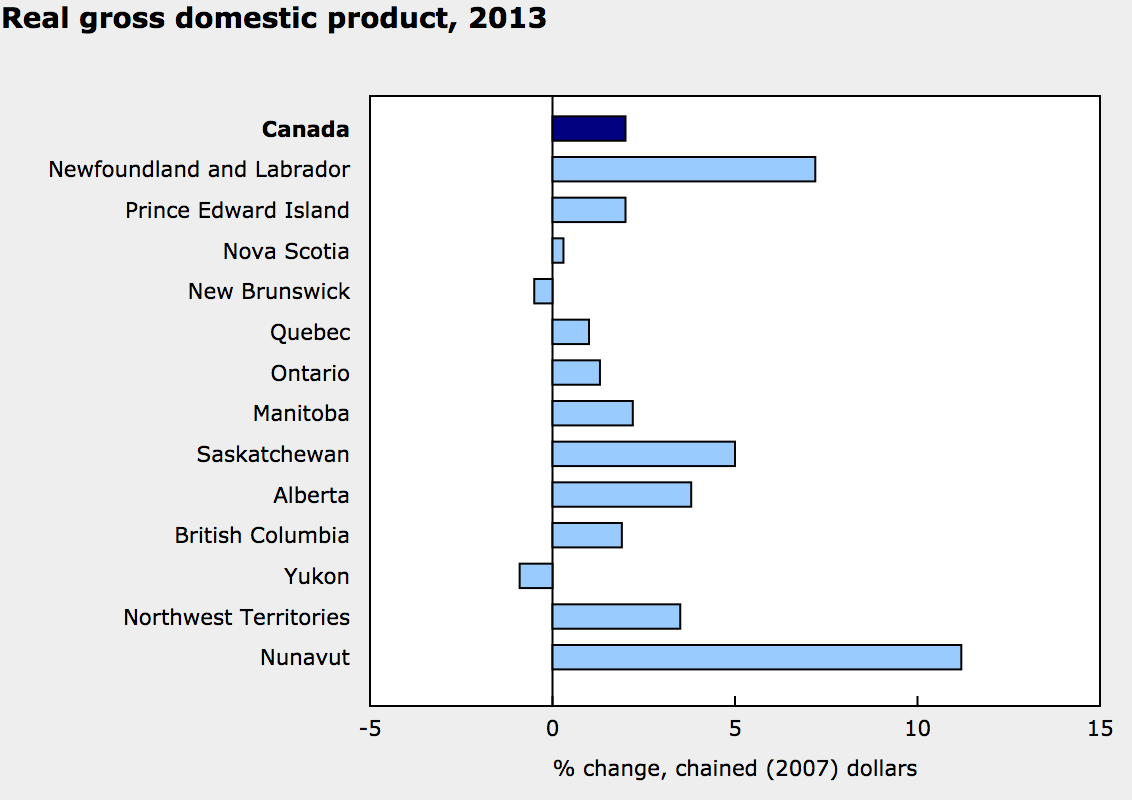
Of the highly populated provinces/territories Alberta and Saskatchewan achieved the most growth.
“The resource-based economies of Newfoundland and Labrador, Saskatchewan and Alberta have seen their share of national income increase since 2003, while Quebec and Ontario have seen their share decline,”
“In 2013, the combined nominal GDP of Newfoundland and Labrador, Saskatchewan and Alberta accounted for 24.1 per cent of national GDP. In 2003, their share was 18.4 per cent. Conversely, Quebec and Ontario have seen their combined share of national GDP fall from 61.5 per cent in 2003 to 55.9 per cent in 2013.”
