
Google’s parent reported rapid growth in revenue and cloud sales. However, heavy investment in artificial intelligence pushed quarterly free cash flow below zero.
Alphabet’s latest financial results show both the promise and the high cost of the artificial intelligence boom.
The parent company of Google reported revenue of $119.8 billion for the second quarter of 2026. This was 24 percent higher than a year earlier. Operating income increased 30 percent to $40.8 billion, while the company’s operating margin rose to 34 percent.
Google Cloud delivered the strongest growth. Its revenue rose 82 percent to $24.8 billion, helped by demand for AI infrastructure, enterprise AI products and other cloud services. Cloud operating income increased from $2.8 billion a year earlier to $8.8 billion.
Free cash flow turns negative
Alphabet’s strong sales growth was not enough to offset the amount of money it spent on new infrastructure.
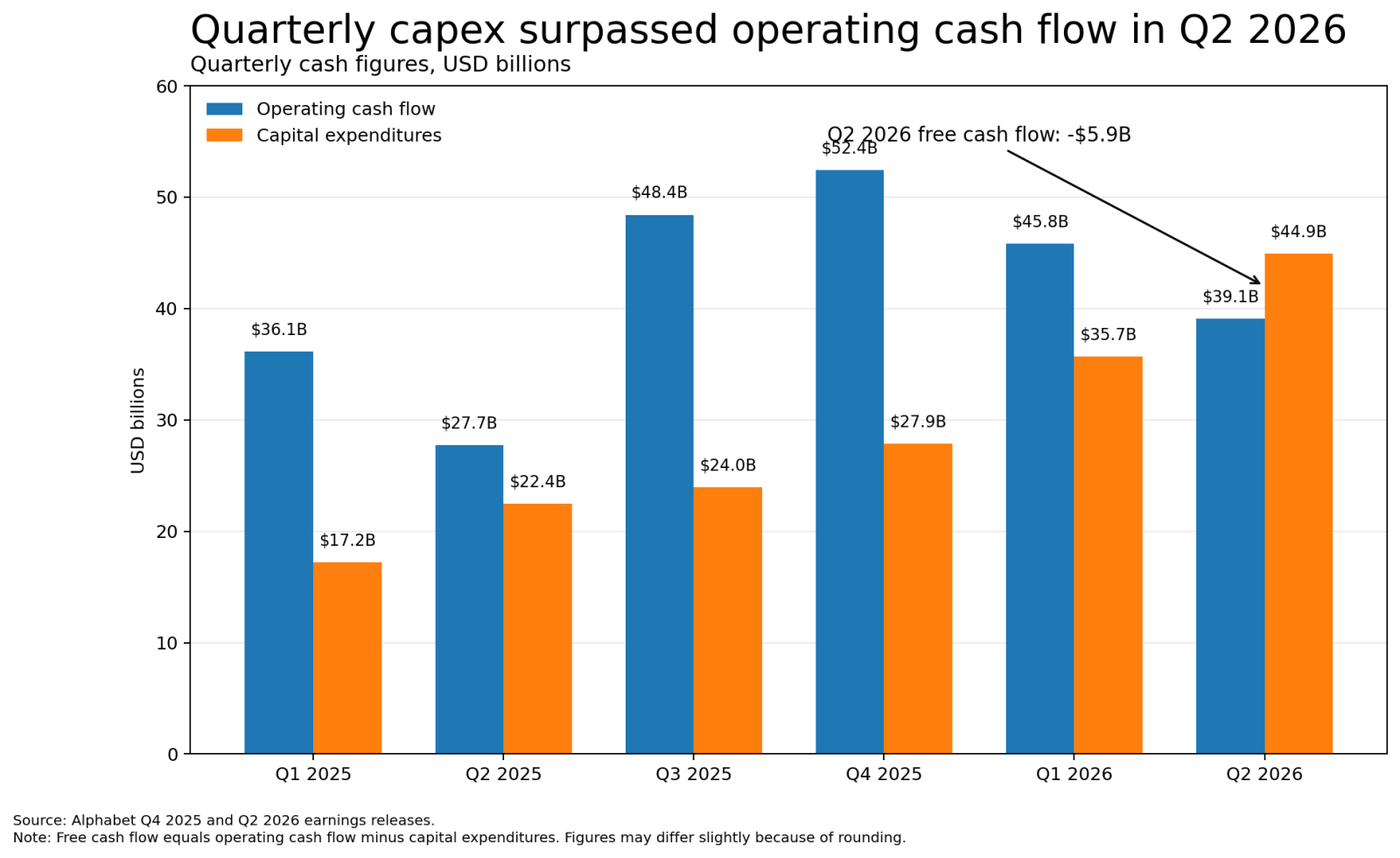
The company generated $39.1 billion in operating cash flow during the quarter. However, purchases of property and equipment reached $44.9 billion. Under Alphabet’s definition of free cash flow, this produced a negative result of $5.9 billion. Reuters described it as Alphabet’s first negative quarterly free cash flow on record.
Free cash flow measures how much cash remains after a company pays for major investments. It can be used for dividends, share buybacks, acquisitions, debt payments and further expansion.
A single quarter of negative free cash flow does not necessarily signal financial trouble. Alphabet still produced $53.3 billion in free cash flow over the previous 12 months. However, the quarterly decline shows how quickly AI investment is changing the company’s spending requirements.
Alphabet raises its spending forecast
Alphabet now expects capital expenditure of between $195 billion and $205 billion in 2026. Its previous forecast was between $180 billion and $190 billion.
Capital expenditure, commonly known as capex, is money spent on assets that are expected to support a business for several years. Alphabet’s spending is largely connected to technical infrastructure for its cloud and AI operations.
Chief Financial Officer Anat Ashkenazi said demand continues to exceed the company’s available capacity. Faster delivery of new capacity also contributed to the higher forecast.
The increase means Alphabet could spend about twice its 2025 capital expenditure. The company reported capital expenditure of $91.4 billion for that year.
Cloud growth shows that AI demand is real
The results do not suggest that Alphabet is struggling to find customers for its AI infrastructure.
Google Cloud’s 82 percent revenue increase shows that businesses are buying more computing capacity and AI services. The company said growth came from enterprise AI infrastructure, enterprise AI solutions and its core Google Cloud Platform services.
Alphabet has also said that customer demand is so strong that it plans to lease additional data center capacity from other providers. This could help the company serve customers sooner, although external capacity may place pressure on profit margins.
The main concern is whether AI revenue will rise quickly enough to cover the full cost of the expansion. These costs include new equipment, data centers, leases, depreciation and ongoing operating expenses.
Alphabet’s net income needs context
Alphabet reported net income available to common stockholders of $112.1 billion, compared with $28.2 billion one year earlier. The large increase was not produced entirely by Google’s normal business operations.
The company recorded about $98 billion in other income, mainly because of unrealized gains on equity investments. Alphabet said gains on equity securities added $77.1 billion to net income after tax.
Unrealized gains reflect increases in the estimated value of investments that have not necessarily been sold. Their value can rise or fall in future reporting periods. For that reason, operating income and cash flow provide a clearer view of the performance of Alphabet’s core businesses.
Investors focus on the cost of the AI race
Alphabet shares fell sharply during Thursday trading, even though the company reported strong revenue and cloud growth. Investors focused on the higher spending forecast and the decline in free cash flow.
The results may also increase scrutiny of Microsoft, Amazon and Meta. All three companies are investing heavily in AI computing capacity. Investors are likely to examine whether their AI revenue is keeping pace with rising infrastructure costs. Reuters reported that combined spending by major technology companies is expected to exceed $700 billion this year.
What this means for Alphabet
Alphabet’s quarter showed that demand for AI services remains strong. It also showed that meeting this demand requires much more capital than investors were accustomed to seeing from major technology companies.
The company is producing faster cloud growth and stronger cloud profits. At the same time, infrastructure spending is rising faster than operating cash flow.
The long term question is no longer whether AI will create revenue. The question is whether that revenue will arrive quickly enough, and at high enough margins, to justify the extraordinary cost of building the required infrastructure.
