
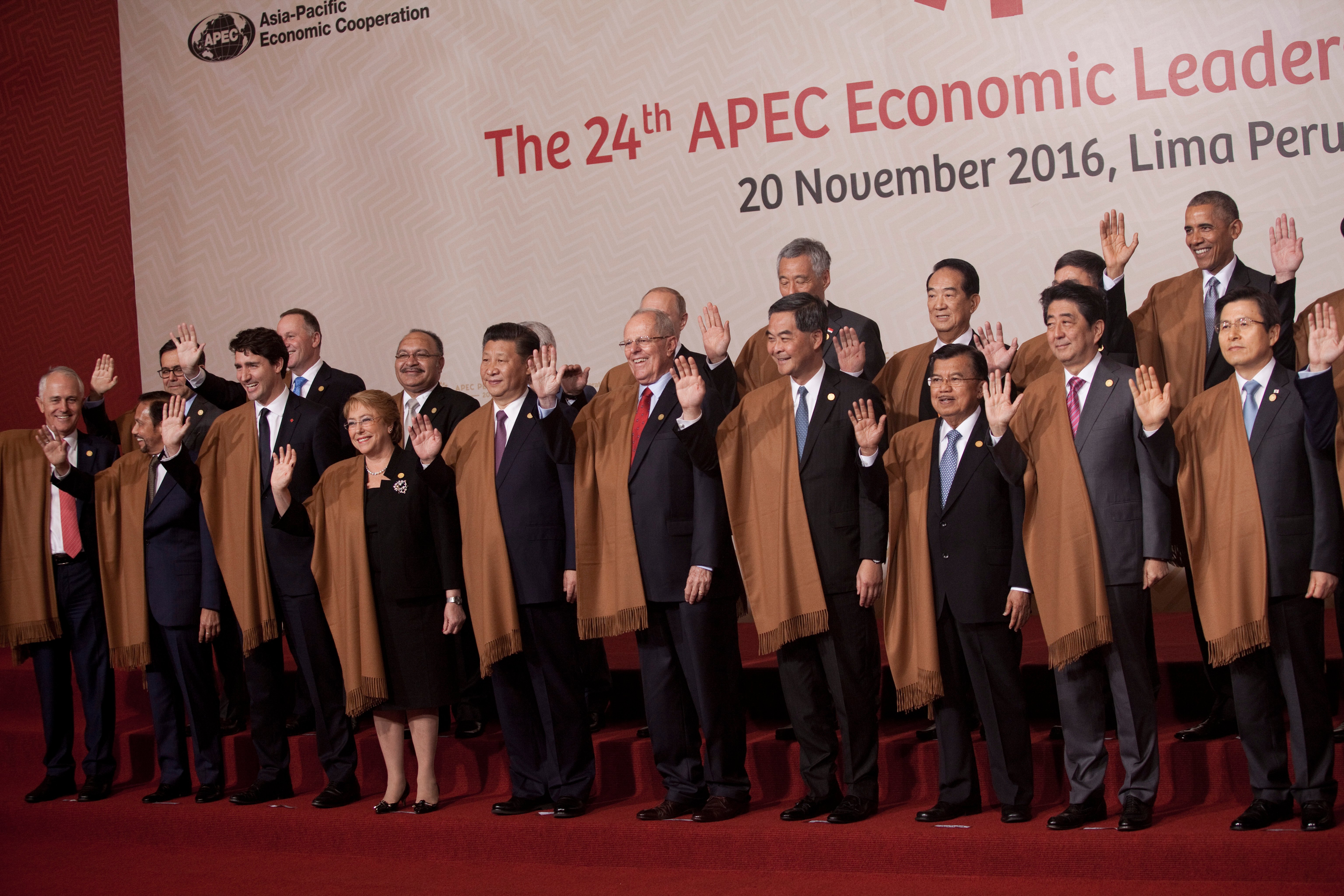
The leaders of APEC recently reaffirmed their commitment to promote free trade and sustainable economic growth in the Asia-Pacific region.
The 24th Annual APEC Economic Leaders’ Meeting in Lima, Peru, on Sunday, brought together leaders of the 21 member economies, including several heavyweights such as Barack Obama (United States), Shinzo Abe (Japan), Xi Jinping (China), and Vladimir Putin (Russia).
 Leaders from 21 member economies attended the APEC summit in Lima, Peru, where they reaffirmed their commitment to free trade. Image: APEC
At the summit, the APEC leaders adopted a declaration on “advancing quality growth and human development.”
The declaration contains policy commitments for APEC members to address “challenges and opportunities for free trade and investment in the current global context.”
The policy commitments also deal with moving towards “real and functional connectivity in the region,” and address issues of food security, climate change, and access to water.
Protectionist trends
The declaration recognizes that while world economic recovery is progressing, there are deep uncertainties about the future and the challenges are far-reaching. Among these is the emergence of protectionist trends as a reaction to globalization, about which the APEC leaders give out a strong message:
“We reaffirm our commitment to keep our markets open and to fight against all forms of protectionism by reaffirming our pledge against protectionism through a standstill commitment that we agree to extend until the end of 2020 and to roll back protectionist and trade-distorting measures, which weaken trade and slow down the progress and recovery of the international economy.”
Opposite to Trump’s position?
This statement appears to be in direct opposition to sentiments expressed by United States president-elect Donald Trump during his campaign for the presidency. These came to a head on Sunday when he promised that withdrawal from the Trans-Pacific Partnership (TPP) trade deal will be one of the actions he intends to trigger as soon as he takes office.
The TPP agreement, which was designed to create a type of single market similar to the concept of the European Union, is promoted by the current U.S. administration as a vehicle for advancing American values, and “helping to build a global trading system that will allow our workers to effectively compete in the modern economy.”
But Trump describes membership of the TPP as a “disaster for our country,” and says he intends instead to focus on developing “fair bilateral trade deals.”
Does this move by Trump signal a desire to move away from multilateral, free trade deals?
Will China take up the free trade leadership mantle?
Over the summit weekend, China president Xi delivered a forceful speech defending free trade, suggesting that APEC’s response to rising protectionism should be to create a free trade area encompassing the entire Pacific Rim.
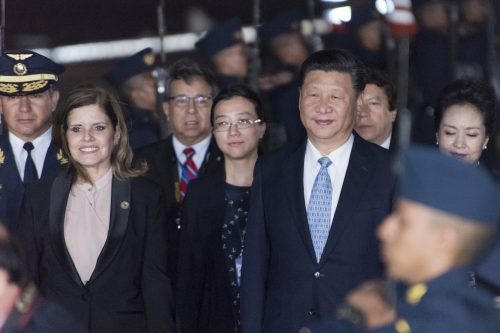 President Xi of China arrives at APEC summit. Image: APEC
“China will not shut the door to the outside world – but will open it even wider,” said Xi.
A question that prevails following the APEC summit, despite the declaration, is will the U.S. be supporting the forum as strongly when Trump takes over from Obama? And if not, then will members look to another heavyweight to take up the mantle of free trade in the Pacific Rim? Does Xi’s message indicate China’s readiness to step into that role?
About APEC
APEC is a cooperative, multilateral economic and trade forum for 21 Pacific Rim economies that together account for around 40 percent of the world’s population, about 59 percent of global GDP, and 49 percent of world trade.
The forum was established in 1989 to accelerate integration of the Asia Pacific economies and increase prosperity for the people of the region through inclusive, sustainable, and secure growth.
The 21 APEC members are: Australia (joined 1989), Brunei Darussalam (1989), Canada (1989), Chile (1994), People’s Republic of China (1991), Hong Kong, China (1991), Indonesia (1989), Japan (1989), Republic of Korea (1989), Malaysia (1989), Mexico (1993), New Zealand (1989), Papua New Guinea (1993), Peru (1998), Philippines (1989), Russia (1998), Singapore (1989), Chinese Taipei (1991), Thailand (1989), United States (1989), and Viet Nam (1998).
In APEC, commitments are not binding and do not constitute treaty obligations. They are undertaken voluntarily and capacity-building projects help members implement them. All members have an equal say and decisions are reached by consensus.
Projects are funded from members’ contributions and range from electronic customs processing, regulatory reform, enhancing competitiveness among small and medium enterprises, to helping regions adopt renewable energy technologies.
