

An incredible bionic hand could give people who have lost limbs new hands “nearly like the real thing”, says a group of British scientists. It senses pressure and temperature and feeds data directly to the brain.
The research project, led by Newcastle University, plus experts from the Universities of Leeds, Essex, Keele, Southampton, and Imperial College London, has been made possible thanks to a ₤1.4 million grant awarded by the EPSRC (Engineering and Physical Sciences Research Council).
The ultimate aim is to develop artificial hands that connect to the neural networks in the forearm, allowing 2-way communications with the human brain.
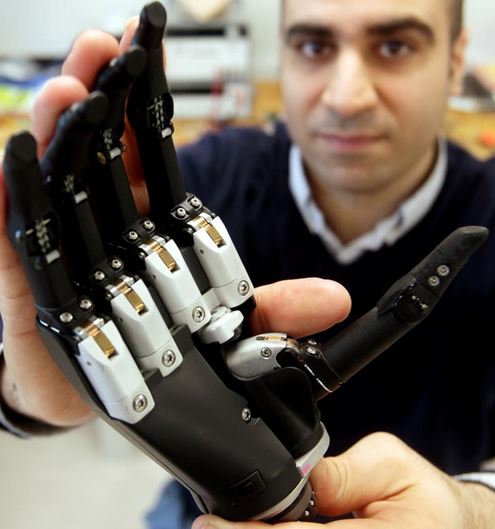
Dr. Nazarpour and colleagues hope the bionic hand will improve amputee’s lives. (Photo: EPSRC)
The bionic hand’s electrodes will be wrapped around the arm’s nerve endings, thus making it possible for the prosthesis to communicate directly with the brain, sending real-time data about what it senses, including pressure, temperature and shear force.
Dr Kianoush Nazarpour, who teaches Biomedical Engineering at Newcastle University, and team say they plan to develop a number of technologies that enable amputees gain a real sense of feedback and create limbs that are “nearly like the real thing.”
Dr Nazarpour commented:
“The UK leads the way in the design of prosthetic limbs but until now one of the limiting factors has been the technology to allow the hand to communicate with the brain.”
“If we can design a system that allows this two-way communication it would help people to naturally reach out and pick up a glass, for example, whilst maintaining eye contact in a conversation, or pick up an apple without bruising it.”
“This will advance the field of prosthetics, provide enhanced function to prosthesis users, and also reduce the time involved to learn how to use the device because the movements will come naturally. The technology will also have applications for patients with neurological conditions where reduced sensation is a factor.”
A realistic sense of touch
The UK’s experts in the field of rehabilitation have come together to build fingertip sensors that will give the artificial hand a “realistic sense of touch”, including the ability to feel temperature, pressure and shear.
The aim is for the user to be able to use the artificial hand without having to look directly at it (proprioception), by processing its signals so that the brain is able to understand the data and then stimulates the nervous system.
With current artificial hands, the user must look at it. He or she cannot fumble blindly within his or her pockets to find things such as keys or coins, like people with natural hands can.
Dr. Rory O’Connor, Senior Lecturer in Rehabilitation Medicine at the University of Leeds, who is Clinical Advisor in this project, said:
“We are seeing many more active young people who are surviving severe injuries that result in them losing one or more limbs and requiring a prosthesis. The current designs are like a plug and socket. The socket fits over the end of the limb and picks up signals from the muscles.”
“The prosthesis fits onto this and by learning to flex certain muscles the patient can work the hand. The drawback is that for many patients – particularly survivors of trauma – the muscle ends are too damaged to be able to use the limb.”
“What patients tell us is they want something that is more intuitive and more closely replicates the natural movement and feel of a real hand and that is what we hope to achieve through this project.”
Millions of people could benefit
The EPSRC says there are about 11.6 million disabled individuals in the United Kingdom. A total of 6.5 million are estimated to have mobility impairments, 6.3 million have difficulties carrying or lifting things, while 2.7 million have coordination problems.
To be able to have a hand that senses heat, pressure and shear force, one that can be used without having to look at it all the time, to regain a decent level of dexterity, could be no longer just a dream, but a reality one day, for millions of people.
Chief Executive of EPSRC, Philip Nelson, said:
“These research studies will improve patients’ lives, allow greater independence and benefit patients with a wide range of mobility and co-ordination difficulties. With the UK’s ageing population and a rise in disabilities EPSRC investment in healthcare research has a national impact.”
