
Did you know that bots steal many online advertising budgets? Online advertising budgets are infested with nasty bots that steal companies’ hard-earned advertising dollars.
In an article in Entrepreneur Europe, guest writer Harry Kabadaian explains how companies are wasting their advertising budgets. According to several studies, waste is a common feature of many online advertising budgets.
Kabadaian is digital marketing agency Fancy Lab’s CEO, and also co-founder of Magento development company Ideal Evolved.
The term ‘online advertising’ refers to using online venues such as websites as advertising media. In other words, adverts on the Internet.
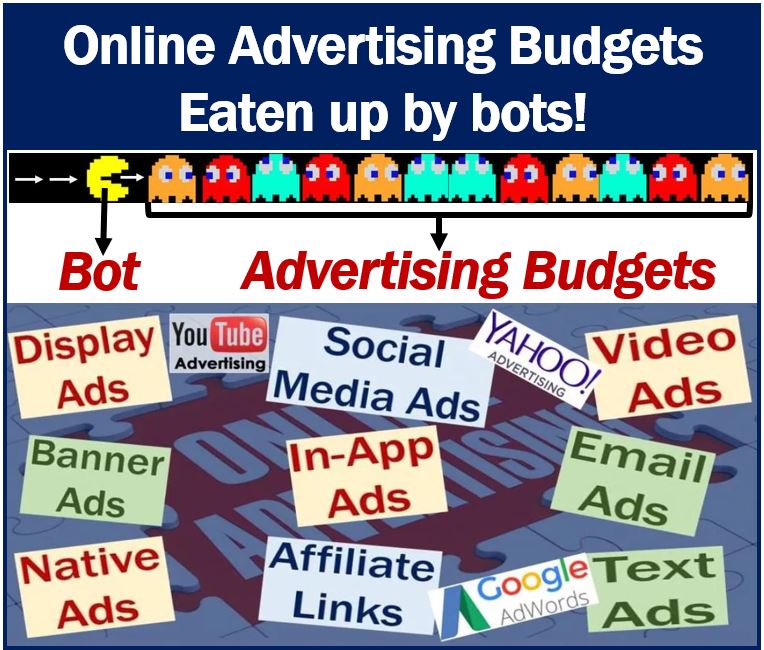
Online advertising budgets – real people
The National Association of Advertisers informs that only about 25% of all online ad spend actually gets to real humans beings. Human beings, in this context, refers to the consumers that the advertiser is targeting, rather than bots.
Marc Pritchard, Chief Brand Officer at Procter & Gamble, has a new rule regarding online advertising budgets. If they cannot prove that only customers are seeing its adverts, don’t spend there.
Procter & Gamble’s global advertising budget will probably exceed $600 billion by 2021.
Online advertising blockers
Most people hate seeing loads of ads when they are online. In fact, they hate them so much that they abandon pages when the ads appear. They also install ad blockers.
In an article in ADWEEK, Sean Tyson informed that in 2016, nearly 400 million devices used ad blockers. Experts believe that this number will continue to rise.
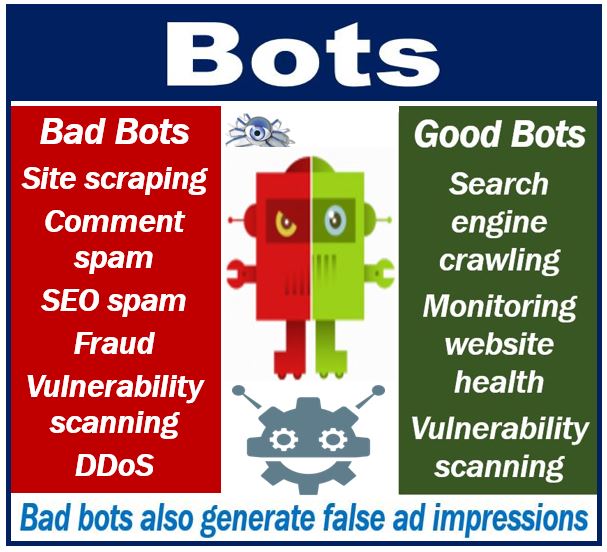
Bot fraud
Bots are responsible for $7 billion’s worth of fraud each year. In other words, businesses lose $7 billion annually because of bot-driven fraud.
However, advertisers have had enough. Apart from Procter & Gamble, hundreds of other companies are reforming their online advertising budgets.
JPMorgan Chase
JPMorgan Chase, for example, has a list of 5,000 websites in which it advertises. The company does not place digital ads anywhere else.
However, Chase’s measure only has only had a marginal effect on impressions and ad visibility.
Advertisers getting wiser
Kabadaian writes:
“For a long time, the high ROI of digital advertising has been able to distract businesses from the massive waste involved. But that’s changing fast as advertisers are demanding more transparency, seeking to reclaim their lost budgets.”
ROI stands for return on investment.
Online advertising waste plus solutions
Here are some ways, Kabadaian explains, advertising may be wasting their budget, plus some possible solutions:
Targeting bots rather than humans
A bot is a software application that runs scripts – automated tasks – over the Internet. We also call it a WWW robot or Internet bot. Put simply; bots are mini-robots that exist in the online world.
One of the things they do is visit websites. They may also click on online advertising.
Some bots mimic what people do. However, they are not people.
Let’s suppose your online ad had one million impressions, but half of them were generated by bots. Therefore, as far as your target consumers are concerned, it only had 500,000 impressions.
There are ad fraud detectors you can download which monitor your Bing Ads, AdWords, etc.
Online advertising budgets – targeting
Marketing and advertising without precision or targeting is neither marketing nor advertising.
Despite knowing this basic fact, companies lose billions of dollars annually due to poor targeting strategies.
There are several tools available today that can help advertisers perfect their targeting.
Online advertising budgets – using a CLV calculation
CLV stands for customer lifetime value. CLV is a prediction. It predicts how much of a company’s net profit will come from its entire relationship with a customer.
In the world of advertising and marketing, CLV is extremely important. It tells the company how valuable its relationship with a consumer is. It also helps advertisers and sales personnel decide what to do now and in the future.
Surprisingly, many companies launch online advertising campaigns without doing a CLV calculation beforehand. Slightly less than 24% of marketers are monitoring their CLV data effectively.
In another Enterprise Europe article, Susan Gunelius writes about resources that help advertisers understand and exploit CLV.
Gunelius is CEO of KeySplash Creative Inc. She has also written several books about marketing, branding, copywriting, and social media.
Online advertising budgets – where’s the waste?
Let’s suppose you spend $1m on advertising and know that $500,000 has been a waste of money. However, you might not know which lot of $500,000 is the waste and which is generating sales.
John Wanamaker (1838-1922), an American merchant, politician, proponent of advertising, and marketing pioneer, once said:
“Half the money I spend on advertising is wasted; the trouble is I don’t know which half.”
Fortunately, user-behavior-tracking tools exist today that can help us determine exactly where we waste our advertising money.
