
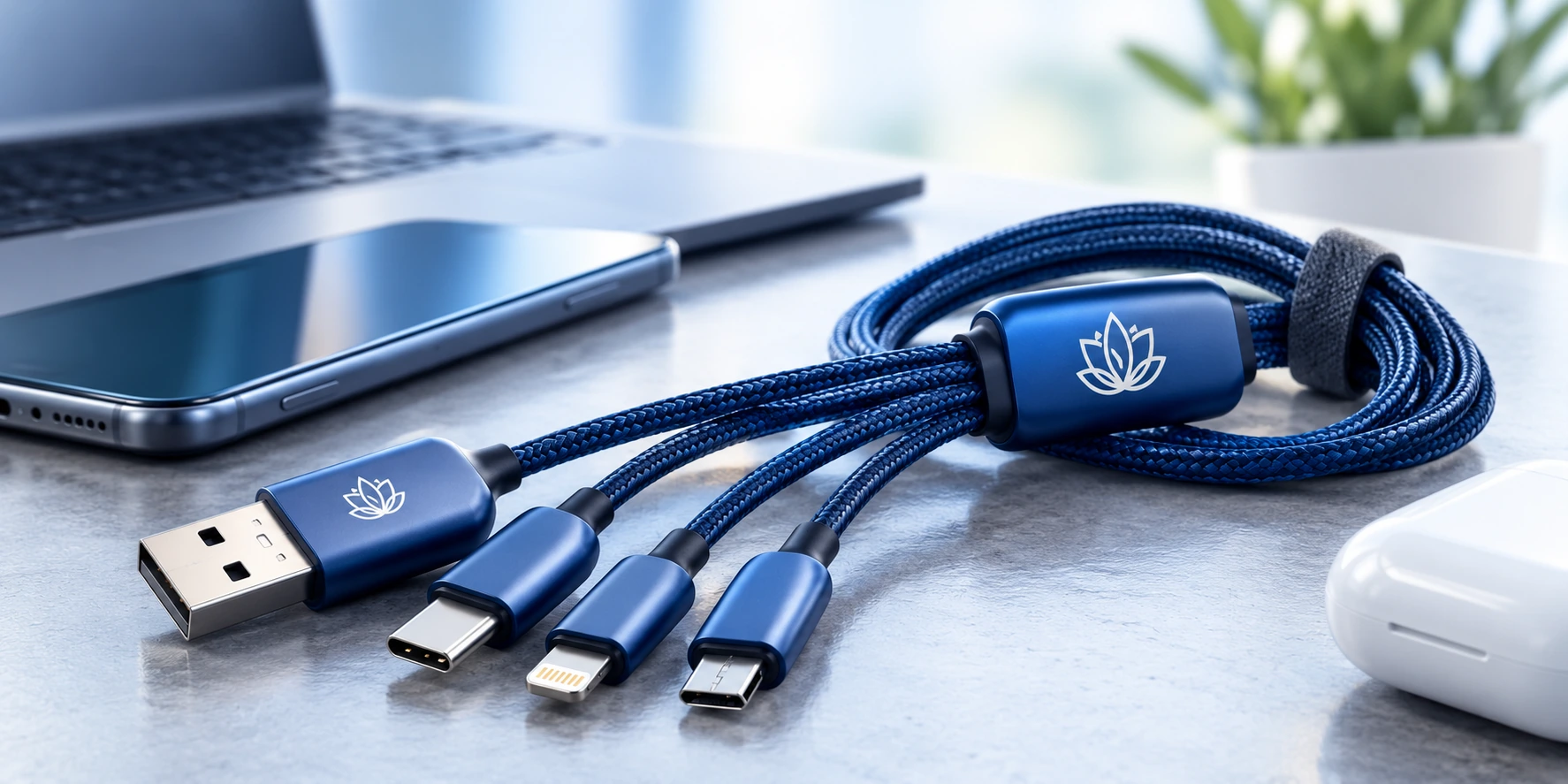
Smartphones have developed from simple communication devices into tools for work, payments, navigation, entertainment, and personal organization. As people depend on them for more tasks, access to a reliable charging cable has become increasingly important.
For businesses, this creates an opportunity to offer a promotional item that has a practical purpose. A branded cable can remain in a desk drawer, travel bag, vehicle, or meeting room and be used repeatedly. That gives it a different role from a flyer or other short-lived marketing material.
However, usefulness depends on quality and compatibility. A cable that charges too slowly, does not fit the recipient’s devices, or fails after limited use is unlikely to create a positive impression. The product itself must be useful before the branding placed on it can deliver value.
The Psychology of Functional Gifting
Academic evidence about promotional merchandise is more limited than industry marketing sometimes suggests. Still, a 2021 peer-reviewed study based on two controlled laboratory experiments found that people responded more positively to an unfamiliar brand after incidentally using its promotional merchandise. The effect appeared even when participants did not consciously notice the logo, but it did not extend to a familiar brand.
Quality also matters. A separate peer-reviewed study found that low-quality giveaways could reduce attitudes toward the sponsoring brand in an experiment involving 678 people. A second experiment involving 104 people found that personalization could help.
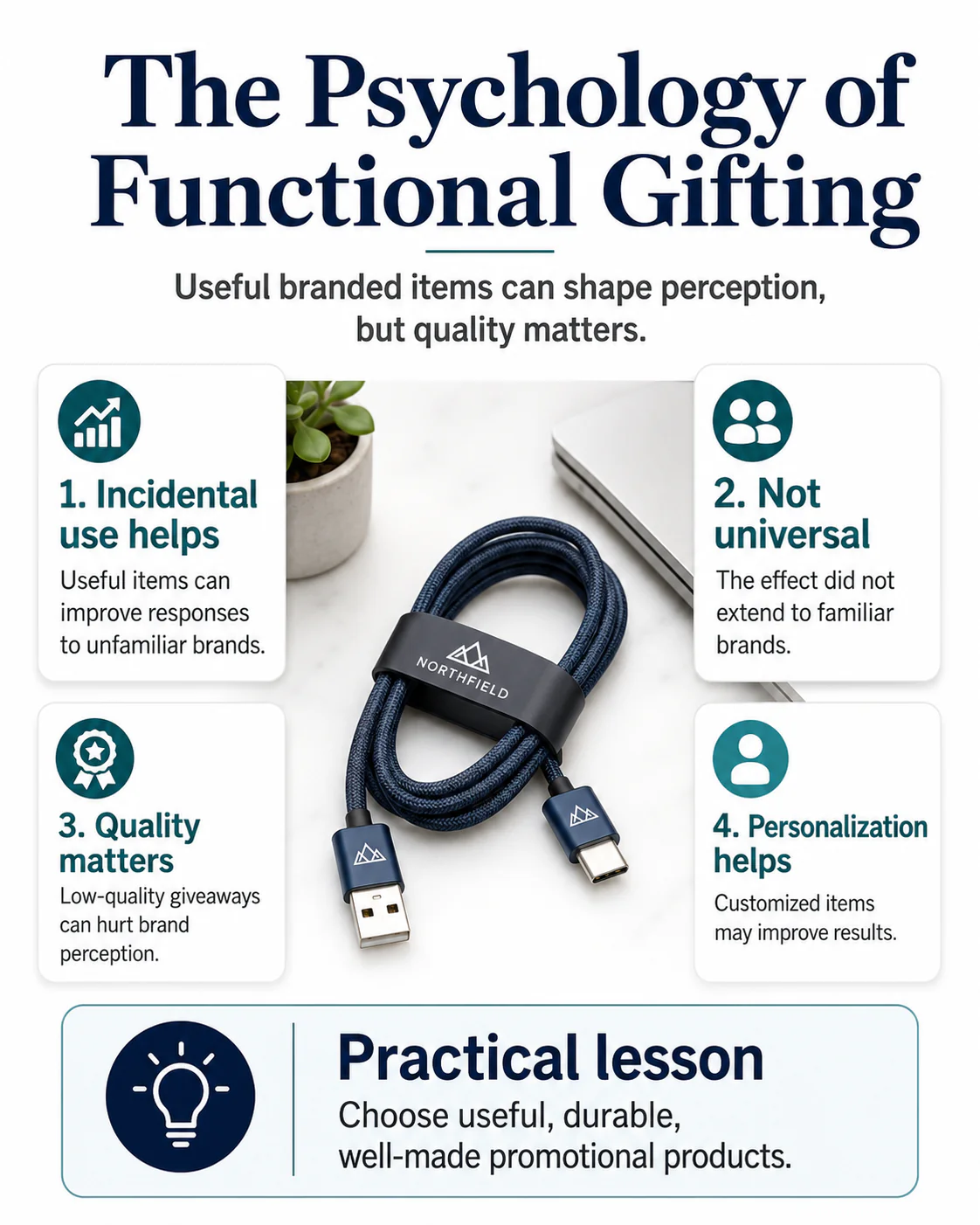
The practical lesson is that promotional merchandise should not be treated as a guaranteed route to loyalty or sales. A useful, durable, and well-chosen item may support brand recognition, while a poor-quality product can produce the opposite effect.
Why Charging Cables Are the Gold Standard of Promotional Merchandise
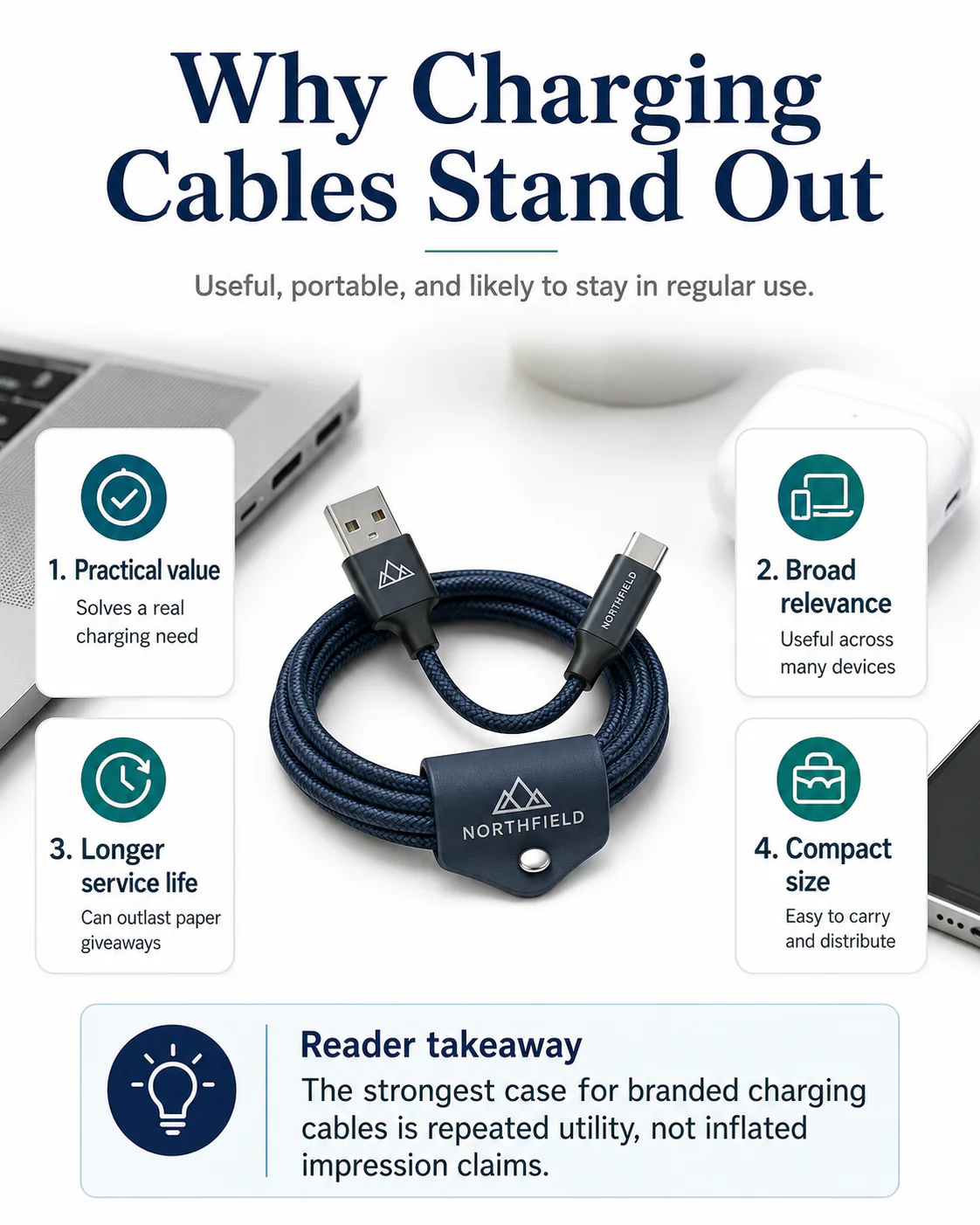
Charging frequency varies according to the device, battery condition, and user behavior, so a fixed number of annual brand impressions is difficult to substantiate. The stronger case for charging cables is repeated utility. A cable that remains in regular use can create recurring exposure to the brand printed on it.
- Practical value: A cable solves a recognizable problem when a phone, tablet, headphones, or another device needs power.
- Broad relevance: Most clients and employees use rechargeable electronic devices, although the connector and power requirements may differ.
- Potentially long service life: A well-made cable may remain useful longer than paper-based promotional materials or consumable giveaways.
- Compact size: Charging cables are easy to distribute at events and convenient to keep in a bag, desk, or vehicle.
When sourcing branded charging cables, from a provider such as Totally Branded, the product should be assessed on more than its appearance. Connector compatibility, charging performance, construction quality, and compliance documentation all influence whether the item will be useful to the recipient.
Understanding Technical Specifications for Maximum Utility
Providing a cable that does not fit the recipient’s devices is a missed opportunity. Before approving an order, buyers should consider the connector mix, maximum charging power, data-transfer capability, cable length, construction material, and intended audience.
The Rise of the Multi-Cable Solution
Multi-connector cables commonly combine USB-C, Micro-USB, and Lightning outputs. This can make them useful for a mixed audience that owns newer phones, older accessories, wireless headphones, power banks, and other rechargeable products.
USB-C is now the more future-oriented option for many new devices. Apple states that iPhone 15 and later models use USB-C. Lightning remains relevant for older Apple devices and accessories, while Micro-USB continues to appear on some older electronics.
For products that include a Lightning connector, Apple recommends using certified accessories carrying the MFi badge. Apple warns that counterfeit or uncertified Lightning accessories may fail to charge or sync correctly and could become damaged or overheat.
Connector Shape Is Not the Full Specification
USB-C describes the connector, but it does not by itself guarantee a particular charging rate, data speed, or video capability. According to the USB Implementers Forum, USB-C-to-USB-C cables going through its compliance program must carry a 60W or 240W power marking. With the exception of USB 2.0 cables, compliant cables must also display the data rate they support.
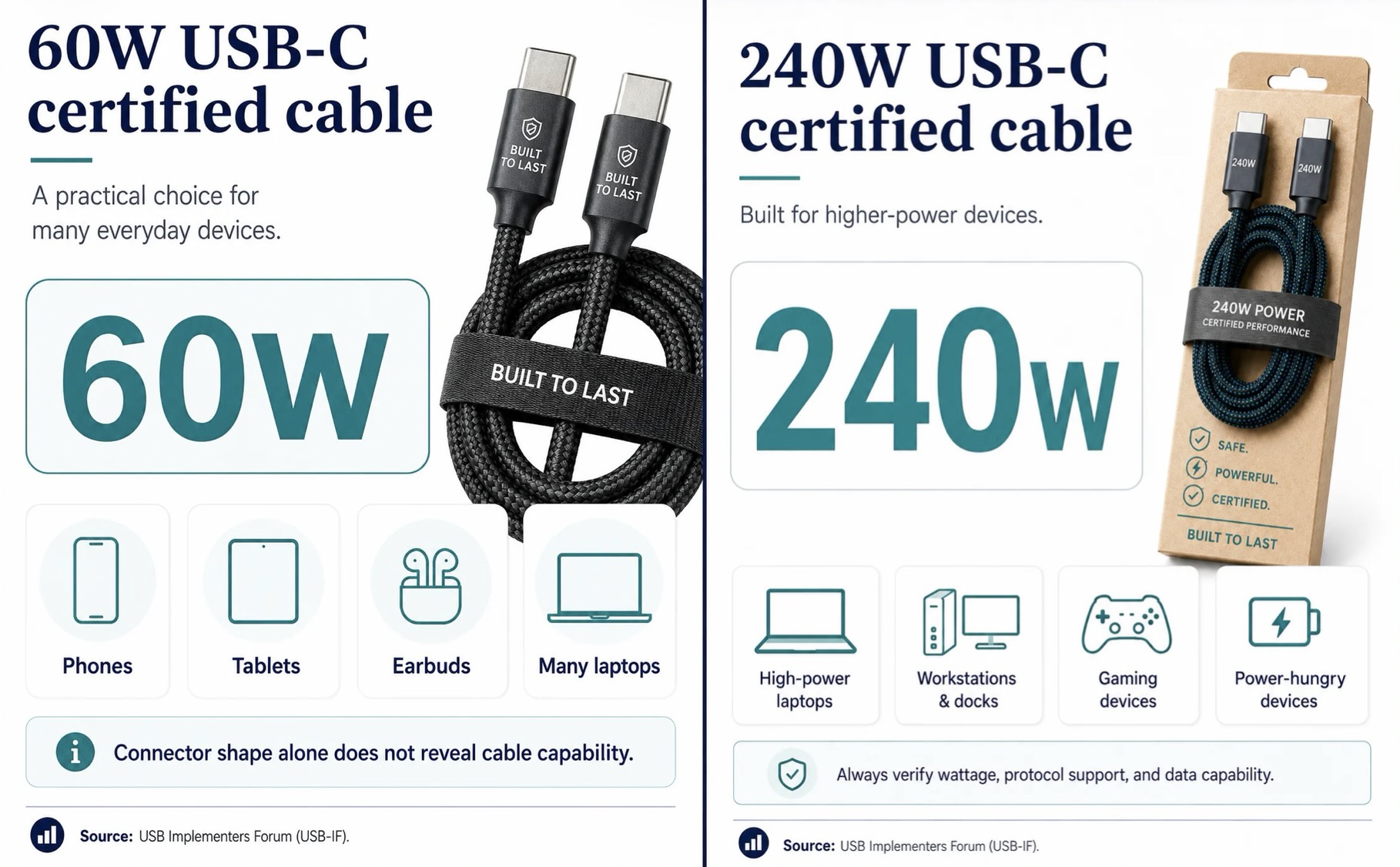
This is important because two cables can look similar while having very different capabilities. Some promotional cables support charging only, while others support both charging and data transfer. On multi-connector products, the capabilities may also differ between outputs.
Power Delivery and Data Transfer
A current rating such as 2.4A does not tell the whole story. Charging speed depends on the power source, cable, charging protocol, and receiving device. USB Power Delivery 3.1 can support up to 240W, but only when the charger, cable, and device are all designed to support the required power level.
Before placing a bulk order, ask the supplier for the following information:
- The input and output connector types
- The maximum supported wattage
- Whether the cable supports USB Power Delivery or another fast-charging protocol
- Whether it supports data transfer as well as charging
- The data speed, if applicable
- Whether any Lightning connector is MFi-certified
- The cable length, warranty, and available test documentation
A physical sample should also be tested with the types of devices the intended audience is likely to use.
Strategic Distribution and Targeted Audience Engagement
A useful product can still underperform if it reaches the wrong audience. The distribution method should be matched to the campaign’s purpose and the devices recipients are likely to own.
Charging cables can work particularly well at trade shows and conferences, where attendees often use their phones for event apps, messaging, navigation, photographs, and networking. Offering a charging accessory can solve an immediate problem and provide a natural opening for a conversation.
- New employee onboarding: A cable can be included in a welcome pack alongside other practical workplace accessories.
- Executive gift sets: A higher-specification cable can be paired with a compatible power bank or travel adapter.
- Event sponsorship: Cables can be distributed near charging stations or included in attendee packs.
- Travel-focused campaigns: Compact or retractable designs may be more useful for recipients who regularly work away from the office.
A USB-C-first product may be appropriate for a technology-focused or professional audience using recent devices. A multi-connector model may be better for a public event where the device mix is less predictable.
When working with Totally Branded for event merchandise, businesses can also coordinate cables with related accessories. The important point is to keep the product range consistent in quality, appearance, and intended use.
Design and Customization Techniques for Premium Branding
Charging cables offer several branding options, including printed or engraved housings, custom-colored trims, braided cable finishes, and illuminated logos. The most suitable approach depends on the available branding area, order size, budget, and intended setting.
Logo Placement and Lighting Effects
Some products include an LED-backlit logo that becomes visible when the cable is connected to a power source. This can make the branding more noticeable in vehicles, offices, event venues, and other low-light settings.
Because the branding area is usually small, a simple logo often works better than a detailed design or long message. Buyers should request a digital proof and, where possible, a physical sample to check legibility before production begins.
Packaging as a Branding Tool
Packaging can provide space for information that will not fit on the cable itself. A pouch, card, or box can explain the supported connectors, power rating, data capability, environmental attributes, and any relevant disposal instructions.
A campaign-specific QR code can also be placed on the packaging. This can direct recipients to setup information, a landing page, a digital business card, or a special offer while making campaign response easier to measure.
Sustainability and the Future of Electronic Promotional Products
Some promotional cables are marketed as containing recycled plastic, recycled aluminum, recycled PET, plant-based composites, bamboo, or other alternative materials. These descriptions should be checked carefully. A material claim may apply only to the housing, cable covering, packaging, or a limited percentage of the finished product.
The scale of electronic waste makes durability and end-of-life handling important. According to the Global E-waste Monitor 2024, the world generated 62 million metric tons of e-waste in 2022. Only 22.3% was documented as properly collected and recycled. The total is projected to reach 82 million metric tons by 2030.
Environmental claims should therefore be specific and supported by evidence. The UK Competition and Markets Authority’s Green Claims Code says claims should be truthful, accurate, clear, substantiated, and considered across the product’s life cycle.
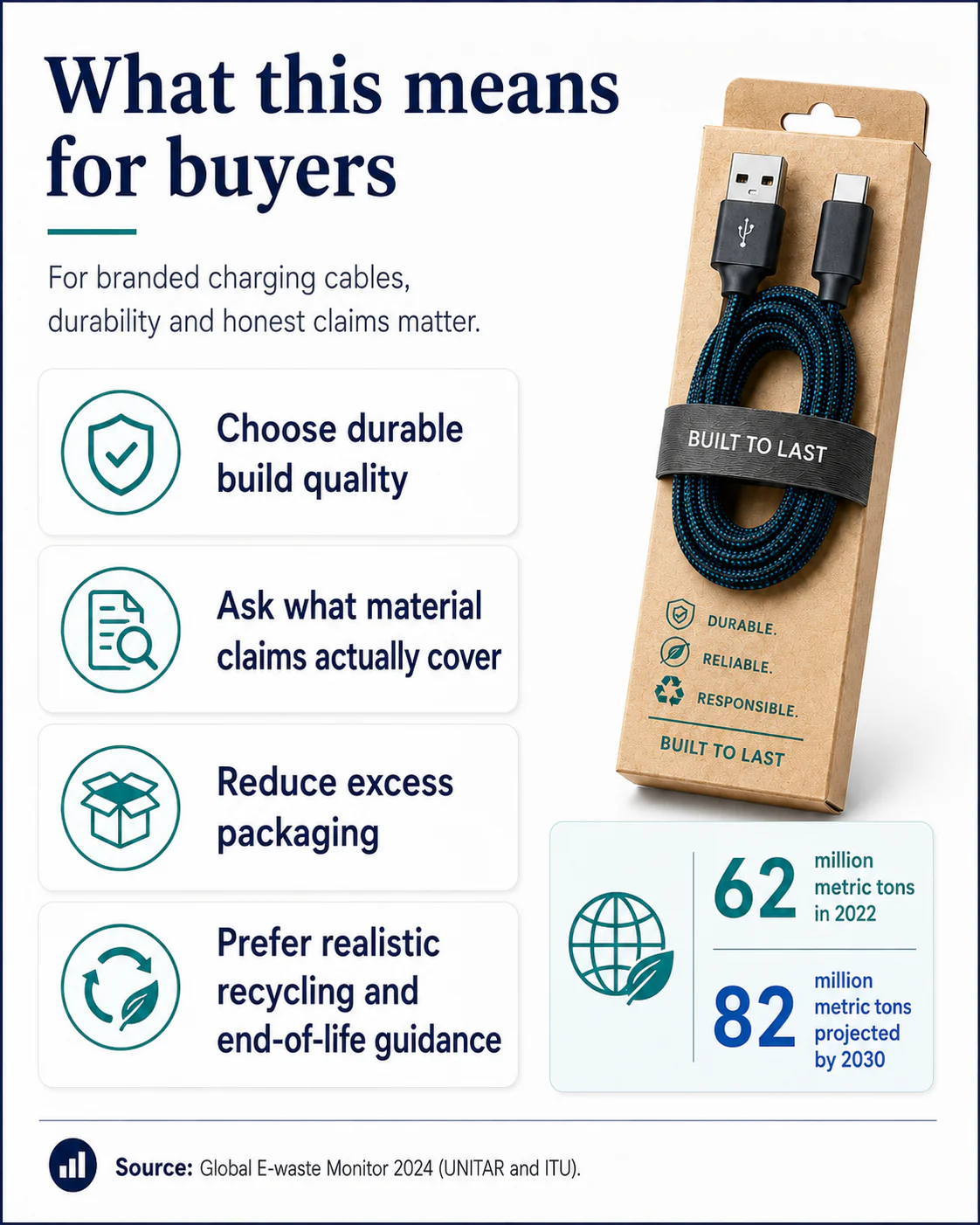
Instead of accepting a broad description such as “eco-friendly,” buyers should ask:
- Which component contains the claimed material?
- What percentage of the finished product is recycled or renewable?
- Is the material claim independently certified?
- Can the product or any of its parts be recycled through a realistic local route?
- What packaging is included, and can it be reduced?
- Is there a replacement, warranty, or takeback process?
A durable cable that remains useful is generally preferable to a disposable novelty item. However, businesses should avoid claiming that a product reduces electronic waste unless they have evidence supporting that specific claim.
Integrated Marketing Strategies and Measuring Return on Investment
A branded charging cable should be connected to a wider campaign rather than distributed without a plan. A unique QR code or short URL can link the physical item to a campaign-specific landing page and create a measurable response.
Tracking the Impact
Physical promotional items are harder to measure than digital advertisements, but their performance can still be assessed using practical metrics:
- Scan rate: Unique QR-code scans divided by the number of items distributed
- Qualified lead rate: Qualified leads divided by the number of items distributed
- Cost per qualified lead: Total campaign cost divided by the number of qualified leads
- Conversion rate: Completed purchases, registrations, or another defined action divided by unique campaign visits
- Item retention: The percentage of surveyed recipients who still have or use the cable after 30 or 90 days
- Brand recall: The percentage of surveyed recipients who correctly remember the brand connected to the item
Where possible, compare results between events, recipient groups, or different promotional products. Client retention should not be attributed to the cable alone without a comparison group or other supporting evidence.
Using the same supplier across a large campaign can make branding, packaging, specifications, and product quality more consistent. Businesses should still inspect samples and verify that bulk production matches the approved version.
Selecting the Right Partner for Your Promotional Technology Needs
Electronic promotional products require more due diligence than many traditional giveaways. A supplier should be able to explain the product’s connector compatibility, power rating, data capability, materials, branding method, minimum order quantity, lead time, and available documentation.
CE and UKCA are conformity markings rather than independent quality awards. RoHS is a legal restriction on hazardous substances rather than a general product-safety certificate. The applicable requirements depend on the product and the market in which it will be sold or distributed.
For products covered by the relevant rules, ask for:
- The applicable Declaration of Conformity
- Supporting technical or test documentation
- Product, type, batch, or serial identification
- The name and contact details of the responsible manufacturer or importer
- The applicable CE, UKCA, or other conformity marking
- Confirmation of compliance with relevant hazardous-substance restrictions
UK RoHS guidance states that products within its scope, including cables, require supporting technical documentation, a Declaration of Conformity, required labeling, and the appropriate conformity marking. Requirements differ between Great Britain, Northern Ireland, and the European Union, so the destination market matters.
End-of-life responsibilities should also be checked. Under the UK’s Waste Electrical and Electronic Equipment rules, businesses that import covered electrical or electronic equipment or sell it under their own brand may be treated as producers. The exact obligations depend on the product and supply arrangement.
When sourcing from a supplier such as Totally Branded, request samples, digital proofs, documentation, and written confirmation of the final specification before approving a bulk order. This is especially important when the same product is available with several connector, material, or power options.
Future-Proofing Your Brand in a Rapidly Changing Digital Landscape
USB-C is becoming the default connector across a growing range of portable devices. The European Union’s common-charger requirements have applied to mobile phones and several other categories of portable electronics since December 28, 2024. They have applied to laptops since April 28, 2026.
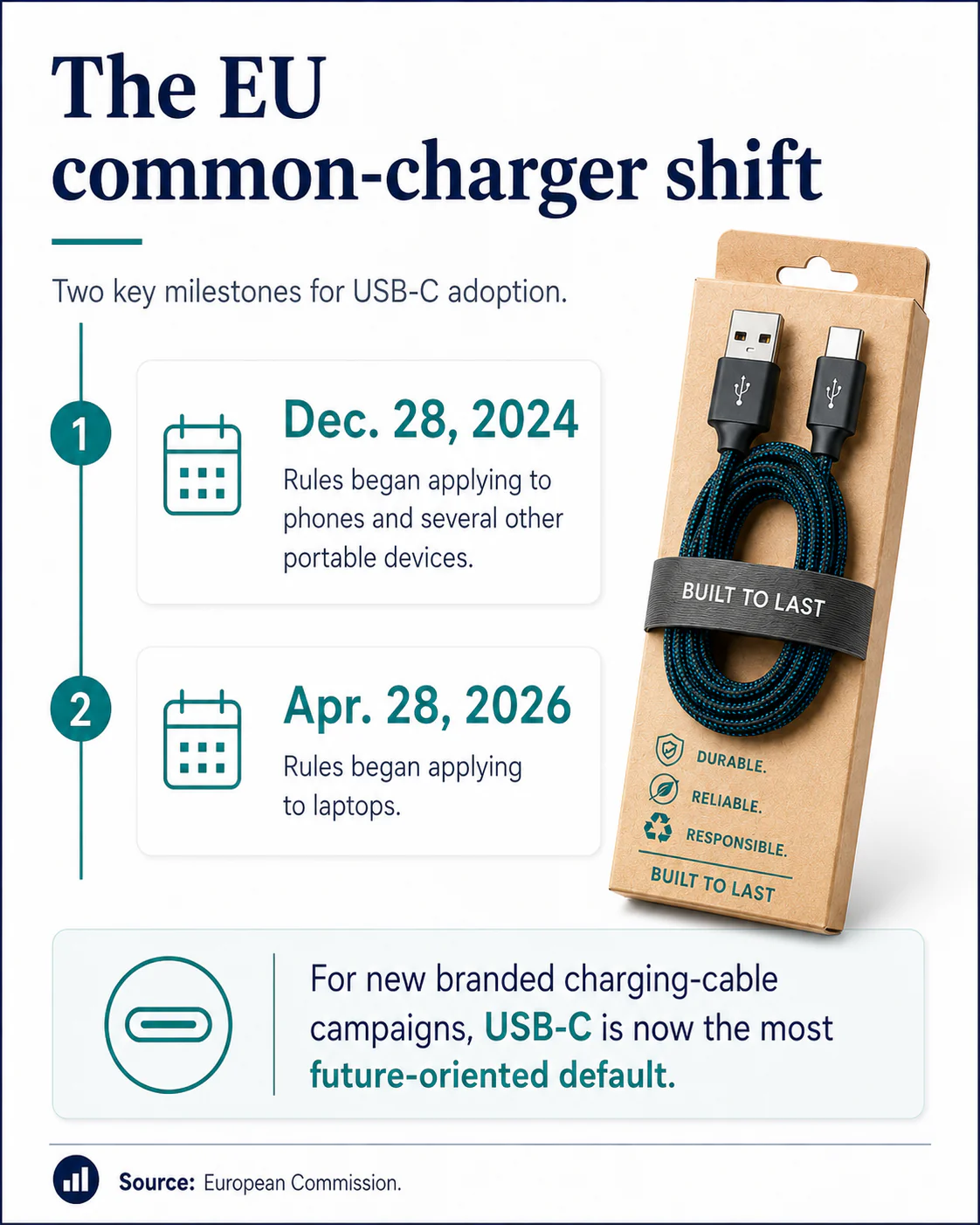
The European Commission estimates that the common-charger measures could reduce electronic waste by 980 metric tons per year and save consumers at least €250 million annually on unnecessary charger purchases.
These changes make USB-C a sensible starting point for many new campaigns. Lightning support may still be useful for audiences using older Apple devices, while Micro-USB may remain relevant for older accessories. The correct balance depends on the intended recipients rather than on a single connector being suitable for everyone.
Adapting to New Standards
Wireless charging does not make cables obsolete because charging pads still require a wired connection to a power source. Wired and wireless charging also vary according to the device, charger, cable, protocol, and operating conditions.
The more useful question is whether a promotional cable supports the devices and power levels its intended audience actually uses. A cable that provides the right connectors, sufficient power, clear specifications, and dependable construction is more likely to remain useful as technology changes.
Building Lasting Connections
The purpose of a promotional item is to create a useful point of contact between a business and its audience. A branded charging cable can do that when it performs reliably and reaches people who genuinely need it.
The strongest campaigns match the product to the audience, test its technical performance, verify its compliance documentation, substantiate environmental claims, and measure what happens after distribution. That approach turns a simple branded accessory into a more credible and useful part of a wider marketing strategy.
