
Government-backed scientists in the United States are to develop ways to mass-produce seaweed as a biofuel for cars and trucks.
The Department of Energy (DOE) is funding 18 projects to the tune of $22 million to make tools for turning “marine biomass” into fuel for transportation and bio-based chemicals.
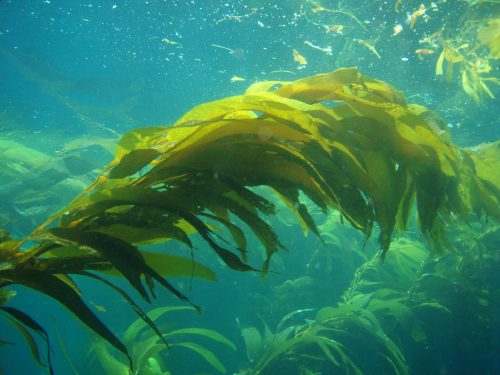 Projects led by the DOE Pacific Northwest National Laboratory in the U.S. are to develop technologies to allow cars and trucks to run on biofuel made from seaweed. The kelp in this picture is an example.
Credit: National Oceanic and Atmospheric Administration
The Macroalgae Research Inspiring Novel Energy Resources (MARINER) initiative comes under the DOE’s Advanced Research Projects Agency-Energy (ARPA-E) program.
‘Global leader of marine biomass’
The aim of MARINER is to make the U.S. a “global leader in the production of marine biomass.”
“From Alaska to the Gulf Coast, the United States has offshore resources capable of producing enough seaweed to handle as much as 10 percent of our demand for transportation fuel,” says Eric Rohlfing, ARPA-E Acting Director.
At present, seaweed, which scientists call macroalgae, is mainly cultivated as human food.
Under pressure to move away from fossil fuels, countries are looking for alternative, renewable sources of energy that are “carbon neutral.”
At first, it looked as though producing biofuels from land-based crops might solve the problem. However, there are several reasons why this might not be such a good idea.
For example, growing crops like soybean and corn requires land preparation, water, fertilizers, and pesticides. The energy consumed in meeting these needs could exceed the energy that the crops yield as biofuel.
Turning theory into practice
The aim of MARINER is to develop technologies that provide “economically viable, renewable biomass for energy applications without the need for land, fresh water, and synthetic fertilizers.”
The idea to use seaweed to make liquid and gas biofuels has been topical for a while. In theory, it appears to be the ideal biofuel crop. But, in practice, it will take a lot of serious investment to overcome the economic and technical challenges involved in making seaweed fuel into a viable green industry.
Two of the MARINER projects, led by the DOE Pacific Northwest National Laboratory (PNNL), are to investigate some of these challenges and come up with workable solutions.
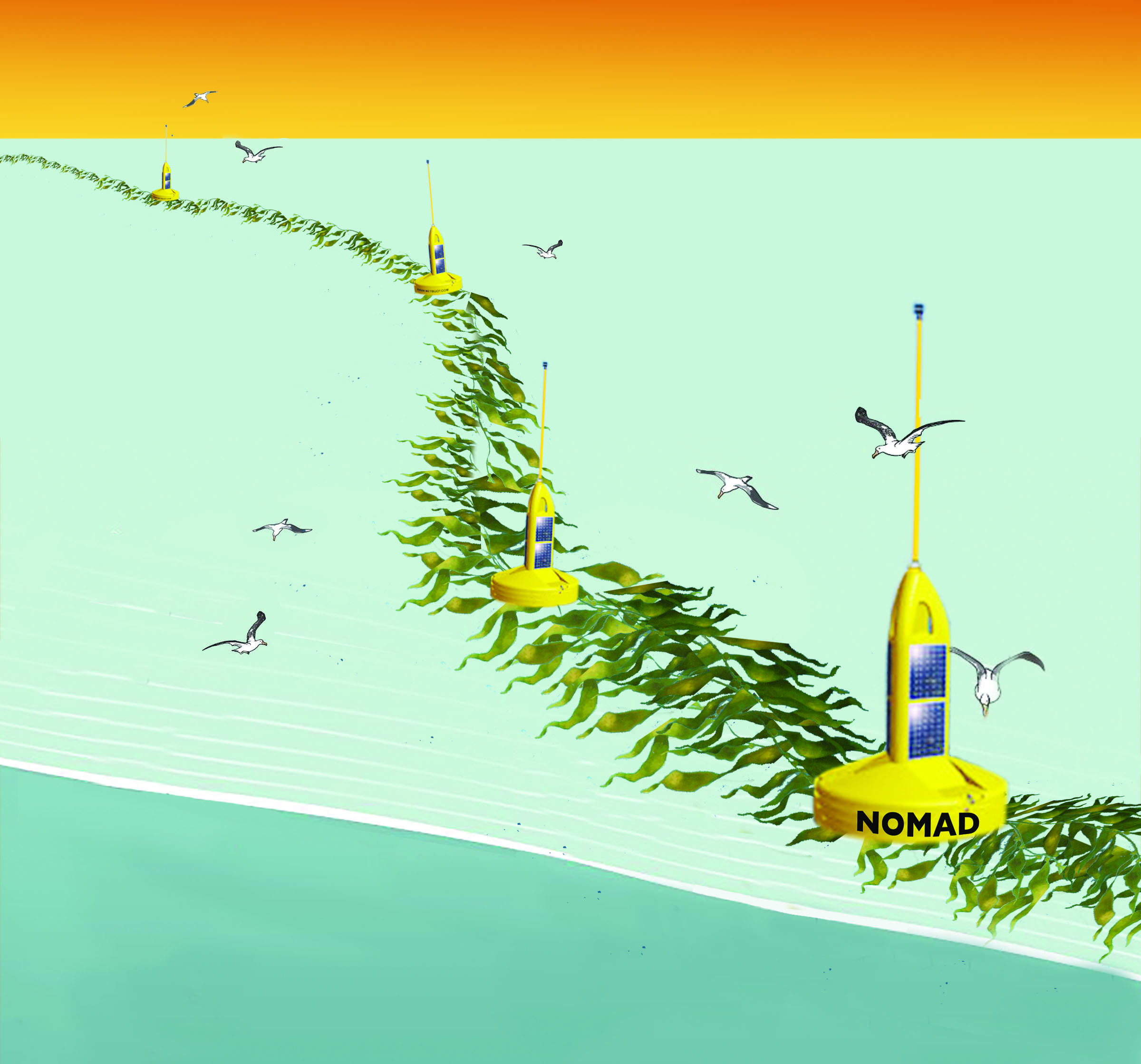
 In the NOMAD system, the seaweed grows along 5-kilometer ropes that free-float in open-ocean farms.
Credit: Reliance Laboratories.
Where to grow the seaweed
An easy question to ask, but a hard one to answer, is where and when to grow the seaweed efficiently and effectively.
This project that is addressing this question is to receive more than $2 million over 2 years to come up with some answers.
Seaweed growers will need to do a lot of “number crunching” to predict the best times and places to grow seaweed efficiently in “open-ocean farms.”
The project team will review existing modelling methods and create new tools to do the number crunching.
Seaweed growers could then use the tools to assess seaweed growth potential and availability of nutrients. They could also use them to estimate the extent to which weather, currents, tides, waves, wind, and storm surges might affect productivity.
PNNL will be collaborating with Georgia Tech, Los Alamos National Laboratory, and Oregon State University on the project.
‘Autonomous cultivation’ of seaweed
Another PNNL-led project – the Nautical Offshore Autonomous Device (NOMAD) – is to develop an “autonomous cultivation system” for farming seaweed.
NOMAD will receive an initial injection of $500,000 over 12 months. This may be topped up with additional funds later.
The idea of NOMAD is that the seaweed grows along a 5-kilometer carbon-fibre rope made of waste material from the aviation industry.
The rope and seaweed growing on it – called the “longline system” – will keep afloat with the aid of free-floating buoys equipped with an array of sensors.
The sensors will keep track of vital data for managing the longline system, such as its position, how fast it is moving, and how much light it is exposed to under water.
Programs will then automatically use the tracking data to work out how fast the seaweed is growing in the longline system. The project will initially test two species of kelp.
PNNL’s collaborators on this project are: Colorado State University, Composite Recycling Technology Center, Reliance Laboratories and Marine Agronomics, LLC.
