
EU residents spent €379.4 billion on trips abroad in 2025, exceeding the €266.2 billion spent on domestic trips, although journeys within their own countries accounted for 70% of the total.
The contrast, set out in Eurostat figures released on 9 October, gives travel businesses two different pictures of demand. Domestic travel provides most journeys, while foreign travel accounts for more expenditure.
Residents made 1.20 billion personal and professional trips last year, 1.4% more than in 2024. Some 848 million were domestic and 264 million went to another EU country. Together, those categories represented 92% of trips.
Accommodation and transport take much of the budget
On foreign trips, residents spent €131.3 billion on accommodation and €121.5 billion on transport. Those categories represented 35% and 32% of expenditure respectively.
Foreign travel in these figures includes both other EU countries and destinations outside the bloc. The €379.4 billion should therefore not be described as spending entirely within the EU.
The totals also measure travellers’ expenditure, not the revenue or profit of a particular hotel, airline or booking platform. A company’s share depends on the destinations, services and customers it serves.
Domestic travel varies sharply between countries
Domestic journeys made up 89% of trips by Romanian residents and 87% of those by Spanish residents. Luxembourg recorded the smallest domestic share at 5%, followed by Belgium at 29% and Malta at 32%.
These are shares of journeys made by each country’s residents. They do not rank countries by the number of visitors they attract, nor establish why residents chose a particular destination.
For a travel business, the relevant market can consequently differ from the EU average. A domestic-focused operator and a specialist in overseas trips may face different customer mixes even when overall travel grows.
The count covers overnight tourism
Eurostat’s statistical definitions generally cover residents aged 15 and over making personal or business trips with at least one overnight stay. The headline total is not a count of daily commutes, shopping journeys or every border crossing.
Expenditure covers purchases for and during the trip, including transport and accommodation. It can be incurred before departure as well as at the destination.
Transport’s share of foreign-trip spending also gives context to our earlier examination of competition between high-speed rail and short-haul flights. Travellers compare fares alongside total journey time and convenience. The Eurostat release does not identify how much of the reported expenditure went to each transport mode.
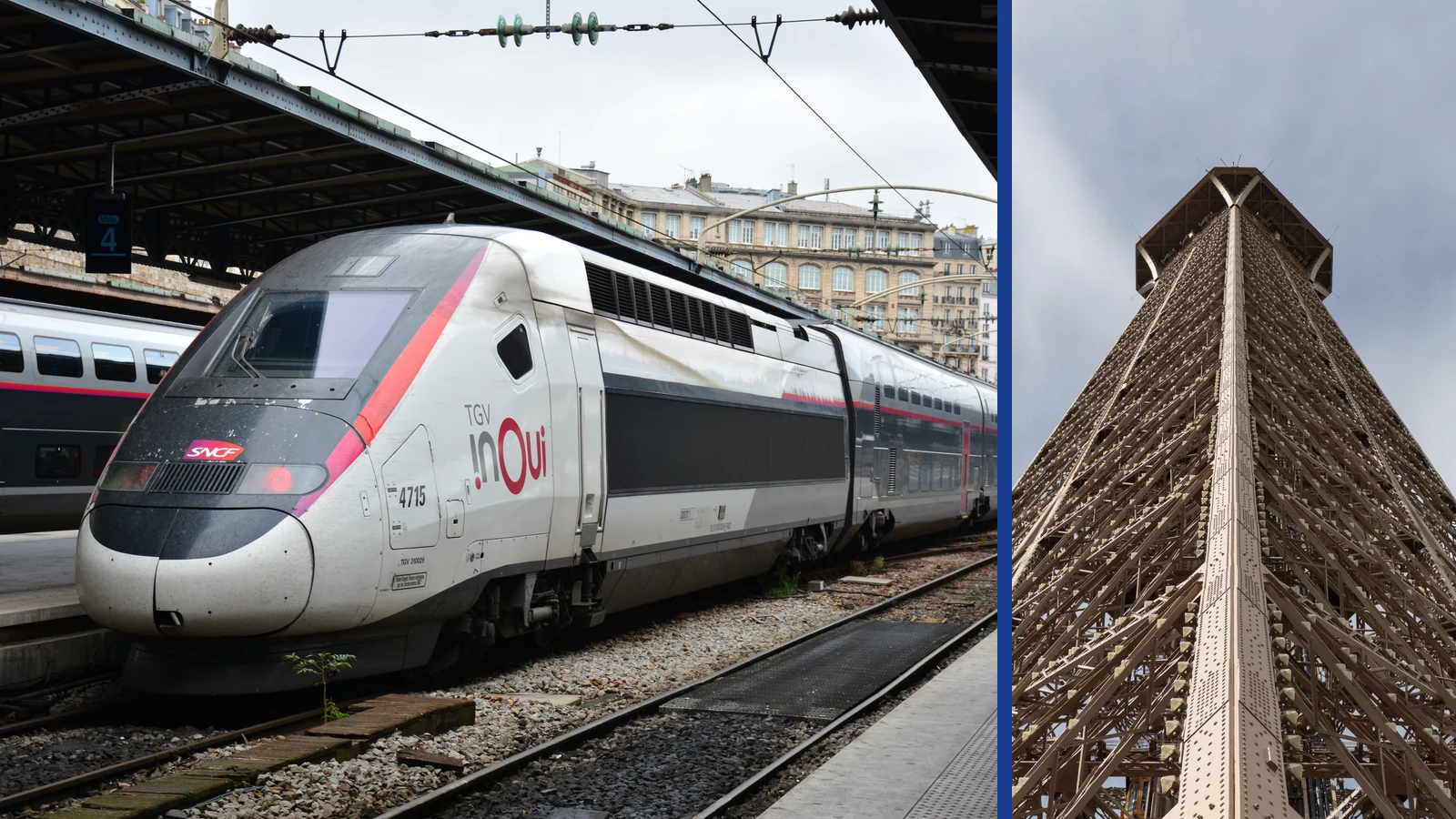
Cover: An SNCF TGV at Paris Gare de l’Est in 2019 and an upward view of the Eiffel Tower in 2015, shown separately. Representative archival travel imagery, not one journey or event. Photograph: Cheng-en Cheng (CC BY-SA 2.0). Photograph: William Crochot (CC BY-SA 4.0). Cropped and arranged by Market Business News. Adapted cover licensed CC BY-SA 4.0.
