

Bundesbank economists are still optimistic about the German economic outlook for the next three years, even if Q2 growth has not been as buoyant as it was in Q1. They forecast 1.9% GDP growth for 2014, then 2% in 2015 and 1.8% in 2016.
Germany’s statistical agency Destatis attributed Q1 strong growth to stronger domestic demand, which was partly due to a very mild winter.
Bundesbank President, Jens Weidmann said regarding the latest projection:
“Germany’s strengthened domestic economy as well as the ongoing improvement in the economic situation of the industrial countries and the gradual recovery of the euro area suggests that Germany will follow a robust growth path.”
Mr. Weidmann warned that a tighter labor market shaped by demographic change later on could undermine growth.”In light of these changes, measures such as the option of drawing a full pension at 63 will not help,” he explained.
Aggregate output
Starting from a normal level, aggregate capacity utilization should increase perceptibly, given potential growth of 1.2% annually, says the Bundesbank.
With high levels of immigration, the German central bank’s economists predict continued growth in employment.
The government’s budget is expected to remain close-to-balance throughout this year and well into 2015, and then turn into surplus in 2016, due to a further decline in the interest rate burden and the country’s favorable economic situation.
However, the Bundestag’s recently approved pension legislation will undermine an improved budgetary development.
Inflation and wages
The Bundesbank economists expect the new general minimum wage and labor market shortages to push wages up. These factors could lead to an increase in consumer price inflation from 1.1% this year to 1.5% in 2015 and 1.9% in 2016.
Excluding energy, the Bundesbank team forecast an inflation rate in excess of 2% by 2016.
Possible risks
Mr. Weidmann warned that in spite of positive indicators associated with the German economic outlook, risks remain, mainly of an external setting.
Mr. Weidmann said:
“Heightened geopolitical tensions or a renewed flare-up of the crises in the euro area would dampen GDP growth not only through the external trade channel, but also by affecting confidence.”
The Bundesbank team pointed out there is considerable uncertainty regarding:
- The volume of future migration flows,
- the reserves that could potentially still be mobilized in the domestic labor market,
- the effects of the general minimum wage, and
- the option of taking early retirement at 63 years of age on a full pension.
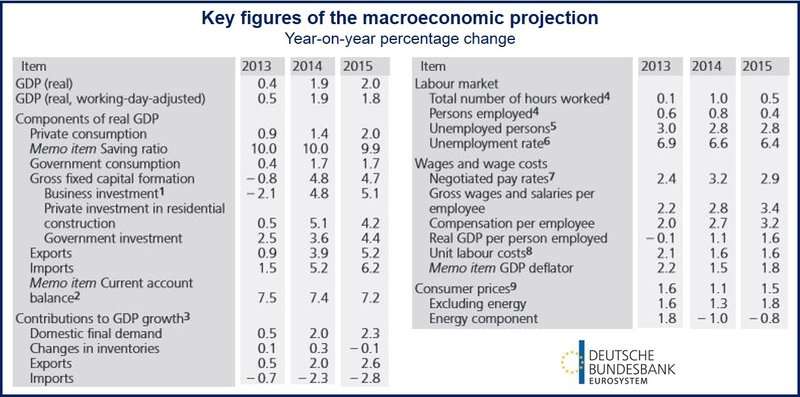
(Deutsche Bundesbank)
