
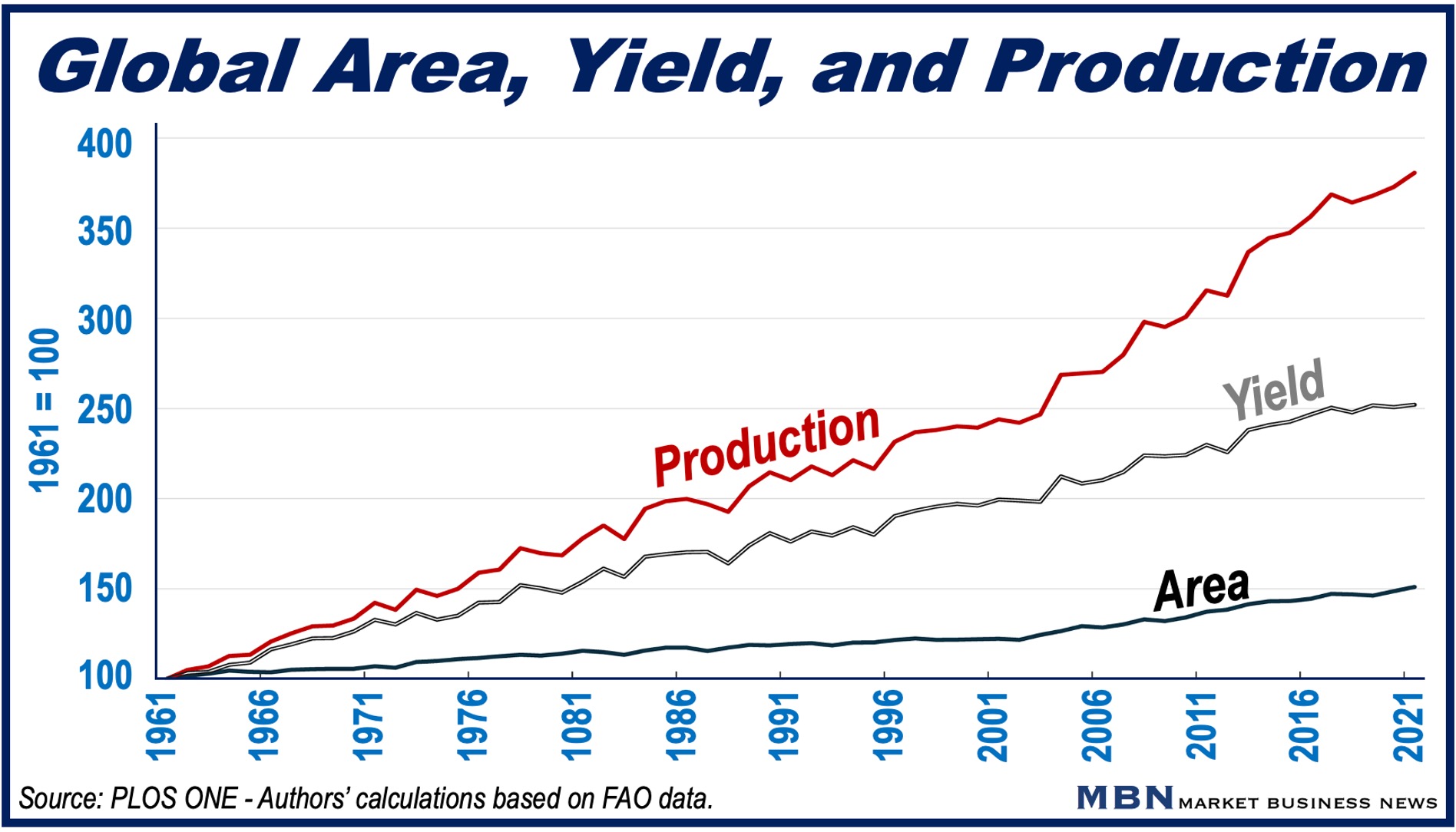
Global food yields have not stagnated in recent decades, as many people believe. Since the 1960s, yields have grown steadily, that is, at roughly the same rate, say two researchers.
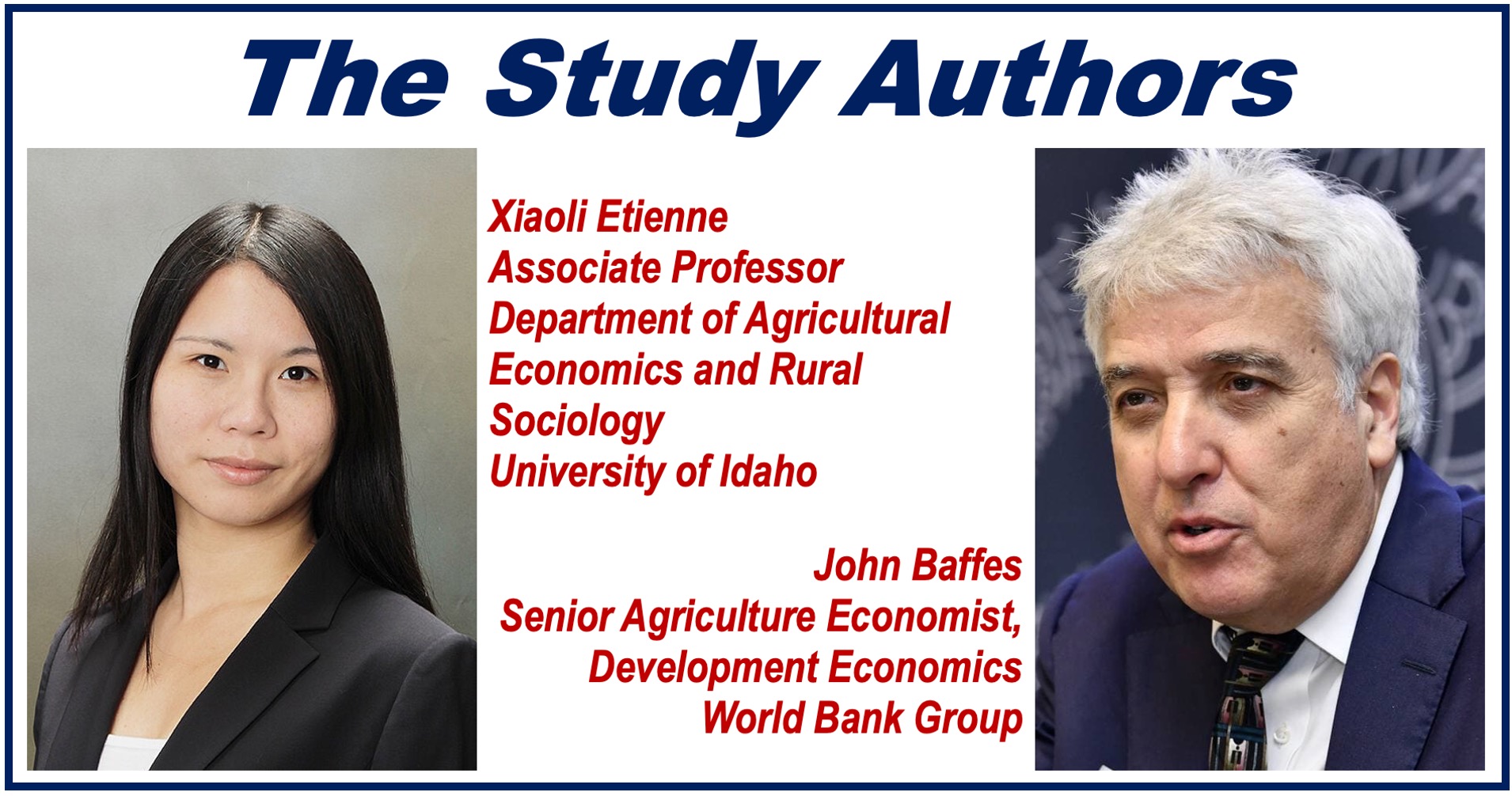
Xiaoli Etienne of the University of Idaho, U.S., and John Baffes of the World Bank, wrote about their study and findings in the peer-reviewed, open-access journal PLOS ONE (citation below).
PLOS stands for the “Public Library of Science,” which is a nonprofit publisher and advocacy organization dedicated to advancing science and medicine through open-access journals like PLOS ONE.
Global Food Yields Critical in the Future
Global food yields will become increasingly critical to feed our planet’s growing population. By the middle of this century, nearly 10 billion humans will inhabit Earth, compared to 8.2 billion today (December 2024).
Since the 1960s, much of the increase in agricultural production has been the result of technological advances such as:
- Mechanized farming equipment.
- Synthetic fertilizers.
- Improved irrigation systems.
- Precision agriculture technologies (e.g., GPS-guided tractors)
- Automated harvesting systems.
- Pesticides & herbicides.
- Genetic engineering.
- Drones for crop monitoring.
- Artificial intelligence for yield prediction.
- Hydroponics.
- Vertical farming.
- Controlled environment agriculture.
- Climate-resilient farming techniques.
- The widespread development and use of better varieties of crops.
Some studies, however, have suggested that agricultural production growth has leveled off, sparking concerns about the ability to meet future food demands, particularly in low- and middle-income countries experiencing rapid population growth.
New Study Found Yields Grew Steadily
In this latest study, Etienne and Baffes gathered and analyzed data on 144 crops covering 98% of farmland globally. They developed standardized measures for production and yield, which allow policymakers and scientists to compare agricultural productivity across various countries and regions.
Their findings showed that over the last six decades, there has been no discernable slowdown in global food yields. Slowdowns they observed in certain countries or regions were offset by gains in others.
Yields were found to have increased annually by the equivalent of approximately 33 kilograms of wheat per hectare.
Ongoing Obstacles to Global Food Security
Although the study’s findings offer reassurance regarding global food supply, the researchers warn that ensuring sustainable food production and maintaining food affordability will remain significant obstacles to achieving global food security.
How will global food yields fare as the consequences of climate change intensify? The world’s population and average incomes will continue to grow, which means that demand for food will also increase.
The authors wrote:
“Utilizing a comprehensive caloric-based index of production and yield for 144 crops, covering 98% of global agricultural land and food output, this paper reveals that, on an aggregate level, global yield growth—a vital indicator of agricultural productivity—has not slowed over the past six decades.”
“This steady growth equates to an annual increase of approximately 33 kilograms of wheat per hectare, highlighting continued productivity gains worldwide.”
Citation
Baffes J, Etienne X (2024) Yield growth patterns of food commodities: Insights and challenges. PLOS ONE 19(11): e0313088. https://doi.org/10.1371/journal.pone.0313088
