

If a completely neutral product is liked by somebody whose political views we find disagreeable, we are more likely to distance ourselves from that product.
These were the findings of four studies carried out at Linköping University in Sweden.
This type of behavior is even stronger if others are watching when we have to make a decision.
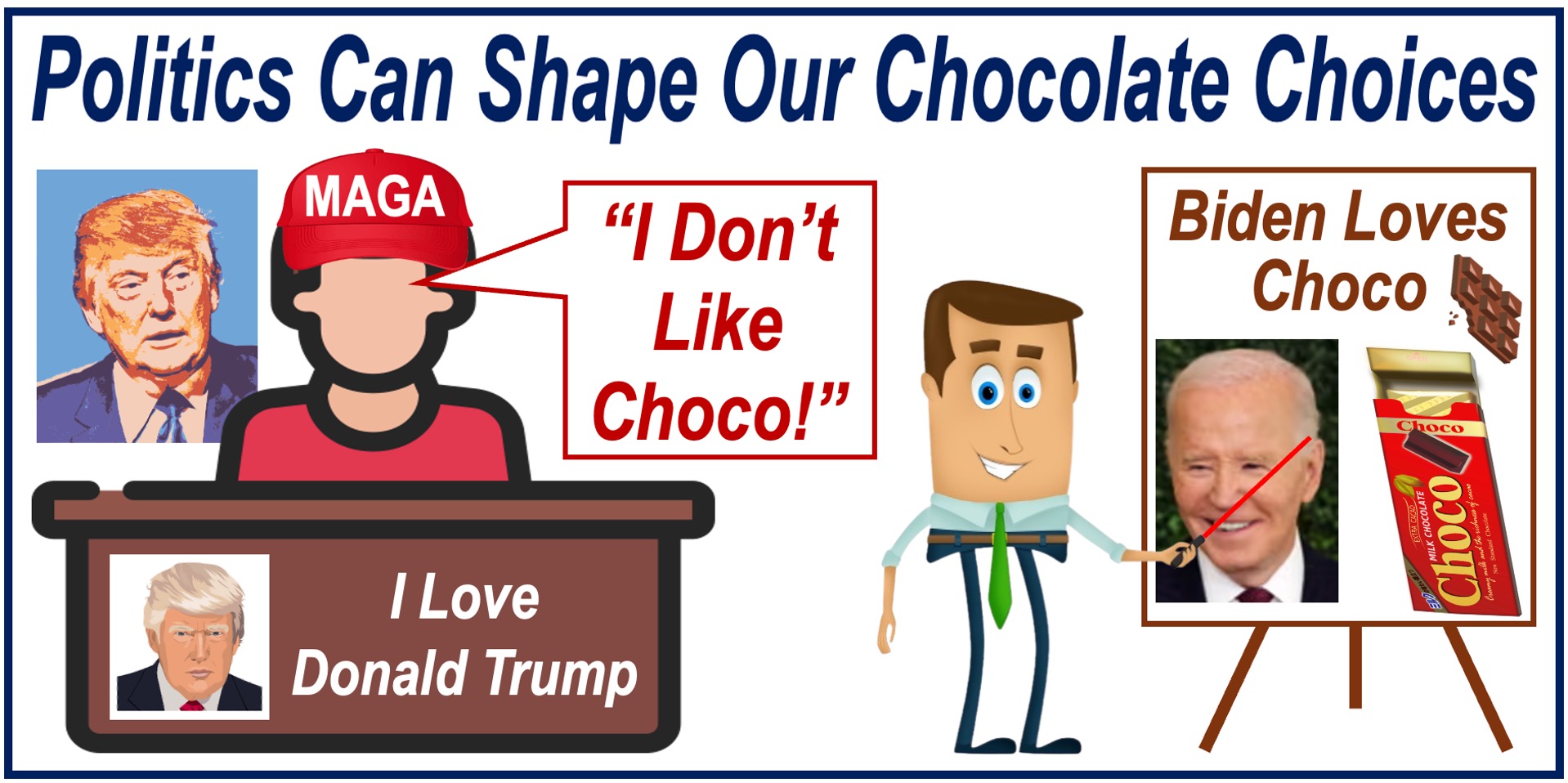
Political distancing influences our decisions more profoundly than previously recognized, shaping our preferences even in unrelated contexts. The studies showed that even a neutral product, like chocolate, can become politically charged.
Arvid Erlandsson, senior associate professor at the Department of Behavioral Sciences and Learning at Linköping University, said:
“From a social perspective, it can unfortunately be rational to distance ourselves from these neutral things, but this contributes to a more polarized society.”
Four Studies – Products and Political Views
In four separate studies, researchers gathered and analyzed data on people’s attitudes to completely non-political products before and after associating these products with individuals or groups holding differing political views.
The researchers, who wrote about their studies and findings in the peer-reviewed journal Personality and Social Psychology Bulletin (citation below), believe that theirs was the first such investigation.
-
First Study – Clothing
Over six hundred study participants were shown several pictures of individuals wearing formal clothes. The pictures did not include the people’s heads.
Participants had to comment on the clothes’ design, fit, and color. They were also asked to tell the researchers how much they would want to buy them.
The researchers also asked the volunteers about their views on political parties. They were then shown the pictures again and asked to re-evaluate the clothes, however, this time the faces of those in the images were visible.
The faces were those of well-known Swedish politicians. The participants, who were also Swedish, knew whose faces they were.
The results in the second round were not the same as in the first. The clothes of the politicians whose political parties the participants least liked were often described as less stylish than in the first assessment.
-
Second Study – Chocolate
More than 800 volunteers took part in this study. In the first round, they had to rate six well-known chocolate brands by giving each one a score. They also had to state their political stance.
In the second round, participants were divided into groups. The researchers told the members of one group that according to a previous pilot study, a specific brand of chocolate was liked best by their political opponents.
The other group was told which chocolate brand was preferred by the politicians they liked. They then rated the chocolates again.
In the second round, the chocolate that their political opponents liked got a much lower score. However, the chocolates preferred by the politicians that they liked did not get a higher score.
Prof. Erlandsson, said:
“It’s less about you associating with what your own side likes and more about avoiding what’s liked by the opposing side.”
-
Third Study – Donate to Charity
In the third study, which involved over 1,200 volunteers, researchers measured participants’ willingness to donate money to various charities.
The findings were similar to those in the first and second studies. Participants were less likely to donate to charities that they were told were preferred by political opponents.
The researchers believe we behave this way unconsciously to maintain a consistent self-image.
The participants were unaware that the pilot study revealed everyone, regardless of political beliefs, had actually favored the same chocolate brands and supported the same charities.
-
Fourth Study – Animated Faces
The last study involved 1,295 participants. As in the other studies, they had to choose between products, however, there was a difference.
In one group, the volunteers were being observed by animated faces while they made their choices. They were told that the faces belonged to individuals who shared their political views.
The study found that people were even more likely to avoid products favored by their political opponents.
The researchers concluded that we care deeply about how others perceive us.
Prof. Erlandsson said:
“Knowing about it might make you think twice, instead of just going on a gut feeling.”
Implications for Marketing and Brand Strategies
Could these findings be of interest to marketing professionals?
Understanding how political associations influence consumer behavior may help brands avoid alienating customers, prospects, and consumers in general.
Should companies consider marketing strategies to maintain neutrality or appeal to diverse audiences?
By being aware of the subconscious biases that shape consumer preferences, marketers can make informed decisions when targeting or positioning products.
The Swedish Science Council funded the research.
Citation
Erlandsson, A., Nilsson, A., Rosander, J., Persson, R., & Van Boven, L. (2024). Politically Contaminated Clothes, Chocolates, and Charities: Distancing From Neutral Products Liked by Out-Group or In-Group Partisans. Personality and Social Psychology Bulletin, 0(0). https://doi.org/10.1177/01461672241298390
