

A business gains little from a polished elevator pitch if the listener cannot tell who buys its product or what problem it solves. Artificial intelligence can help produce a fluent script, but the business still has to choose a specific audience, substantiate its claims and give that person a reason to continue the conversation.
For founders, salespeople and independent professionals, the hardest part is often deciding what to leave out. A company may serve several markets and offer dozens of features. Its opening explanation needs to give one listener enough information to judge whether a longer discussion is worth their time.
Our Marketing Business Network video, published on October 13, 2026, introduces the elevator pitch and its purpose. This guide develops that introduction into a method for writing, checking and delivering one, including how to use AI during preparation.
What is an elevator pitch?
An elevator pitch is a brief spoken explanation of a business, product, idea or professional background. It tells someone what you do, whom you help and why the subject might interest them.
The name describes a short opportunity to speak, rather than a requirement to deliver a sales presentation in an elevator. You might use one at a trade show, in a video introduction, during a supplier meeting or when a potential customer asks what your company does.
There is no universally correct duration. Our video describes roughly 20 to 60 seconds, while the Broad Institute communication guide uses about 20 seconds for its scientific pitching exercise. Treat 30 seconds as a rehearsal target, adjusting to the setting and the listener’s response.
The immediate objective is a relevant question or an agreed next step. Detailed financial analysis, technical specifications and purchasing decisions usually require more time.
Below is our video explaining the fundamentals of an elevator pitch:
Choose the listener before writing the script
A prospective customer, an investor and a potential employee have different decisions to make. An introduction that tries to answer all their questions will struggle to answer any of them clearly.
Start by naming the person you expect to speak with and the decision you want them to consider. A customer might agree to a demonstration. A distributor might assess whether your product fits its customers. An investor might agree to review your commercial evidence.
Keep the underlying facts consistent across audiences. Change the emphasis, the vocabulary and the next step. Customers and investors should hear compatible descriptions of the same product.
A competitive advantage is something that helps a business compete more effectively. Your pitch needs to explain a relevant reason to choose your offer. Calling it unique, innovative or AI-powered leaves the listener to work out what the advantage actually is.
Build the pitch around five questions
The following framework is an editorial method for preparing a pitch, not a scientifically validated scoring system. You do not have to recite five separate sentences, but you should be able to answer each question.
- Who is it for? Identify a recognizable customer or user. “Independent building contractors” is more specific than “businesses of every size.”
- What problem do they have? Describe a task, cost, delay or unmet need the listener can picture.
- What do you deliver? Name the product or service and explain what it does. Separate an available feature from one still being developed.
- What supports the promise? Use a relevant demonstration, a documented result or another verifiable fact. If you are still testing the idea, say so.
- What happens next? Ask for a step that fits the listener’s interest and the evidence available, such as reviewing a sample or arranging a demonstration.
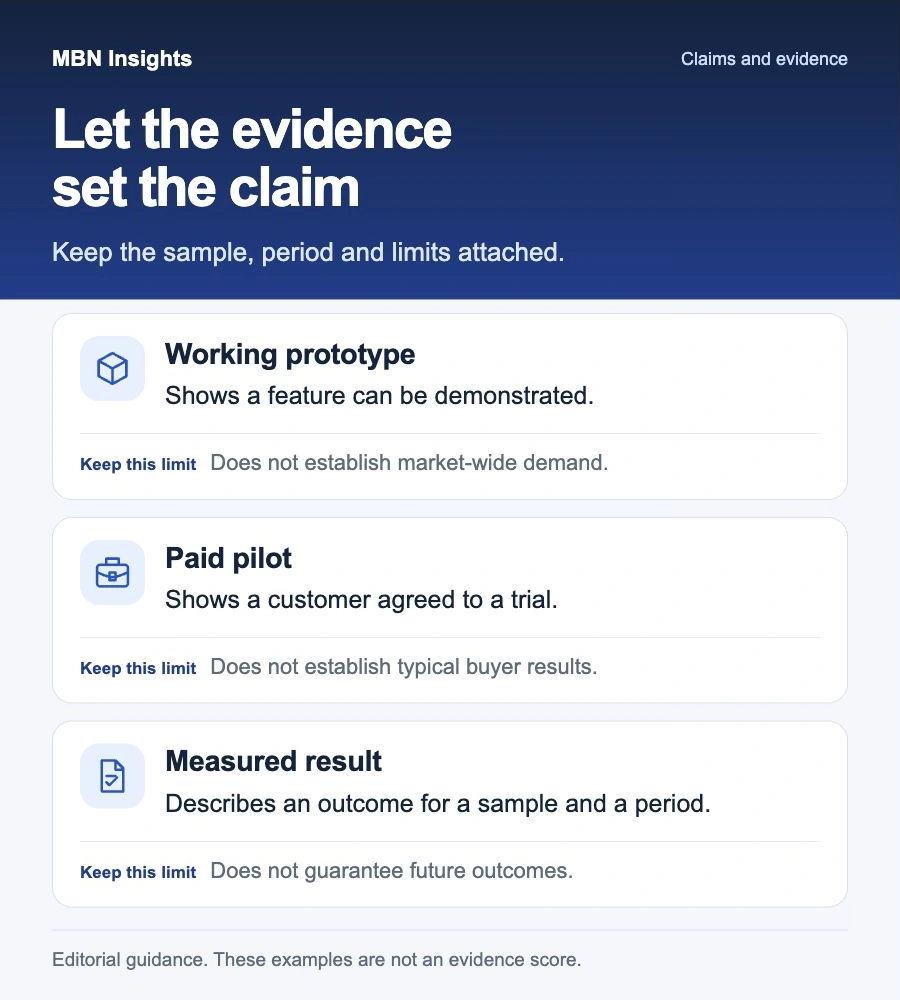
The evidence question deserves particular attention. A working prototype establishes that a feature can be demonstrated. A paid pilot establishes that a customer has agreed to test it commercially. Neither, on its own, establishes that the whole market wants it.
A business with no customers can describe its development stage and ask for feedback. Inventing traction to fill a gap in the script creates a much larger problem when someone asks for details.
A worked example shows what to cut
The examples below are fictional illustrations, not quotations from a company or claims about actual results.
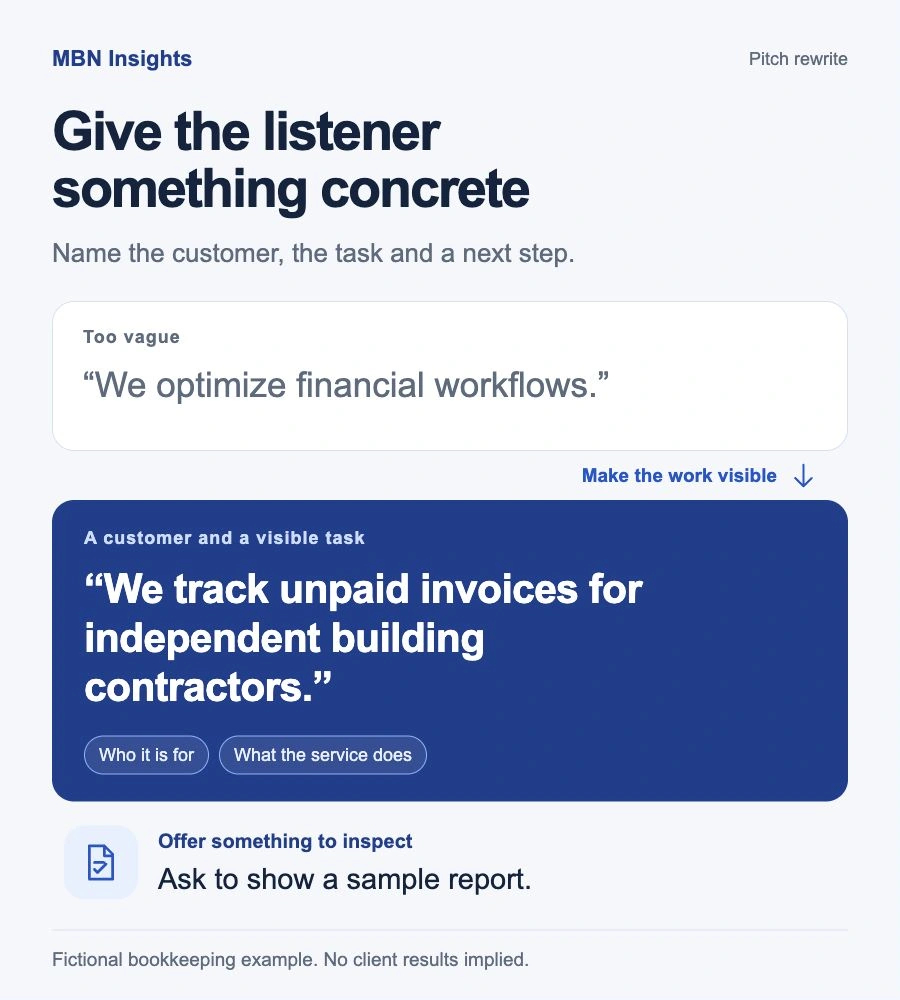
Consider this opening for a bookkeeping service.
We are an innovative financial solutions partner empowering small businesses to optimize their workflows through a comprehensive, customer-centric approach.
The sentence provides no clear picture of the customer, the work performed or the reason to buy. Replacing it with concrete tasks gives the listener something to assess.
We handle invoice records and payment follow-ups for independent building contractors, so the owner can see which bills are still unpaid. We can show you a sample weekly report. Would reviewing one help you decide whether the service fits your business?
The revised version identifies the customer, describes the service and offers a way to inspect its output. It makes no unsupported claim about the amount of time saved or money recovered.
If the business later measures those outcomes, it can add a supported result with enough context to understand it. The report should identify the period, what was measured and whether the result came from one client or several.
Research provides a reason to take specific language seriously. Grant Packard and Jonah Berger’s study in the Journal of Consumer Research combined field analysis of more than 1,000 customer interactions with controlled experiments. In the settings examined, concrete wording was associated with better customer responses, and experiments found effects on satisfaction and willingness to purchase.
The research concerned customer-service exchanges, rather than elevator pitches. Its application here is a writing recommendation, not a measured promise that a particular script will increase sales.
The next question changes with the audience
A pitch becomes easier to edit once you know what information the listener needs next.
Choose a listener to see what the introduction needs to establish.
Prospective customer
EstablishThe problem addressed, the service provided and evidence that can be inspected.
A possible next stepReview a sample or discuss their current process.
Potential investor
EstablishThe customer, how the business earns money, its development stage and the evidence gathered so far.
A possible next stepArrange a meeting to examine demand, costs and risks.
Potential partner
EstablishThe customers you could serve together and each party's contribution.
A possible next stepDiscuss a specific joint opportunity.
Hiring manager
EstablishThe work you can perform and an achievement or example relevant to the role.
A possible next stepShow work or discuss a relevant vacancy.
For an investor introduction, be ready to explain who pays and how revenue is generated. A subscription, a transaction fee and a one-off implementation project produce different commercial questions.
For a hiring conversation, keep your claimed contribution accurate. Distinguish your own work from a team’s result, and describe a completed project without exposing a former employer’s confidential information.
Use AI to challenge the pitch
Generative AI, software that produces new text and other content from instructions, can produce alternative scripts and simulate questions from different audiences. It is most helpful when you first supply the facts you can stand behind.
Write a short fact sheet containing your audience, current product, available evidence, development stage and intended next step. Ask the tool to use only those facts and flag any missing information. Then check the output for capabilities, customer names and results you never supplied.
There is evidence that AI assistance can make writing more similar. A 2024 experiment by Anil Doshi and Oliver Hauser, published in Science Advances, found that access to AI-generated ideas improved evaluations of short stories while making the resulting stories more alike. It tested fiction, not business pitches, so it cannot establish how buyers respond to an AI-assisted introduction.
For pitch preparation, ask the tool to identify wording a competitor could use unchanged. Replace that wording with facts about your customers and work. A request to make the pitch “more impressive” can push the exercise toward claims you cannot verify.
One rehearsal prompt is to ask it to act as a skeptical prospective customer, use only the facts provided and ask one question at a time about price, implementation, evidence or limitations. Assess whether you can answer each question accurately and plainly.
Keep customer identities and confidential records out of the exercise unless you have permission and an appropriate approved system. AI feedback can identify gaps in an explanation; actual prospects are needed to establish whether the offer interests them.
Make the spoken version work in conversation
Read the draft aloud at your normal speaking pace. If finishing requires rushing, remove material. A shorter explanation with room for a question is easier to use than a script that depends on uninterrupted delivery.
Prepare a one-sentence introduction and a longer version for someone who asks for more. These are rehearsal formats, not fixed rules about human attention. Keep specialist terminology for listeners who use it themselves.
Practice answering an interruption halfway through. A prospect may recognize the problem immediately or explain that it does not apply to them. Respond to that information instead of restarting the script.
For a recorded video, look at whether the opening sentence makes sense without the description underneath it. Add accurate captions and check product names and numbers. Leave enough time for the spoken words to be understood.
For a live call, pause and invite a response. The pitch can reveal that the person is a poor fit, which saves both sides a longer meeting.
Try your spoken version
Write an opening you could say naturally. Check its length, then read it aloud and leave room for a response.
Add your pitch or load the fictional example.
This tool runs in your browser and does not submit or save your text.
How this estimate works
The default of 130 words per minute is an editable calculation assumption, not an ideal speaking rate. Pauses add time. The estimate counts space-separated words and rounds up to whole seconds.
Manual check if the tool is unavailable: divide your word count by your chosen words per minute, then multiply by 60. Read it aloud to measure your actual delivery.
Test understanding before testing persuasion
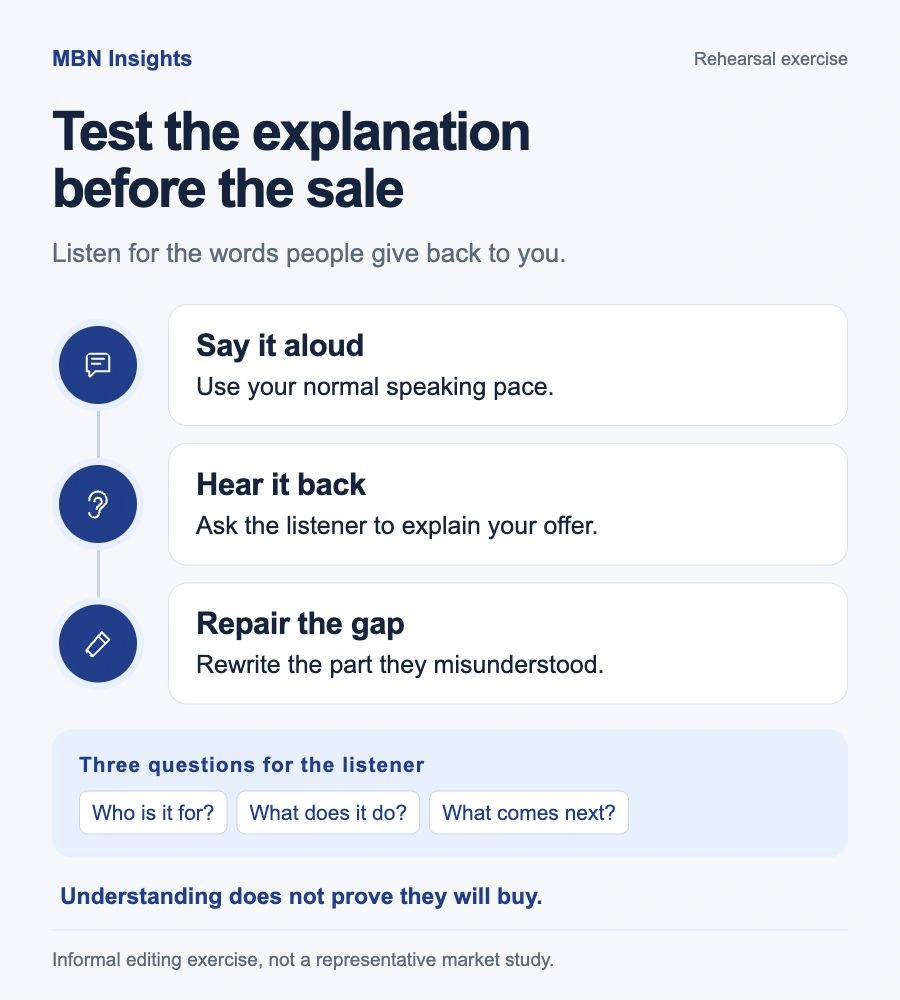
Ask a few people unfamiliar with the business to listen without seeing your website. Then ask them to explain who the customer is, what you provide and what they would expect to happen next. This is an informal editing exercise, not a representative market study.
Record the words they use. If they mistake a service for software, or think a planned feature is already available, correct the explanation before using it with prospects.
Ask what evidence they would want before continuing. Repeated questions about setup, price or compatibility can show which information belongs in the follow-up material.
When testing with prospective buyers, track whether the conversations lead to relevant follow-ups and eventual customers. Our guide to conversion rates explains how to calculate the share of people who take a specified action. Use comparable audiences and channels before attributing a different result to the wording.
A high meeting count can still produce few suitable customers. Record who attended, what they needed and why the conversation progressed or stopped. Feedback about a poor product fit may call for a different offer, not another rewrite.
Check every promise before using it
A short format leaves little room for qualifications. Choose a narrower claim when the evidence cannot support a broad one.
The US Federal Trade Commission’s advertising substantiation policy requires a reasonable basis for objective advertising claims before they are disseminated. A claim placed in a promotional video or on a website needs scrutiny just as it would in other advertising.
Check phrases such as “guaranteed savings,” “fully automated” or “works with every accounting system.” A limited pilot, a process requiring human checks or a short compatibility list may support a much narrower description.
Keep a dated record of the pitch, the evidence behind each factual promise and the follow-up you offer. Update it when the product, pricing or customer base changes. The conversation that follows should give the listener more detail about the same business you introduced.
