

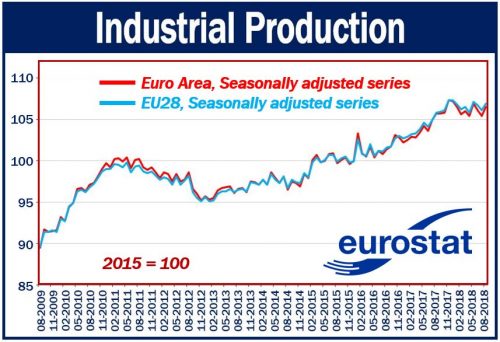
Industrial production in the euro area rose by 1% in August compared to July. In the EU28, industrial production increased by 0.8% in August versus July, says Eurostat. Eurostat is the European Union’s official statistical agency.
In July, industrial production had fallen by -0.7% and -0.6% in the euro area and EU28 respectively.
Compared to the same month in 2017, industrial production rose by 0.9% and 1.2% in the euro area and EU28 respectively.
Industrial production – monthly comparison
Euro area
In August 2018, in the euro area, energy production increased by 1.9% compared to the previous month. Durable consumer goods were 1.5% up, and both capital goods and non-durable consumer goods increased by 1.4%. Intermediate goods rose by 0.4%.
Capital goods are goods that we use to make things and deliver services. Consumer goods are products that people buy for their own use. We don’t buy and then sell consumer goods or use them to make other things that we then sell.
EU28
In the EU28, there was a 1.2% increase in the production of capital goods in August compared to July. Non-durable goods rose by 1.1%, energy by 0.9%, intermediate goods by 0.3%, and durable consumer goods by 0.8%.
Malta, which registered the greatest increase, saw industrial production rise by 9.9%, followed by Ireland (8%) and Hungary (3.8%).
Denmark’s industrial production fell by -4.5%.
Industrial production – monthly comparison
Euro area
In August 2018, in the euro area, compared to August 2017, non-durable consumer goods production increased by 3.1%. Capital goods rose by 1.3%.
Durable consumer goods, on the other hand, declined by -1.1%. Intermediate goods and energy also declined, by -0.4% and -0.3% respectively.
EU28
In the EU, production of non-durable consumer goods increased by 2.8%, capital goods rose by 1.6%, and durable consumer goods by 1.2%.
Production of intermediate goods increased by 0.4%, while energy production declined by -0.7%.
The following EU28 member states registered the highest increases and decreases in industrial production:
Ireland 15.1%
Slovenia 7.0%
Latvia 6.4%
Denmark -3.8%
Portugal -3.3%
Luxembourg -2.6%.
What are the euro area and EU28?
The European Union has twenty-eight member states. We refer to them as the EU28.
Not all the member states have the euro as their national currency. Denmark and the UK, for example, chose to keep their currencies, i.e., the Danish krone and pound sterling.
The euro area refers to countries that have the euro as their national currency. Germany, for example, has the euro as its national currency. It is also in the European Union. Therefore, Germany is both in the euro area and the EU28.
The UK and Denmark, on the other hand, are in the EU28 but not the euro area. All euro area nations are in the EU28, but not all EU28 nations are in the euro area.
