
A Mars show home is on display at the Royal Observatory Greenwich – it contains features to help human pioneers survive in their first colony on the Red Planet. The model home gives us a glimpse of what house-building will be like in the future if we ever manage to colonize Mars.
The Mars show home is set in a simulated Martian landscape at the Royal Observatory Greenwich, in southeast London. In the pod-like dwelling, there is enough space for a computer desk, a bed, food supplies, scientific equipment, plus room for growing plants and exercising.
The pod was designed by Stephen Petranek, author of How We’ll Live on Mars, and astronomers at the Royal Observatory. Petranek was a consultant in the soon-to-be published mini-series ‘Mars’, which is set in 2033 when a manned mission travels to Mars with the aim of setting up our first colony there.
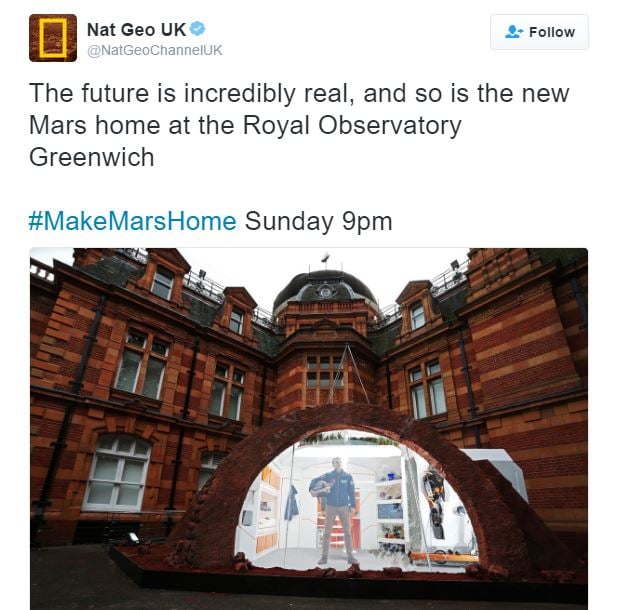 If you are anywhere near south London, don’t miss the Mars Show Home display at the Royal Observatory Greenwich. You will have the opportunity to see what the human pioneers’ living quarters will be like. (Image: twitter.com/NatGeoChannelUK)
Mars show home took months to build
The Mars show home, which was constructed over several months by Cardiff-based Wild Creations, has been designed to be situated in a 4,000km long, 100 km wide system of canyons on Mars’ equator called Valles Marineris (Latin for ‘mariner valleys’).
The dome-like construction resembles brickwork forged from regolith and microwaved to create sturdy construction material. Regolith is the layer of unconsolidated solid material covering the bedrock of a planet, which in this context means ‘Martian soil’.
The Martian home has a double air-locked entrance to protect humans from the Red Planet’s inclement atmosphere and freezing temperatures. In equatorial Mars, temperatures can drop to minus 100 degrees F (minus 73 C).
One side of the Mars show home is transparent, so that visitors can see what conditions are like inside. Humans will be able to visit each other by going through linking tunnels.
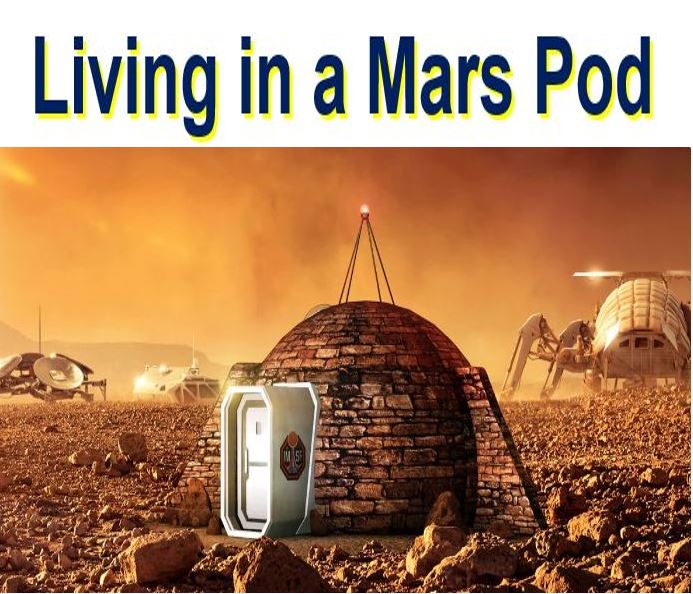 Imagine living in a tiny Mars home like this one for the rest of your life. The first colonizers will most likely be on a one-way trip to the Red Planet. The moment they step into the rocket that takes them into space, breathing fresh air will become just a memory. (Image: twitter.com/NatGeoChannelUK)
According to the Mirror, Dr. Marek Kukula, Royal Observatory Greenwich Public Astronomer, said:
“It’s amazing to live at a time when space agencies and private companies are seriously contemplating sending humans to Mars.”
“Science fiction is on the verge of turning into science fact and it’s exciting to think that a young visitor to the show home here in Greenwich might turn out to be the first human to actually set foot on Mars in the not so distant future.”
In an interview with Reuters, Petranek said the Mars show home is more of a ‘survival centre’ than a typical Red Planet house.
The pod will make oxygen for humans to breathe, and will suck water from the Martian atmosphere. During the Martian nights, humidity reaches about one hundred percent.
 The crew in National Geographic’s ‘Mars’ miniseries: Marta Kamen, a Russian geologist and exobiologist. Javier Delgado, a Spanish hydrologist and geochemist. Hana Seung, an American mission pilot and systems engineer. Ben Sawyer, an American systems engineer who is mission commander. Amerie Durand, a French physician and biochemist. Robert Foucault, a Nigerian mechanical engineer and roboticist. (Image: mars.natgeotv.com/uk/daedalus-crew)
Most of the human pioneers’ needs will be made by a 3D printer, Petranek explained.
The Mars show home will be on display in London until 16th November.
‘Mars’, the National Geographic mini-seires, will be launched on November 14th. The year is 2033, and an international coalition of Earth’s best researchers – the Daedalus Crew – is nearing the end of its voyage to the Red Planet to start a new era of interplanetary science.
The series portrays the amazing story about the first human crew mission from Earth in a unique, story-telling format. Although the whole thing is fiction, each episode is presented as if it were a real news article or part of a documentary.
Video – Mars show home
In this National Geographic TV UK video, Dr. Marek Kukula, Public Astronomer at the Royal Observatory Greenwich, talks about the Mars show home that is currently on display. This unique structure provides us with a glimpse of what life on the Red Planet could be like for humans in 2033.

Comments are closed.