
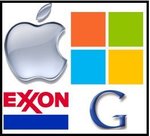
Four largest companies

Microsoft beats Exxon and Google in global market value league table

Published: 06:54, November 15, 2014

Microsoft Corporation is now the second largest company in market value worldwide, pushing Exxon Mobil and Google into third and fourth places respectively. The biggest company by market capitalization is Apple Inc., and by a very long way.

In May 2014, Exxon was in second place, with a market capitalization (the total value of all its outstanding shares) valued at $483.1 billion. The 30% fall in oil prices since June has pushed down Exxon’s share price to $95.09, which means the company is now worth $402.66 billion.

The US shale boom plus falling demand because of China’s economic slowdown have pushed oil prices down.

Satya Nadella, who has been Microsoft’s CEO since February 2014, has shifted the company’s focus towards web-based cloud services, a strategy which clearly has gone down well with investors.

4 largest companiesFour largest companies: 1. Apple 2. Microsoft 3. Exxon 4. Google.

Under Mr. Nadella, Microsoft has been able to shake off its reputation as a clumsy giant dinosaur that is unable to respond to shifting consumer preferences and tech trends.

On Friday November 14th, Microsoft shares closed at $49.58, giving it a market capitalization of $408.7 billion. In May 2014, the company was worth $343.8 billion. Its stock has risen almost 70% since April 2013.

Analysts say Microsoft is not yet out of the woods. The company is still heavily dependent on a shrinking personal computer market. However, when compared to other old-time tech stalwarts, such as Oracle, Hewlett-Packer and IBM, the Redmond-based company is faring better.

Google Inc., in fourth place, has a market capitalization of $369.5 billion, which is down from the $382.5 billion figure in May.

Apple Inc. is still way ahead in first place, with a market capitalization valued at $669.65 billion.

Christian Nordqvist Avatar

Other News

Internet coverage alone cannot close the digital divide, World Bank says

Nov 1, 2026

Energy upgrades can save businesses money, but financing the work remains a hurdle

Nov 1, 2026

Why tighter credit can disrupt supply chains before orders disappear

Oct 31, 2026

South Africa plans a more open payments system as digital transactions grow

Oct 31, 2026

African cities face a jobs test as urban populations grow

Oct 31, 2026

Online platforms can open foreign markets, but sellers still face costs

Oct 31, 2026

Trade barriers beyond tariffs can keep Balkan exporters from growing

Oct 31, 2026

Off-grid solar reaches more customers, but affordability limits its growth

Oct 31, 2026

World Bank survey finds a wide gap in business innovation across economies

Oct 30, 2026

Air conditioning is adding a growing challenge for electricity grids

Oct 30, 2026

Fewer bidders can make public contracts harder for businesses and taxpayers

Oct 30, 2026

Small firms’ productivity gap is wider in manufacturing than services

Oct 30, 2026

Battery storage is expanding beyond emergency grid support

Oct 30, 2026

Hiring pressure persists in technical, health and teaching jobs, OECD finds

Oct 30, 2026

Small manufacturers face different costs in the shift to new supply chains

Oct 29, 2026

Crowded hedge fund trades can deepen market falls, IMF research finds

Oct 29, 2026

Electronic payments are linked to easier credit for small businesses

Oct 29, 2026

China’s carbon market may reward cleaner plants while increasing output

Oct 29, 2026

Groundwater pumping can create costs that arrive years later

Oct 29, 2026

Commodity shocks are spreading from energy to food and metals

Oct 28, 2026