
Stanford University scientists have created mini robots that can climb walls like a gecko and carry cargos more than 100 times their own weight. The mighty bots will be presented at the International Conference on Robotics and Automation, Seattle Washington (May 26-30, 2015).
As with geckos, the secret is in having controllable adhesion in their feet. In geckos, each toe is covered in flaps of skin (lamellae), which are in turn covered in arrays of microscopic hair-like structures (setae). The robot’s synthetic feet have tiny rubber spikes that grip firmly onto the wall as it climbs.
The spikes bend when pressure is applied, which increases their surface area, which in turn makes them stickier. When the mighty bot picks its foot back up, it detaches easily because the spikes straighten out.

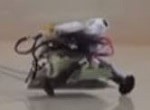
The little robot with gecko-like sticky feet pulls a load more than 100 times its weight. (Image: YouTube)
The robot’s movement also mimics the inchworm – one pad helps bring the robot forward while the other stays put, supporting the heavy load. The arrangement stops the little machine from falling if it misses a step. It also allows it to remain stationary without using up valuable battery juice.
A mean lifter
The Stanford engineers have created a little robot that is much stronger than it looks. The 9-gram (0.31oz) bot can pull a 1 kilogram weight up a wall, which is more than 100 times it own weight. That’s like a 70kg human pulling a large male African elephant.
There is also a super-mini bot, weighing in at just 20 milligrams (0.0007oz), that can carry 500 milligrams (0.0176oz). Elliot Hawkes, a mechanical engineering graduate student, built it using a microscope and tiny tweezers.
The most impressive bot, nicknamed μTug, has to be the most awesome. It weighs just 12 grams (0.42oz), but can drag a load two-thousand times heavier than its own weight.
The New Scientist quotes PhD candidate David Christensen, who said about μTug:
“(What μTug pulled is) the same as you pulling around a blue whale.”
Christensen and Hawkes believe their research may lead to robots being used in factories or construction sites to carry or pull heavy things. Perhaps they could be used in emergency situations, where one might carry a rope ladder to a person trapped high up in a building that is on fire.
In order to find uses for these robots in such industries, they will need to build much bigger ones, and find ways of attaching the adhesives to their feet.
Hawkes climbing walls
Last year people could see Mr. Hawkes stuck to the sheer glass side of a building on the Stanford campus, testing his dissertation work.
He was working with a team of engineers who were developing controllable, reusable adhesive material that could form a strong bond with smooth surfaces, but also release with minimal effort.
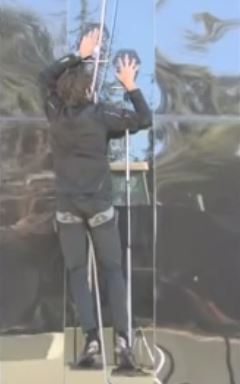
Hawkes scaling a glass wall with gecko-inspired dry adhesives. (Image: Stanford University)
One of the big problems in using gecko-inspired adhesives is that when things get larger performance tends to suffer. However, Hawkes and colleagues developed a device that shares large loads very evenly across every patch of the adhesive.
Hawkes said:
“It’s a lot of fun, but also a little weird, because it doesn’t feel like you should be gripping glass. You keep expecting to slip off, and when you don’t, it surprises you. It’s pretty exhilarating.”
