
The crater slopes on the Moon that face its Poles have 23 parts-per-million-by-weight more hydrogen than its Equator-facing slopes, according to recent observations by NASA’s Lunar Reconnaissance Orbiter (LRO) spacecraft. This could mean space travelers from Earth might not need to bring water with them.
Space travel is both expensive and extremely difficult. Just launching one bottle of water to the Moon would cost thousands of dollars.
NASA says that the recent discovery of hydrogen-bearing molecules, perhaps including water on the Moon, has scientists excited, because these deposits if they are sufficiently abundant, could be mined.
Perhaps lunar water could be used for drinking, or its components – oxygen and hydrogen – could be utilized to manufacture rocket fuel and breathable air, NASA explained.
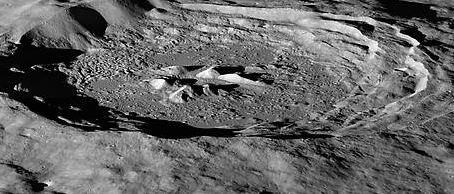
The moon’s Hayn Crater, located just northeast of Mare Humboldtianum, illuminated by the low Sun casting long shadows across the crater floor. (Image Credit: NASA/GSFC/Arizona State University)
Timothy McClanahan of NASA’s Goddard Space Flight Center in Greenbelt, Maryland, said:
“There’s an average of about 23 parts-per-million-by-weight (ppmw) more hydrogen on Pole-Facing Slopes (PFS) than on Equator-Facing Slopes (EFS).”
NASA says it is the first time it has detected a widespread geochemical difference in hydrogen levels between PFS and EFS on the Moon.
According to McClanahan, lead author of a paper on this study published in the journal Icarus, what NASA has detected is equal to a 1% difference in the neutron signal detected by LRO’s Luna Exploration Neutron Detector (LEND) instrument.
The hydrogen-bearing material may be in the form of hydroxyl molecules (an oxygen bound to a hydrogen) or water molecules (two hydrogen atoms bound to an oxygen atom).
The difference in hydrogen levels between PFS and EFS may be similar to what occurs here on Earth, as the Sun mobilizes or redistributes frozen water from warmer to colder places.
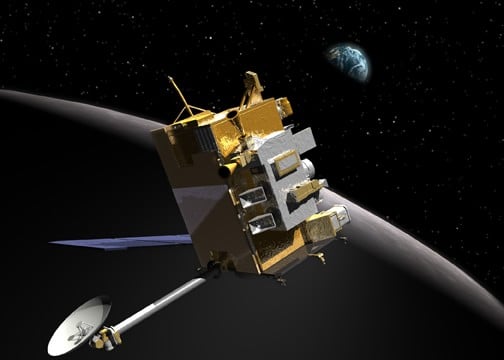
The Lunar Reconnaissance Orbiter. (Image: GSFC NASA)
Mr. McClanahan explained:
“Here in the northern hemisphere, if you go outside on a sunny day after a snowfall, you’ll notice that there’s more snow on north-facing slopes because they lose water at slower rates than the more sunlit south-facing slopes.”
“We think a similar phenomenon is happening with the volatiles on the Moon – PFS don’t get as much sunlight as EFS, so this easily vaporized material stays longer and possibly accumulates to a greater extent on PFS.”
The highest levels of hydrogen were detected on PFS in the Moon’s southern hemisphere, starting at between 50 and 60 degrees south latitude. The largest concentration difference was found on the slopes facing the lunar South Pole.
On the larger PFS near the poles hydrogen levels were about 45 ppmw.
The broader slopes provided more detectable signals than the narrower ones. According to data gathered by NASA scientists, PFS have greater concentrations of hydrogen than their surrounding regions, unlike the larger EFS, whose concentrations are equal to those detected in their surroundings.
The researchers believe the PFS in the northern hemisphere craters also have higher concentrations of hydrogen. They are currently gathering LEND data for the region to confirm this.
Where does the lunar hydrogen come from?
Hydrogen on the Moon could have come from a number of sources. Comets and some asteroids carrying water may have brought hydrogen when they crashed into the Moon.
Interaction with solar wind could have created hydrogen-bearing molecules. Solar wind, which is constantly blown off the Sun, consists of a thin stream of gas, mostly hydrogen. This hydrogen could interact with oxygen in dust and silicate rock on the Moon to form water and hydroxyl.
When these molecules arrive at the Moon, scientists believe they get energized and then bounce across the surface. They eventually get stuck (at least temporarily) in the more shadowy and colder areas.
Fifty years ago, scientists believed that volatile material on the Moon could only exist in permanently shadowed areas in craters near its poles. Recent observations by several spacecraft, including LRO, suggest that hydrogen on the Moon is much more widespread.
Nobody yet knows whether there is enough hydrogen on the Moon to be economically mined.
NASA wrote:
“The amounts we are detecting are still drier than the driest desert on Earth. However, the resolution of the LEND instrument is greater than the size of most PFS, so smaller PFS slopes, perhaps approaching yards in size, may have significantly higher abundances, and indications are that the greatest hydrogen concentrations are within the permanently shaded regions.”
Apart from trying to determine whether the same pattern exists in the Moon’s northern hemisphere, the researchers also want to see whether concentrations of hydrogen change with the transition from day to night. If so, it could confirm current evidence of a very active production and cycling of hydrogen on the Moon’s surface.
