
If everybody in the world adopted the North American diet, there would be a shortage of land. In other words, there wouldn’t be enough land to produce the food we required, a new study has found.
The researchers, from the University of Guelph in Canada, wrote about their study in the journal PLUS ONE (citation below)
Adherence to USDA guidelines would require one giga-hectare of extra land under current farming practices, the researchers concluded. One giga-hectare is approximately the size of Canada. USDA stands for the United States Department of Agriculture.
Therefore, if everybody worldwide adopted the North American diet, we would need an additional farm the size of Canada. Otherwise, we would not have enough land for our dietary requirements.
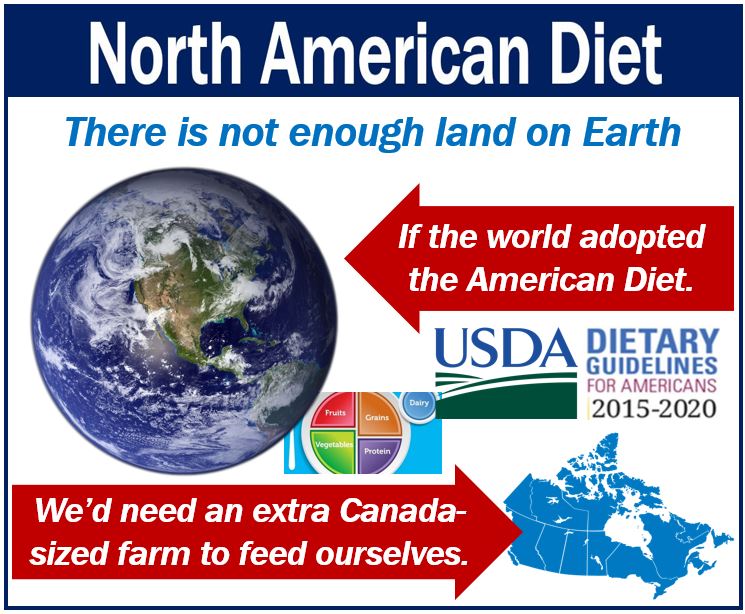
North American diet is unsustainable
Regarding the USDA’s guidelines, Madhur Anand said:
“The data shows that we would require more land than what we have if we adopt these guidelines. It is unsustainable.”
“This is one of the first papers to look at how the adoption of Western dietary guidelines by the global population would translate into food production, including imports and exports, and specifically how that would dictate land use and the fallouts of that.”
Prof. Anand is director of the Global Ecological Change and Sustainability lab.
The dietary guidelines are an improvement on what existed before. However, the USDA needs to develop them further.
Health, global land use, and equity
Apart from using health as a criterion, we must also use global land use and equity, the authors wrote. Equity, in this context, refers to the ownership of farmland as an asset.
Prof. Anand, who is also a professor at the University of Guelph’s School of Environmental Sciences (SES), said:
“We need to look at diet not just as an individual health issue but as an ecosystem health issue.”
North America diet favors Western farms
Globally, there is a strong east-west division, the authors found. The majority of Western Hemisphere nations would utilize less land using the USDA guideline diet. Eastern Hemisphere nations, on the other hand, would use more land.
Prof. Anand said:
“We need to understand human and environmental systems in a coordinated manner, and this is where the interdisciplinary aspect of the work shines. This is also why we worked with an applied mathematician.”
Dietary guidelines – international coordination
Global lands are a limited resource. Therefore, there should be international coordination of dietary guidelines, the authors suggested.
Prof. Anand said:
“This could be similar, at least in principle, to how greenhouse gas emissions are increasingly being coordinated internationally to address another major global problem: climate change.”
Diets must be healthy – farming must be sustainable
Co-author, Prof. Evan Fraser, added:
“One of the 21st century’s great challenges is to develop diets that are both healthy for our bodies and sustainable for the planet.”
“Developing the technologies and insights to help industry and consumers is part of what many of us at the University of Guelph are working on through the Food from Thought initiative.”
Prof. Fraser is Scientific Director of the Food From Thought Project and Director of the Arrell Food Institute at U of G. He is also the holder of a Canada Research Chair in Global Food Security.
The North American diet is based on the USDA Dietary Guidelines. It is the cornerstone of the Federal nutrition programs. According to the USDA:
“The Dietary Guidelines provide food-based recommendations to promote health, help prevent diet-related chronic diseases, and meet nutrient needs.”
Citation
“Global land use implications of dietary trends,” Sarah Rizvi, Chris Pagnutti, Evan Fraser, Chris T. Bauch, and Madhur Anand. PLOS ONE. Published: August 8, 2018. https://doi.org/10.1371/journal.pone.0200781.
