

Humans are plundering the oceans with seafloor mining, shrimp farms, satellite-guided giant-scale sea-fishing with a gold-rush-like fervor that threatens to destroy much of its wildlife in the same way so many land animals became extinct, a new study warns.
Over the past five centuries, about five-hundred land-based animal species have had the same fate as the dodo and become extinct due to human activity.
In the oceans, the extinction of wildlife due to humans is only a fraction compared to what occurred on land, but that is about to change dramatically, says a consortium of scientists.
Team member, Douglas McCauley from UC Santa Barbara, says the same patterns that resulted in the collapse of wildlife populations on land are starting to occur in the oceans.
The scientists say that today wildlife populations in the oceans are about as healthy as they were on land hundreds or thousands of years ago.
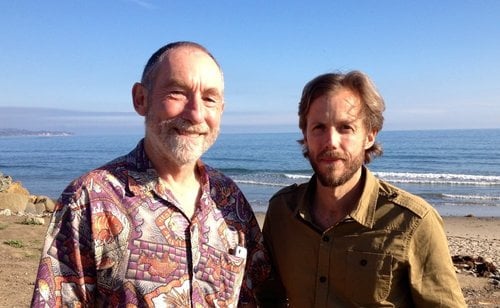
UCSB professors Robert Warner (left) and Douglas McCauley co-authored the report about the state of the world’s oceans. (Image credit: Sonia Fernandez)
However, over the next 100 years things are going to change dramatically for marine life, they warn. Their study findings have been published in the journal Science.
Professor McCauley and colleagues compared the march of the land-based Industrial Revolution to current patterns of human use of our oceans.
During the 1800s we beat back forests to make way for farmland, factories and mines. The mines sucked up resources that were drilled out of the ground. This human activity drove hundreds of terrestrial species to extinction.
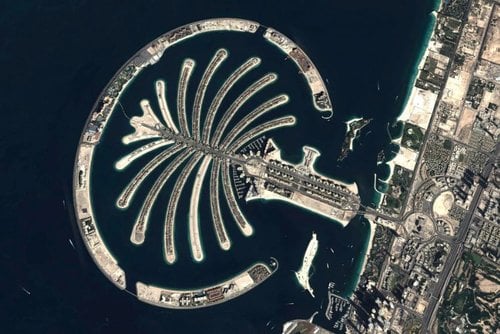
Palm Jumeirah on the Dubai coast was constructed from sand dredged from the bottom of the Persian Gulf. (Image credit: Google Earth)
During the industrial revolution the oceans were spared such exploitation, as fishing continued to rely on sailing ships that fished in small clusters near the shore.
Prof. McCauley, who works in UCSB’s Department of Ecology, Evolution and Marine Biology (EEMB), said:
“A lot has changed in the last 200 years. Our tackle box has industrialized.”
Steve Palumbi of Stanford University, who was also a study co-author, said:
“There are factory farms in the sea and cattle-ranch-style feed lots for tuna. Shrimp farms are eating up mangroves with an appetite akin to that of terrestrial farming, which consumed native prairies and forest.”
“Stakes for seafloor mining claims are being pursued with gold-rush-like fervor, and 300-ton ocean mining machines and 750-foot fishing boats are now rolling off the assembly line to do this work.”
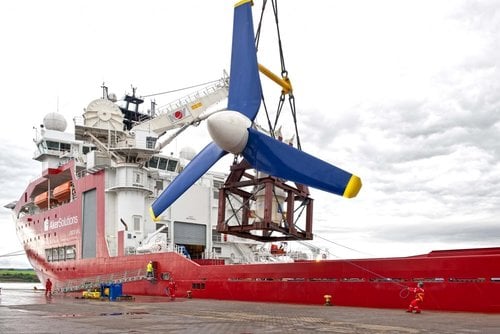
Tidal turbines are used to convert the energy of the tides into usable forms of energy, such as electricity. (Photo credit: Courtesy of Force)
The scientists say the increasing industrial use of the sea’s resources and the globalization of ocean exploitation threaten to devastate the health of marine wildlife populations, making the situation in the oceans as bleak as that on land.
When we fish today, we use satellite-guided super trawlers, long lines that can stretch from Philadelphia to New York. We even use helicopters.
“All signs indicate that we may be initiating a marine industrial revolution. We are setting ourselves up in the oceans to replay the process of wildlife Armageddon that we engineered on land,” Prof. McCauley said.
The authors suggest we should be setting aside more and bigger areas of the ocean that are safe from fishing and industrial development.
Reserves alone are not enough, warns co-author Robert Warner, an EEMB research professor at UCSB. “We need creative and effective policy to manage damage inflicted upon ocean wildlife in the vast spaces between marine protected areas,” he said.
Marine life more vulnerable to climate change
The harming effect of climate change impacts more on marine wildlife habitats than land-based ones, the authors explain.
Co-author Malin Pinsky, an ecologist at Rutgers University, said:
“Anyone that has ever kept a fish tank knows that if you crank up your aquarium heater and dump acid into the water, your fish are in trouble. This is what climate change is doing now to the oceans.”
The oceans are still relatively healthy and there is still a chance to save them, the scientists point out.
Prof. McCauley said:
“Because there have been so many fewer extinctions in the oceans, we still have the raw ingredients needed for recovery. There is hope for marine species that simply does not exist for the hundreds of terrestrial wildlife species that have already crossed the extinction threshold.”
The future of our oceans is yet to be determined, they added. Warner concluded “We can blunder forward and make the same mistakes in the sea that we made on land, or we can collectively chart a different and better future for our oceans.”
Citation: “Marine defaunation: Animal loss in the global ocean,” Douglas J. McCauley, Malin L. Pinsky, Stephen R. Palumbi, James A. Estes, Francis H. Joyce, and Robert R. Warner. Science, 16 January, 2015: 347 (6219), 1255641 [DOI:10.1126/science.1255641].
Scientists from the University of Glasgow in Scotland published a study in December 2014 warning that mussel shells have become more brittle because climate change has made the oceans more acidic. As seawater absorbs higher levels of CO2, their pH levels drop.
The researchers say that our oceans’ current pH level of 8 will drop to 7.7 by the end of this century.
Video – Marine Defaunation
In this UCSB video, researchers and colleagues review the past, present and future of marine animal life.
