
Seeing lots of positive online customer reviews brightens every retailer’s day as they watch sales ramp up. But then, gloom sets in as product returns rise, cost shoot up, and profits evaporate. What could be going wrong? Surely, it’s a good thing to have customers raving about your products?
The answer appears to be not necessarily – because too many positive online customer reviews can raise expectations of new buyers to an unrealistic level. So say researchers who looked at the link between online customer reviews and product returns.
A team of marketing experts from the University of Groningen in the Netherlands and the University of Münster in Germany found that the more positive online customer reviews a product gets, the greater the chance it will lead to a net loss for the retailer.
They suggest retailers should encourage customers to leave honest feedback about the product – no matter whether it is good or bad. This lessens the risk of mismatch between reality and the expectations of customers making new purchases.
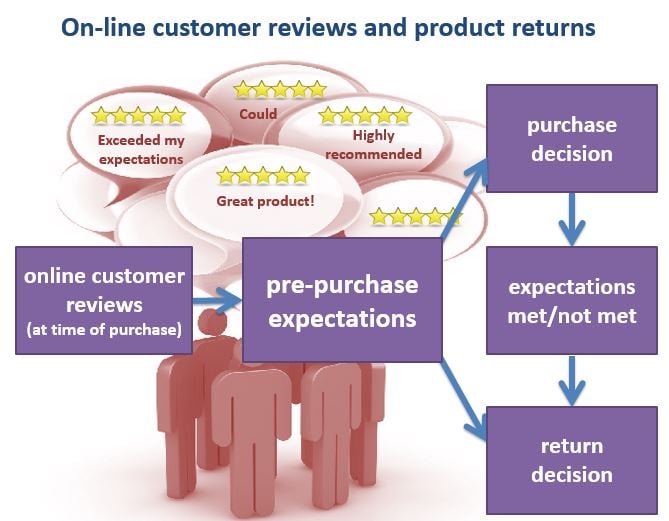 Too many positive online customer reviews can increase sales but they also harm profits by increasing decisions to return products. (Adapted from Alec Minnema et al.)
Reducing cost of returns
Giants like Amazon and Wal-Mart see online shopping as essentially a two-sided business: sales and returns, with both sides offering opportunities to raise profits.
An attractive and easy to use customer return policy is an important part of an online shop – especially if you are selling goods that need to fit properly, such as clothes and shoes. In fact, it is doubtful that an online retailer these days would remain in business for long if they did not have one.
But, while a generous returns policy may attract more customers and increase sales, it also ramps up costs in the form of higher returns. A survey for a BBC consumer program found nearly two-thirds of shoppers who bought women’s clothes online sent at least one item back.
One way retailers can reduce the costs of returns processing is by adopting interactive customer friendly technologies alongside accurate, fast, and efficient logistics. Logistics refers to getting the right materials at the right place at the right time, and also at the right price – plus making sure all customer needs are met.
However, the new study highlights another way retailers could reduce the cost of returns – by examining the effect of too many positive online customer reviews.
‘Reviews should accurately reflect product performance’
The researchers examined over 2 years of sales data from a major European online electronics and furniture retailer. The data covered 2,164 different products with sales activity of nearly 9 million page views and a total of 631,063 purchase transactions.
From the wealth of data, they were able to extract details of online customer reviews available at time of buying, plus return decisions over a long period.
For their analysis the team noted whether the reviews were positive or negative and how many of each type there were per product.
They then plugged the data into a series of simulations and found that while a lot of positive online customer reviews can indeed boost sales, if they are not balanced by less glowing reports, they lead to greater customer disappointment and higher returns.
The effect appears to be stronger for less-experienced buyers and cheaper products, note the researchers, who conclude:
“Our findings encourage retailers to get a large review base that adequately reflects the performances of the product.”
They suggest retailers should “actively stimulate customers to write a review after purchase,” and they should ensure that reviews accurately describe the reality of the customer experience – both positive and negative.
The study is published in the Journal of Retailing.
