

On Friday, Italian luxury fashion house Prada sPa reported a 21% fall in net profit to €244.8 million for the first half of 2014, blaming a strong euro and poor leather goods sales for the disappointing result.
Consolidated net revenue increased by 1.3% to €1.75 billion ($2.25 billion) in H1 2014. Operating profit fell from €551 million in the first half of 2013 to €493 in H1 2014.
Prada said that despite unfavorable forex trends during the first half of the year, as well as a challenging political and macroeconomic environment, it continues its long-term plan of investing in brand value.
Patrizio Bertelli, Chief Executive Officer of Prada sPa, said:
“We remain confident that the luxury goods market – especially the high-end segment where the Prada Group operates with success – will continue to offer interesting growth prospects in the medium-term.”
Geopolitical and macroeconomic challenges, plus a strong euro are affecting business, says Prada sPa.
Margins will be squeezed
While expecting profits for H2 2014 to be broadly in line with the first half of the year, the Milan-based company, founded by Mario Prada in 1913, warned that margins will continue to be under pressure. “(There will be) some marginal improvements deriving from the costs-cutting actions,” it added.
Sales of leather goods, which typically have a high profit margin, fell 1.4% in H1 2014 compared to H1 2013, due to a decline in tourist football in the main shopping destinations in Asia and Europe.
Increased business in the Americas and the Middle East was not enough to offset declines elsewhere, Prada wrote.
Not that long ago, Prada had great hopes for the Asia Pacific region, which posted a 2.1% decline in H1 2014, due to weakness in Singapore, South Korea and Hong Kong. Revenue in mainland China, however, increased by 11.8%.
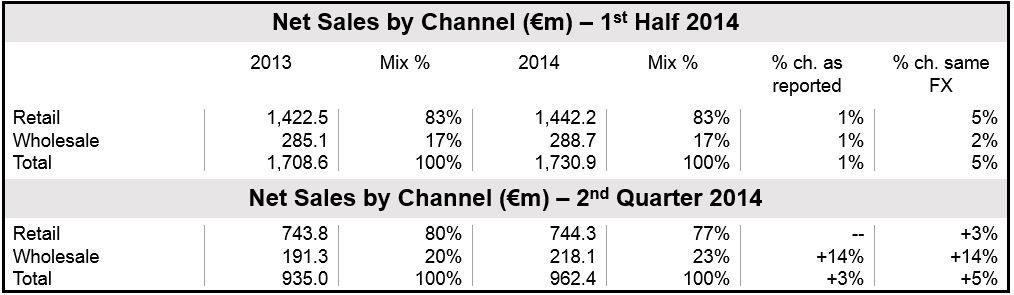
(Data source: Prada sPa)
All the luxury fashion houses, including Louis Vuitton, Prada, and Gucci have reported sharp falls in growth over the past twelve months, as consumers turn from the famous brands that have flooded the market over the last twenty years, to more understated brands, such as Celine and Bottega Veneta.
Sales in menswear increased by 19% during the period, as did shoes and ready-to-wear clothes. Prada says male customers are becoming more fashion-conscious.
