
Pride is perhaps not such a bad thing, after all, says a team of researchers. Traditionally, it is not a trait that we admire. Christians count it among the seven deadly sins, even right up there with envy, lust, and greed. Some people say pride is the worst sin of all.
Many of us have blamed it as the motivating factor behind our greatest mistakes. Hence, the expression: “Pride comes (goes) before a (the) fall.”
Pride and human evolution
Researchers at UC Santa Barbara’s Center for Evolutionary Psychology and the University of Montreal have discovered otherwise.
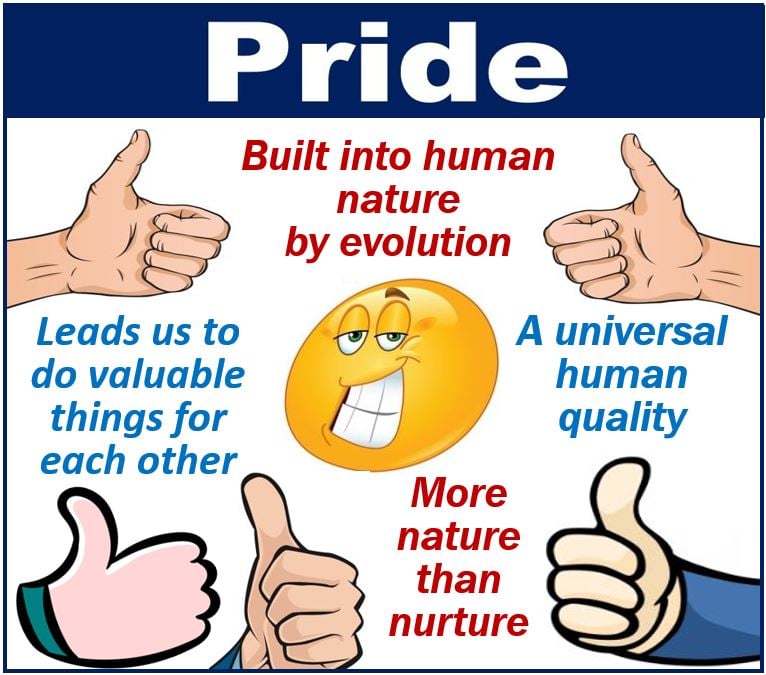
They argue that pride exists thanks to human evolution. In other words, they argue that it is more something we are born with rather than something we acquire. Their study showed that pride had a useful function for our foraging ancestors.
Daniel Sznycer and colleagues wrote about their study and findings in the Proceedings of the National Academy of Sciences (citation below). Sznycer is an assistant professor of psychology at the University of Montreal.
A long time ago, our ancient ancestors lived in small, highly-dependent bands. Life-threatening reversals were common.
Ancestors needed others to value them
People needed their fellow band members to value them. Most importantly, to value them enough during difficult times to pull them through.
Therefore, when making choices, people had to weigh their own selfish interests against winning the approval of others.
In other words, when our ancestors needed help, it was important, above all, for others to value them. Specifically, value them enough to provide help.
Humans needed a counterbalance for their selfish streak
Prof. Sznycer, who was also lead author, said:
“People evolved to have a selfish streak, but they also needed a contrary pull toward acts that would make others value them in a world without soup kitchens, police, hospitals or insurance.”
“The feeling of pride is an internal reward that draws us towards such acts.”
Co-author, Leda Cosmides, explained:
“For this to work well, people can’t just stumble about, discovering after the fact what brings approval.”
“That’s too late. In making choices among alternatives, our motivational system needs to implicitly estimate in advance the amount of approval each alternative act would trigger in the minds of others.”
Cosmides is a professor of psychology at UC Santa Barbara (UCSB) and co-director of the Center for Evolutionary Psychology (CEP).
Somebody who did only what others wanted would be selected against, the authors wrote. However, a purely selfish person would be rejected rapidly, which was another dead end.
Co-author John Tooby said:
“This leads to a precise quantitative prediction. Lots of research has shown that humans can anticipate personal rewards and costs accurately, like lost time or food. Here we predicted that the specific intensity of the pride a person would anticipate feeling for taking an action would track how much others in their local world would actually value that specific act.”
“The theory we’re evaluating is that the intensity of pride you feel when you consider whether to take a potential action is not just a feeling and a motivator; it is also carries useful information to seduce you to make choices that balance both the personal costs and benefits and the social costs and benefits.”
Tooby is a professor of anthropology at UCSB and also a CEP co-director.
Pride – a universal human quality
Pride, as a neural system, inclines us to factor in other people’s regard alongside private benefits. We, therefore, select the act associated with the greatest total payoff, the researchers argue.
Prof. Sznycer said:
“One implication of this theory is that those around you benefit, too, as a side effect of your pursuing actions they value. Thus, pride is more a win-win than it is a sin.”
Pride – a neurally-based motivational system
The key part of the argument is that this motivational system, which is neurally based, is part of the human’s biology.
Prof. Sznycer noted:
“If that is true, we should be able to find this same pride-valuation relationship in diverse cultures and ecologies all around the world, including in face-to-face societies whose small scale echoes the more intimate social worlds in which we think pride evolved.”
Researchers tested hypothesis
The team wanted to test this hypothesis. So they gathered and analyzed data from ten traditional small-scale societies in Asia, Africa, and Central and South America.
These societies have very different lifestyles, languages, and religions. Some make their living hunting or fishing while others are involved in subsistence farming or nomadic pastoralism.
Pride should closely track the value of others, for each particular act, in each community. That is, if pride evolved in human nature and is a universal human trait.
However, if pride is more something our cultures created, the study should find a wide variation in this relationship. In other words, if pride is not part of our biological evolution, it might not even exist in some communities.
Prof. Sznycer said:
“We observed an extraordinarily close match between the community’s degree of positive regard for people who display each of these acts or traits and the intensities of pride individuals anticipate feeling if they took those acts or displayed those traits.”
“Feelings of pride really move in lockstep with the values held by those around you, as the theory predicts.”
Pride tracks others’ values, not positive emotions
Additional studies have shown that it is specifically pride, and not positive emotions, that tracks others’ values, Prof. Sznycer added.
Pride closely tracked not only fellow community members’ value but also the values of people in other cultures. However, the study found that the latter relationship was more variable.
For example, among the Mayangna people, pride closely tracked not only the values expressed by fellow Mayangnas but also the values of pastoralists from Tuva, Russia. The Mayangna people are forager-horticulturalists who live in the Bosawás Reserve in Nicaragua.
The same applied to the farmers from Enugu in Nigeria and Amazigh farmers from Drâa-Tafilalet in Morocco.
Some social values are universal
This additional finding, the authors write, suggests that at least some social values people hold globally are universal.
Prof. Sznycer explained:
“Humans are a uniquely cooperative species, so pride leads people to do many valuable things for each other. However, the authors continued, pride in the form of dominance evolved when there was less cooperation, and it was advantageous for an animal to deter rivals from scarce resources by displaying the degree of cost it could inflict.”
“Humans inherited this system too, and, as many have shown, they are proud not only of the good they can do, but also of their aggressive abilities,” Sznycer explained. “Our data supports this, too.”
Pride motivates us in two possible ways
Pride, the authors added, has a two-edged reputation. It can motivate us to benefit others but may also lead us to exploit others.
As Prof. Tooby said:
“When people become intoxicated with how valuable they are to others – or how dangerous – they feel they can safely take advantage of this to exploit people. Prima donnas, alphas and narcissists are the result.”
The authors concluded that, for better or worse, the pride system appears to be a fundamental part of our nature.
Sznycer said that it is “a neural system that evolved because it helped people increase their esteem and status in the eyes of others.”
Citation
“Invariances in the architecture of pride across small-scale societies,” Daniel Sznycer, Dimitris Xygalatas, Sarah Alami, Xiao-Fen An, Kristina I. Ananyeva, Shintaro Fukushima, Hidefumi Hitokoto, Alexander N. Kharitonov, Jeremy M. Koster, Charity N. Onyishi, Ike E. Onyishi, Pedro P. Romero, Kosuke Takemura, Jin-Ying Zhuang, Leda Cosmides, and John Tooby. Proceedings of the National Academy of Sciences (PNAS), August 1, 2018. 201808418. Published ahead of print August 1, 2018. https://doi.org/10.1073/pnas.1808418115.
