
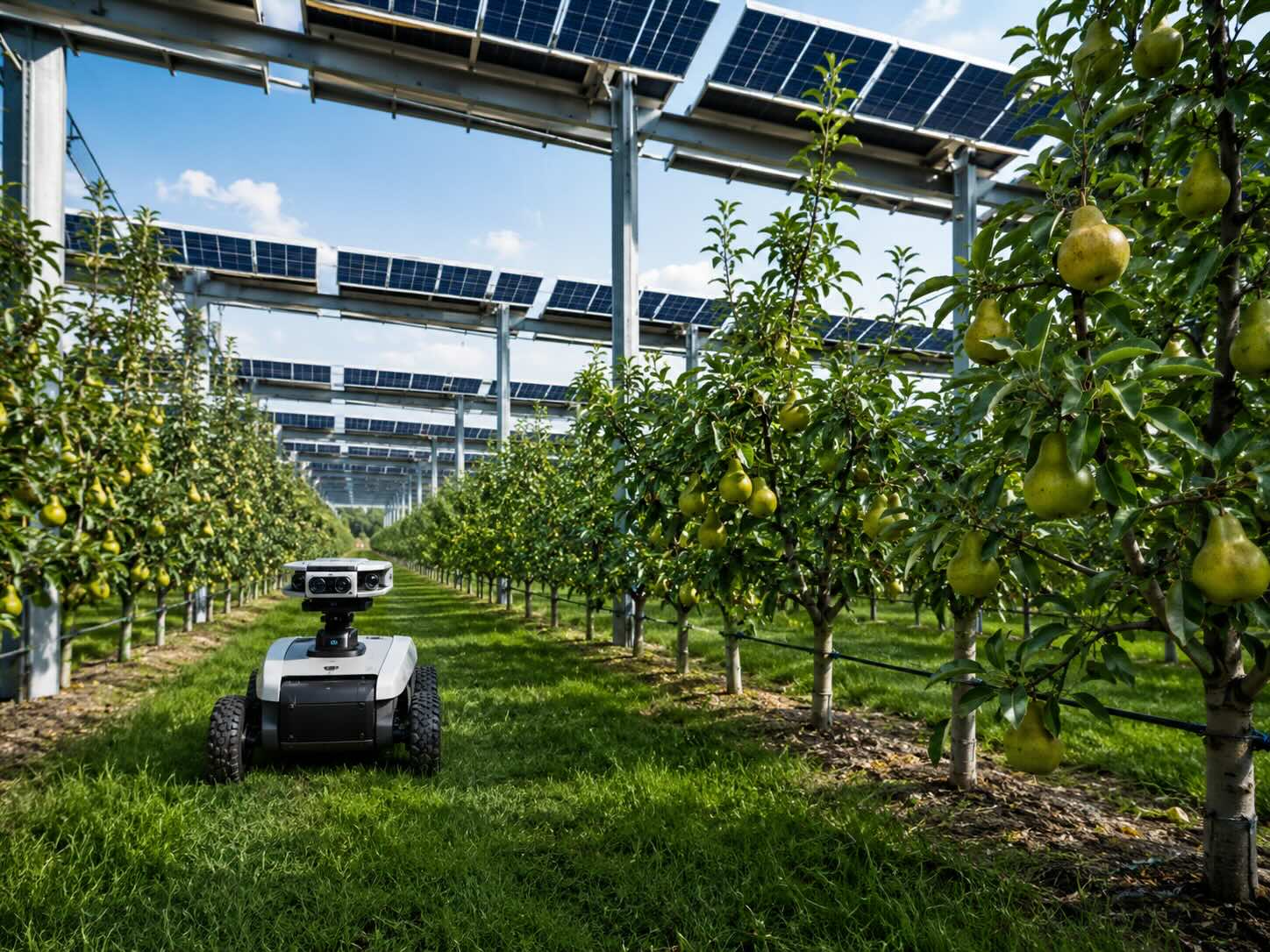
A pear orchard in the Netherlands is offering a glimpse of what farming could look like in the future: fruit trees growing beneath solar panels while an autonomous robot travels between them, using cameras and artificial intelligence (AI) to monitor the crop.
The experimental site in Randwijk combines two emerging technologies. The first is agrivoltaics, also known as agri-photovoltaics or agri-PV, in which the same land is used for agriculture and solar electricity generation. The second is autonomous robotics, which could reduce the amount of manual work farmers need to carry out.
Researchers at Wageningen University & Research (WUR) have been studying the orchard for three years, examining factors such as fruit quality, crop yields and soil conditions beneath the solar panels.
The work forms part of TALOS, a European Union-funded project investigating how robotics and AI could make solar installations more efficient and easier to operate.
One piece of land, two uses
Agrivoltaics addresses a simple problem: solar farms and agriculture can compete for the same land.
Instead of choosing between the two, agri-PV attempts to accommodate both. Solar panels can be installed high enough above crops or sufficiently far apart to allow farming to continue underneath or between them.
Jiří Bím, head of the agrivoltaics section at the Czech Solar Association, gave an example of how this could improve overall land use. If a combined site produced 60% of the crop yield and 70% of the electricity that separate sites could produce, its total land-use efficiency would amount to 130%. Producing the same quantities separately would require 1.3 hectares rather than one.
The potential across Europe is considerable.
According to the European Commission’s Joint Research Centre (JRC), installing agrivoltaic systems on just 1% of the EU’s utilized agricultural land could provide approximately 944 gigawatts (GW) of solar capacity. That figure exceeds the capacity needed to meet the EU’s 2030 solar target.
The European Commission currently aims for the EU to have at least 600 GW of solar photovoltaic capacity by 2030.
Solar panels can also protect crops
Generating electricity is not the only possible benefit.
Solar panels can provide crops with some protection against extreme heat, hail and heavy rain. The shade they create can also reduce evaporation and therefore help retain water.
Hellen Elissen, senior researcher in agrivoltaics and project leader at WUR, pointed to raspberries as an example. Growers already use plastic coverings to protect the fruit during very hot weather. Solar panels could potentially provide protection while generating electricity at the same time, reducing the need for plastic.
Different countries are experimenting with different arrangements. In France and Italy, agri-PV systems are being used with vineyards and orchards, while some German and Austrian installations place panels in rows with enough space for tractors to pass between them.
Enter the robots
Combining farming and solar power also creates a new challenge. Farmers need to monitor not only their crops but also the solar installation.
This is where TALOS comes in.
The project is developing robotic and AI systems that can perform tasks such as inspecting and cleaning solar installations, monitoring vegetation and gathering information about crops. A software platform is also being developed so that different machines, including drones and ground robots, can work together. Humans will remain involved in supervision and important decisions.
The European Commission says TALOS has a total project cost of approximately €10.5 million, of which about €8.77 million comes from the EU. The project began in October 2023 and is scheduled to end in September 2026.
Its goals are ambitious. TALOS aims to demonstrate technologies capable of increasing solar-plant performance by up to 10%, saving up to 35% of water, reducing workers’ exposure to risks by 90%, and cutting the human workload involved in crop monitoring by 90% in its demonstration projects. These are project targets rather than results already achieved.
The robot that watches the pears
At the Dutch orchard, much of the attention is focused on an unmanned ground vehicle called Husky.
The four-wheeled robot is just over one metre long, around 60 centimetres wide and weighs approximately 50 kilograms. It moves autonomously between the pear trees using technologies including satellite positioning and LiDAR.
LiDAR sends out light and measures its reflections to create a three-dimensional picture of the surrounding environment.
Cameras mounted about 1.5 metres above the ground photograph the trees on both sides as Husky travels through the orchard. AI software trained on thousands of images then analyzes what the cameras see.
The system can estimate how much fruit is growing on individual trees and look for signs of disease. Instead of farm workers manually inspecting large numbers of trees, machines could eventually perform much of the monitoring rapidly and repeatedly.
Real farms are harder than laboratories
The experiment has also demonstrated why autonomous farming is not as simple as putting a robot in a field and switching it on.
The robot’s navigation system worked successfully during testing in Athens. When it arrived at the Dutch pear orchard, however, it became confused.
The rows looked so similar that the robot sometimes lost track of its location and believed it was in a completely different row.
Researchers addressed the problem by combining different navigation technologies. LiDAR helps Husky navigate within the rows, while GPS corrections are made when the vehicle reaches the end of them.
Even the solar panels create complications. They can interfere with GPS reception, while their shadows can make it more difficult for the AI system to count fruit accurately.
Such problems are important because commercial farm robots must cope with changing weather, plants, uneven terrain and unexpected obstacles rather than the controlled conditions of a laboratory.
Technology may be advancing faster than regulation
Some of the biggest obstacles to agrivoltaics are not technological.
Rules differ considerably between European countries, and there is still no harmonized EU definition of what qualifies as agrivoltaics. This can create uncertainty over planning permission, taxation and whether land containing solar panels remains eligible for agricultural subsidies. The European Commission’s JRC has also identified the lack of a common definition as a significant barrier to wider deployment.
Cost presents another problem. Installing solar panels high enough to allow fruit trees and agricultural machinery underneath requires substantial upfront investment. At the Dutch experimental site, only one of the three panel configurations tested ultimately proved economically viable.
Land ownership can make matters even more complicated. In the Czech Republic, for example, nearly three-quarters of farmland is worked by farmers who do not own the land. Payments from an energy company may therefore go to the landowner, while the farmer faces uncertainty over agricultural subsidies.
Farming, energy and robotics converge
Agrivoltaics will not be suitable for every farm or every crop. The economics, climate, regulations and design of the solar installation all matter.
However, Europe’s need for more renewable electricity is growing. Its solar strategy calls for at least 600 GW of capacity by 2030, while agricultural land must continue producing food.
Using the same land for both purposes could reduce competition between food and energy production. Adding autonomous robots could further improve the economics by reducing repetitive manual work and allowing crops and solar equipment to be monitored more frequently.
The pear orchard in Randwijk therefore represents more than an experiment with an unusual robot. It brings together three technologies—solar energy, artificial intelligence and agricultural robotics—that could increasingly share the same fields.
Whether that model becomes commonplace may ultimately depend as much on costs and government rules as on what the technology itself can do.
