
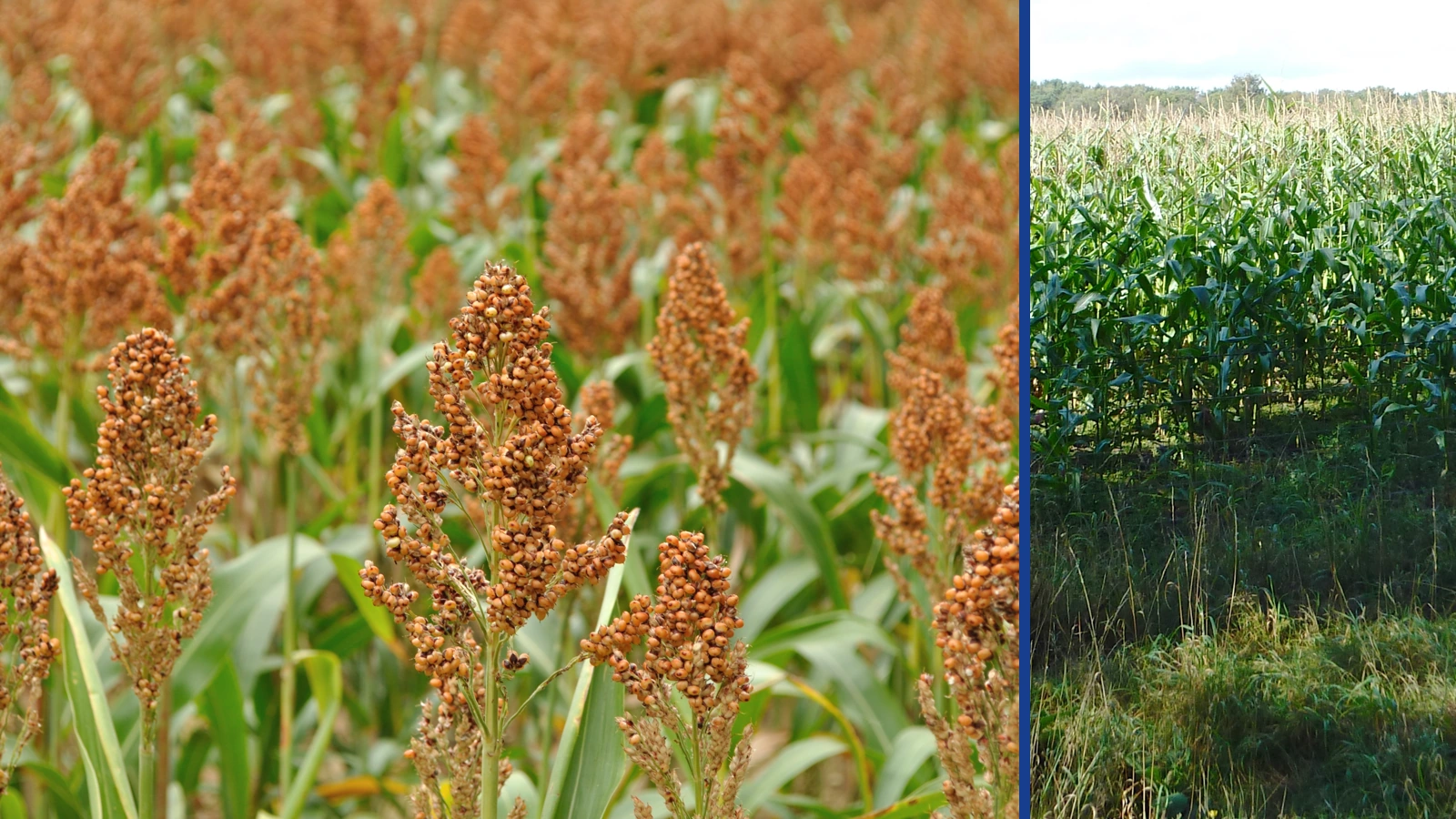
Europe could produce enough sorghum to match much of today’s maize grain used in animal feed, according to a new climate-modeling study. The opportunity is strongest in cooler regions, while increasingly hot and dry conditions could reduce yields farther south.
The research published in Earth’s Future on October 5 examines whether a cereal occupying only about 0.1% of European cropland in the study’s baseline could become a more useful feed crop.
Its production estimates describe potential under specified planting and climate assumptions. They do not establish that farmers will switch crops, that the change would be profitable, or that sorghum could replace maize in every animal’s diet.
What is sorghum?
Sorghum is a cereal in the grass family, grown for grain, animal feed and other uses. It is adapted to warm conditions and can tolerate periods of water shortage, making it a candidate for farms facing more difficult irrigation decisions.
According to INRAE’s account of the research, it generally needs less water and fertilizer than maize. That advantage depends on the variety, soil and growing conditions. Drought tolerance does not guarantee a better harvest than a locally adapted maize crop.
For livestock producers, another usable grain could widen purchasing options. For growers, it would introduce a different crop into rotations, the sequence of crops planted on the same land over successive years.
Warmer northern regions offer the biggest opportunity
The model projects improvements in parts of northern and central Europe, including Germany, Poland and Lithuania. Some areas could gain as much as three metric tons per hectare by the end of the century.
Parts of Spain, southern France and Italy face the opposite outcome, with modeled losses reaching 1.5 metric tons per hectare. A warmer Europe would therefore not provide the same opportunity everywhere.
INRAE says the share of European cropland combining high and stable sorghum yields could rise from about 22% under historical conditions to 29% to 34% late this century. Stability matters because a feed buyer needs dependable deliveries, not just an occasional bumper harvest.
The study assumes sorghum enters suitable crop rotations once every three years. Under its future scenarios, annual output reaches 79 million to 95 million metric tons around mid-century and 98 million to 111 million late in the century.
Those quantities are compared with a fixed reference of roughly 86 million metric tons of maize grain used for feed. The future scenarios could therefore match at least 90% of that reference by weight. They do not forecast future feed demand or demonstrate identical nutritional replacement.
Lower input needs do not settle the business case
A crop that needs less irrigation could reduce pumping and water costs where irrigation is available and necessary. Lower fertilizer use could also reduce spending. Neither saving automatically compensates for a lower yield or a weaker selling price.
French survey figures cited by the researchers illustrate the input difference. Average nitrogen applications in 2021 were about 111 kilograms per hectare for sorghum and 199 kilograms for maize. These are observations from French farming, not prescribed rates for every European field.
Growers have other ways to manage water pressure. Our coverage of sensor-guided irrigation in Italian tomato and grape trials examined savings from changing how existing crops receive water. Introducing sorghum would require a different decision about the crop itself.
Farmers would need suitable seed, advice on planting and harvesting, and buyers willing to purchase the grain. Feed manufacturers would need formulations appropriate to each livestock species, accounting for differences in digestibility and composition.
Land also has an existing use. Expanding sorghum could displace maize, wheat, barley or sunflower, affecting those markets. The most ambitious output scenario is consequently not a recommendation to plant every suitable hectare.
Local trials would have to follow the projections
The machine-learning model used 11,644 historical yield observations from France, Italy, Spain and the United States. The researchers applied it to projections from five climate models under two emissions pathways.
Soil characteristics and farm management were not explicitly represented, and monthly weather data can miss damaging short heat events. The study also does not calculate farmers’ financial returns.
A useful next step would be local trials pairing crop performance with production costs and an actual feed market. For a farmer choosing next season’s seed, a forecast of warmer conditions several decades away cannot substitute for knowing whether a buyer will take the harvest.
Cover: Representative sorghum in Haute-Garonne, France, and maize in Cheshire, England, photographed separately. The fields are not study sites. Photographs by Gyrostat (CC BY-SA 4.0) and Anthony O’Neil (CC BY-SA 2.0). Cropped and combined. Composite licensed CC BY-SA 4.0.
