
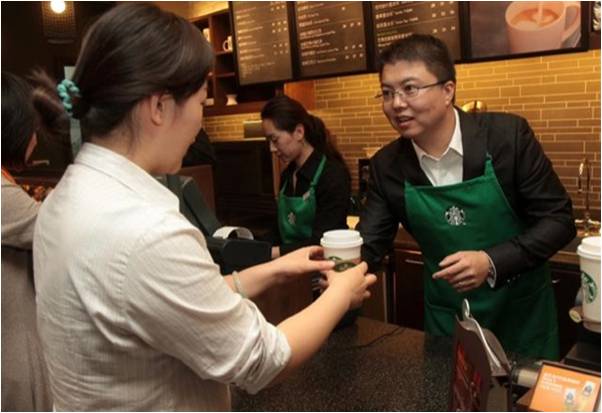
Starbucks’ China footprint is set to double in the next 5 years. By creating 10,000 new jobs a year and more than doubling its store count, the world’s largest coffee chain is planning to have 5,000 stores in mainland China by 2021.
Belinda Wong, the newly-appointed CEO of Starbucks, China, will oversee the American coffee giant’s plan to capitalize on China’s growing coffee culture and a booming middle class.
 Starbucks anticipate China will be their largest market outside the United States in the new few years. Image: Starbucks
In a recent interview with the South China Morning Post, Wong said:
“This is the early chapter of our China growth right now. We have barely even scratched the surface.”
The planned expansion is set to make Starbucks’ China footprint the largest market outside the United States within the next few years.
Growing middle class
China’s middle class is growing, and experts predict that income distribution is set to change dramatically over the next 15 years as more consumers move into the middle-class income bracket.
Joshua Lu, a co-business unit leader for consumer research at Goldman Sachs, describes the growth of China’s consumer class:
“In the coming years, we see that rising income will bring a couple hundred million people into the consumer class. And that is what makes China extremely important in the coming decade.”
Just as the West’s baby boomers – the richest generation in history – reshaped global consumption in recent decades, so China’s working age population is set to do the same between now and 2030. A report released earlier this year from McKinsey says:
“By 2030, China’s working-age population will account for 12 cents of every dollar spent in cities worldwide.”
If you were born between 1945 and about 1965 you are a baby boomer.
Drivers of global consumption
McKinsey suggest there is a subtle difference between the drivers of global consumption in the past and the drivers in the future.
Until the turn of this century, it was growth in population that grew consumer markets, but in the future, growth in global consumption will be driven by individuals spending more.
“This shift has profound implications for companies,” say McKinsey.
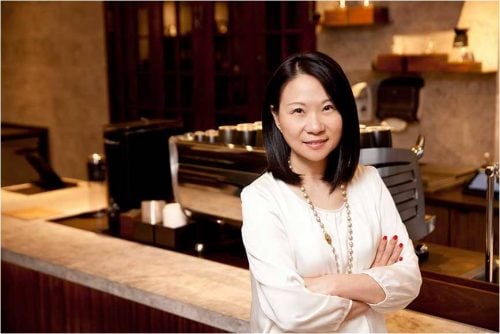 Belinda Wong, CEO of Starbucks, China, says they “have barely even scratched the surface.”
Image: Starbucks
Adding local touches
Starbucks is betting on attracting China’s growing consumer population by adding local touches to its mainland stores – with menu items such as dragon dumplings, moon cakes, and using spicy mocha, oolong and other tea flavors in its beverages.
Wong says the coffee giant hopes to break into around a dozen new urban markets every year, while continuing to increase Starbucks’ China footprint in megacities.
She says there is “plenty of space to infill in first and second tier cities where we have already opened – Beijing, Guangzhou, Shenzhen, Shanghai.”
Since their founding in Seattle, Washington in 1971, Starbucks have grown to become a global giant, with over 23,000 stores worldwide. They opened their first store in China in 1999.
