

The arrival of Uber and Lyft may have increased economic activity in US metropolitan areas without producing a clear rise in overall employment or worker earnings.
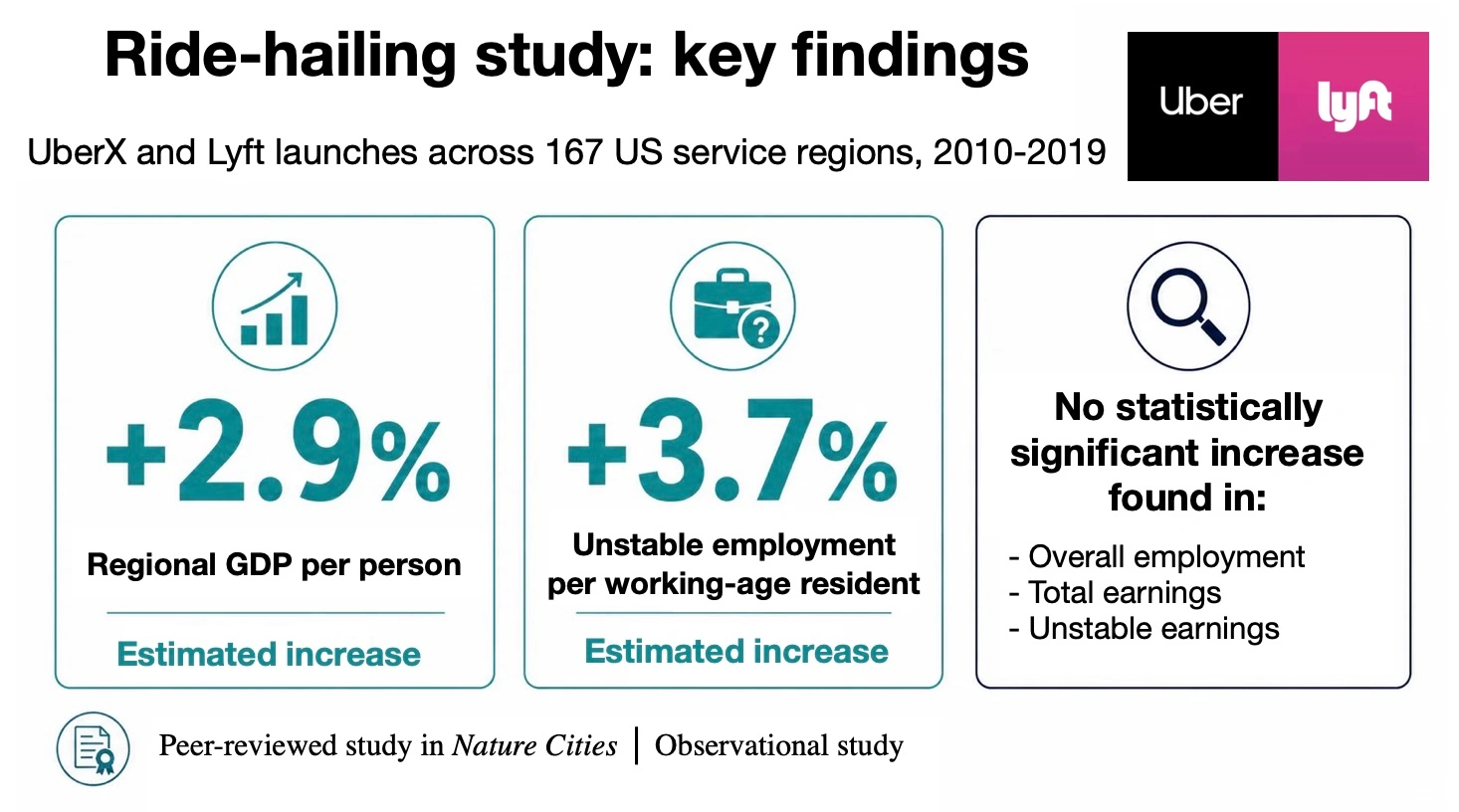
A study published in Nature Cities examined the staggered introduction of UberX and Lyft across 167 service regions between 2010 and 2019.
The researchers estimated that the arrival of UberX or Lyft was associated with a 2.9% increase in regional GDP per person and a 3.7% increase in unstable employment per working-age resident.
However, the study did not find statistically significant increases in total employment, total earnings or earnings from unstable jobs.
The findings suggest that a new digital transportation network platform can contribute to local economic activity without necessarily creating more jobs across the economy or increasing the total amount workers earn.
What the researchers studied
Uber and Lyft did not enter every US market at the same time. Their services became available in different metropolitan areas during different years.
The researchers used this staggered expansion to compare what happened in regions after ride-hailing arrived with what was happening in regions that had not yet received the services.
The analysis covered 167 non-overlapping service regions corresponding to US metropolitan or micropolitan statistical areas.
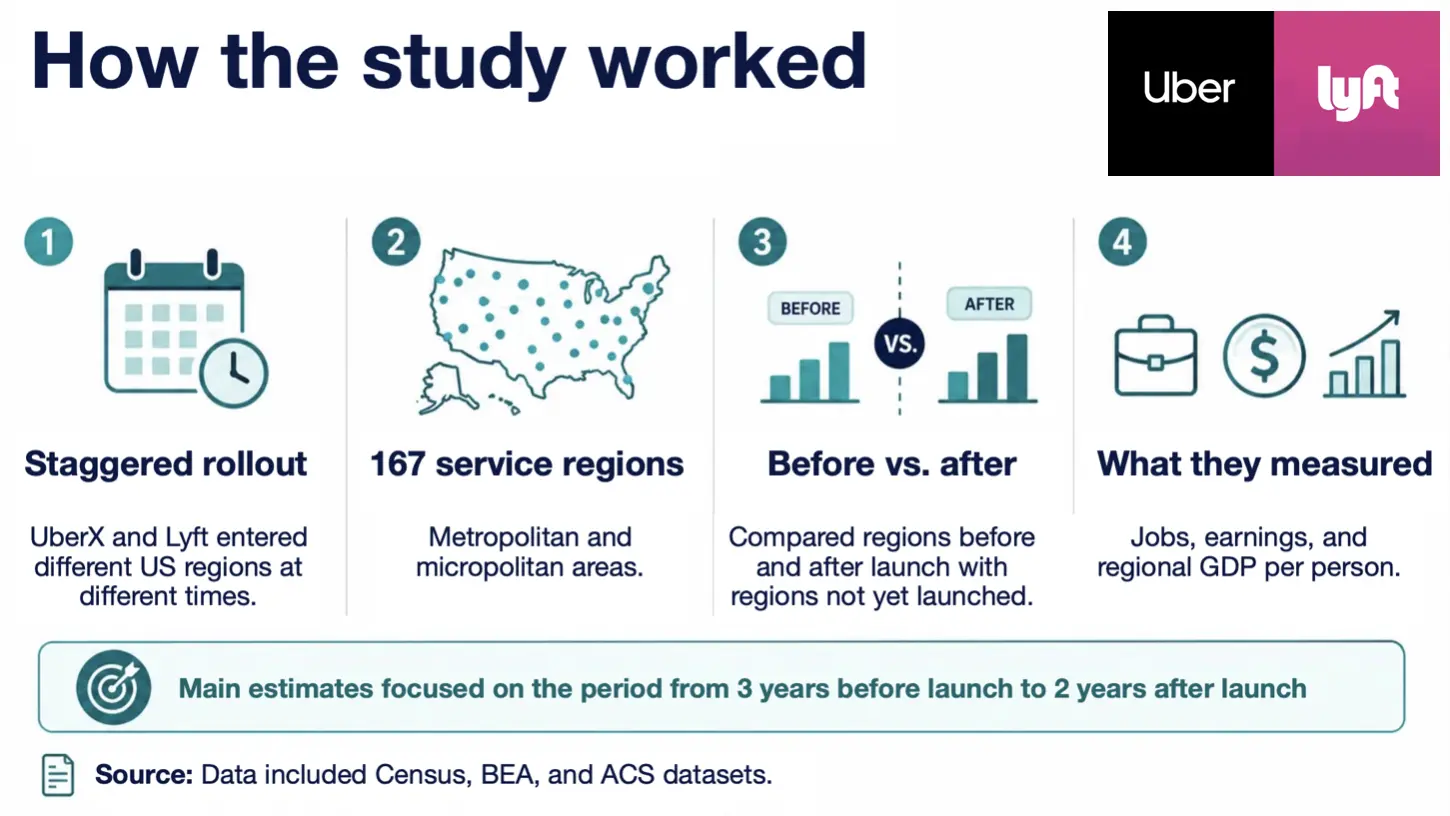
Employment and earnings information came mainly from the US Census Bureau’s Quarterly Workforce Indicators. Regional GDP data came from the US Bureau of Economic Analysis, while population estimates came from the American Community Survey.
The researchers used a difference-in-differences approach designed for situations in which a change occurs at different times in different places.
Their main estimates concentrated on the period from three years before a ride-hailing launch to two years afterward. This helped ensure that data were available for nearly all the regions being compared.
Regional GDP per person increased by an estimated 2.9%
The study estimated that the arrival of UberX or Lyft increased regional GDP per person by 2.9% on average.
Regional GDP measures the value of goods and services produced within an area. Dividing that figure by the population makes it easier to compare places of different sizes.
The estimate came with considerable uncertainty. The researchers calculated a likely range of between 0.7% and 5%.
They also warned that the upper end of that range was probably unrealistic. Real GDP per person across the United States increased by approximately 16% over the full period covered by the data, making a 5% effect from ride-hailing alone unusually large.
The lower end of the estimated range was more plausible, according to the researchers.
The study therefore provides evidence of a positive economic effect, but it cannot determine the exact size with confidence.
Unstable employment increased by an estimated 3.7%
The researchers also found that unstable employment per working-age resident increased by an estimated 3.7% after ride-hailing services arrived.
The likely range around this estimate was between 0.6% and 6.8%.
However, “unstable employment” has a specific meaning in the study. It refers to jobs that were recorded during a particular quarter but were not held continuously across the surrounding quarters.
This category can include seasonal, temporary or precarious jobs. It can also include ordinary jobs that a worker recently started or left.
The result is therefore not a direct measurement of the number of people driving for Uber or Lyft. Ride-hailing drivers are not recorded consistently in government employment data, and the measure includes workers from across the regional economy.
The researchers said the increase could indicate that some permanent employment was replaced by more intermittent work. It could also reflect greater movement between otherwise stable jobs.
The study could not determine which explanation was more important.
Overall employment did not clearly increase
Despite the increase in unstable employment, the researchers did not detect a statistically significant increase in total employment.
They also did not find statistically significant effects on total earnings or earnings from unstable jobs.
This does not prove that ride-hailing had no effect on those measures. The estimates were generally positive, but there was not enough statistical evidence to distinguish them confidently from zero.
Unstable employment also represented a relatively small share of all employment. A measurable change within that smaller category may therefore be insufficient to produce a detectable change in the total number of jobs.
How can GDP rise without more jobs?
GDP and employment do not always move together.
An economy can produce more value without employing more people if existing workers and businesses become more productive, customers spend more or resources are used more efficiently.
Ride-hailing may make it easier for passengers to reach workplaces, restaurants, shops, airports and entertainment venues. Drivers may also use the platform to earn money during periods when they would otherwise not be working.
These are possible explanations rather than conclusions established by the study. The researchers estimated the overall regional effects but could not identify exactly which activities caused the increase in GDP.
Ride-hailing can also replace other activity. A passenger may use Uber instead of a taxi or public transport, while someone may begin driving temporarily instead of remaining in a more continuous job.
The final result may therefore involve a mixture of newly created activity and activity transferred from other businesses or forms of employment.
What the findings mean for businesses
Transportation can act as economic infrastructure
The findings suggest that a transportation platform can affect more than the businesses and workers directly using it.
Making local journeys easier can potentially connect customers with companies, workers with employers and visitors with commercial areas.
For restaurants, hotels, retailers and entertainment businesses, customer access can influence revenue even when the number of jobs in the wider economy does not change.
The study did not measure the effect on each industry separately, but its GDP finding suggests that the economic influence of ride-hailing may extend beyond driver income.
More economic activity does not guarantee better-paid work
The combination of higher GDP and no statistically significant increase in total earnings is important.
GDP measures the total value produced in an economy. It does not show how that value is distributed or whether the average worker is financially better off.
The additional value could be received by drivers, passengers, local businesses, platform companies or other participants. The study was not able to determine who captured the gains.
Governments and businesses should therefore avoid treating GDP growth as a complete measure of economic wellbeing.
Flexible work and net job creation are different
A platform can create more opportunities for short-term or intermittent work without increasing the total number of people employed.
Some workers may use ride-hailing between jobs, alongside another job or only during certain periods. Others may move from one form of work into another.
This can increase labor-market flexibility, but it does not necessarily mean that the economy has created an equivalent number of additional jobs.
The absence of a statistically significant increase in unstable earnings also means that more participation in intermittent work should not automatically be interpreted as higher aggregate income.
Local leaders need more than one performance measure
A city evaluating the effect of ride-hailing should not look only at GDP or the number of registered drivers.
Total employment, job stability, earnings, congestion, public transport use, accessibility and the effects on existing transportation businesses may all matter.
A service can produce economic benefits in one area while creating costs or disruption elsewhere.
The study examined employment, earnings and GDP. It was not a complete cost-benefit analysis of ride-hailing.
The study has important limitations
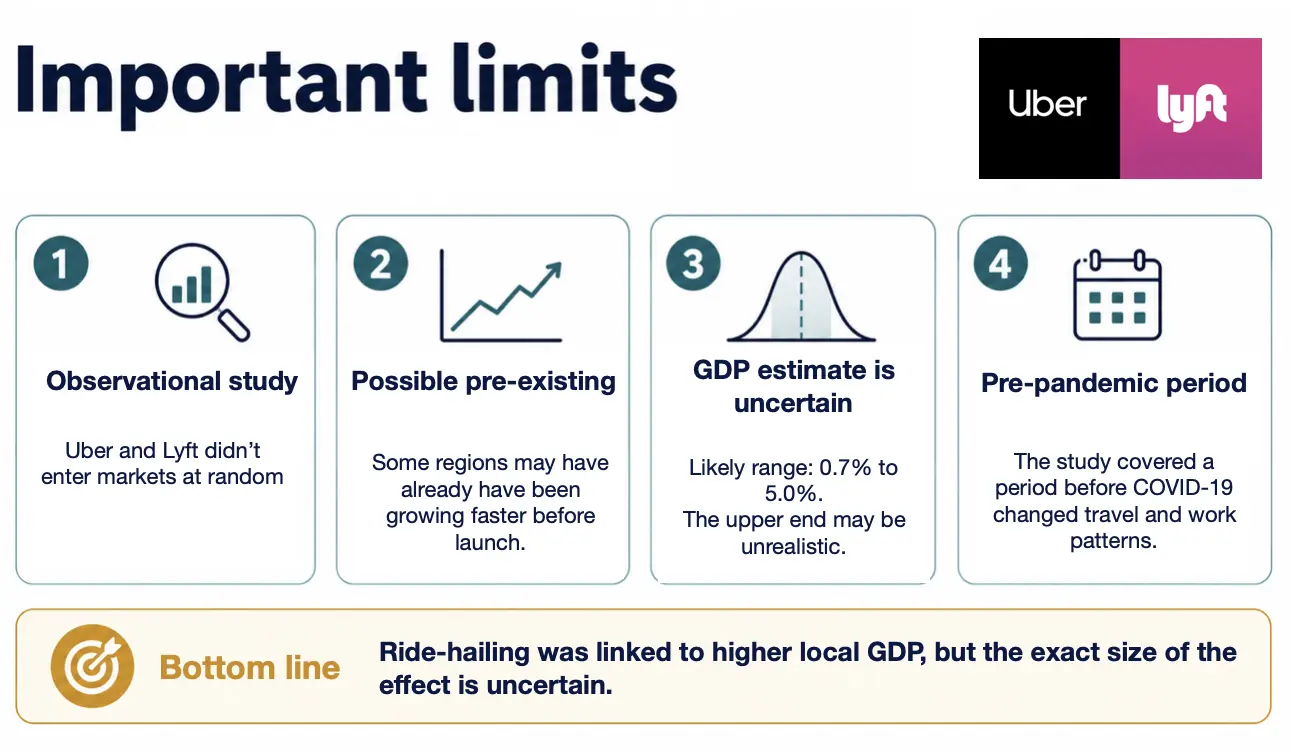
The research was observational rather than a randomized experiment. Uber and Lyft decided where and when to launch their services, meaning their entry was not random.
The companies generally entered larger, wealthier and more densely populated markets earlier than smaller regions.
The most important concern is that Uber and Lyft may have launched in places that were already beginning to experience stronger economic growth. In that case, part of the estimated effect could reflect existing growth rather than the arrival of ride-hailing.
The researchers examined trends before each launch and did not find compelling evidence that the companies were consistently entering immediately before increases in employment or earnings. However, this does not completely eliminate the possibility of reverse causation or other unmeasured differences.
Other digital labor platforms may also have entered some markets around the same time. The researchers could not track those launches as precisely as the expansion of Uber and Lyft.
The GDP estimate was also uncertain. The researchers themselves said that the upper end of its likely range was probably unrealistic.
The study covered 2010 to 2019, before the COVID-19 pandemic significantly changed travel patterns, working arrangements and the platform economy. Its findings should not automatically be assumed to describe the ride-hailing market in 2026.
The wider lesson
The study presents a more complicated picture of ride-hailing than simply saying it creates jobs or destroys them.
Uber and Lyft were linked to higher regional GDP per person and more intermittent employment. However, the researchers did not find clear evidence of more overall jobs or higher total earnings.
For businesses and governments, the wider lesson is that economic growth, job creation and job quality are separate outcomes.
A platform can make an economy more active while changing the way work is organized rather than increasing the total number of jobs.
Source: Adam Koling, Jeremy Michalek, Daniel Armanios, Connor Forsythe and Akshaya Jha, Effects of Uber and Lyft on jobs, wages and GDP, Nature Cities, published July 24, 2026.
The researchers have also made their data and analysis code publicly available.
