
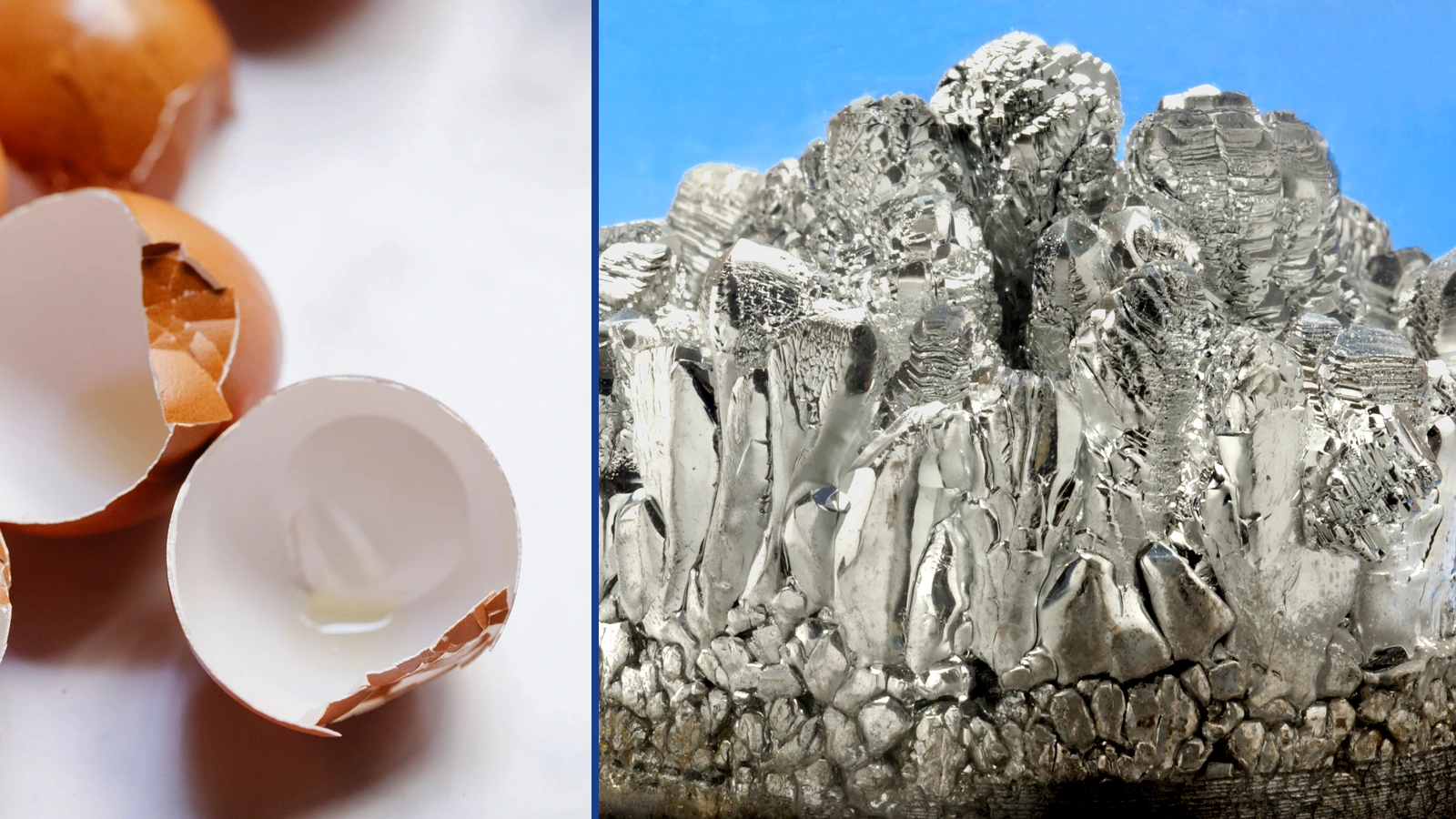
Researchers led by North Carolina State University have incorporated powdered waste eggshells into magnesium, producing experimental rods with a finer internal structure and greater resistance to continued deformation in microscopic compression tests. The technique offers a possible use for food waste in metals manufacturing, although industrial performance and environmental savings remain to be established.
The work combines mechanical mixing with chemical reactions inside the metal. Some of the calcium carbonate in the eggshells becomes reinforcing compounds during processing, allowing the researchers to investigate how a biological waste material bonds with magnesium.
NC State announced the research on October 1. The team included researchers from Pacific Northwest National Laboratory, City University of Hong Kong and the Indian Institute of Technology Delhi.
The study in the Journal of Magnesium and Alloys describes a proof of concept. Its results concern laboratory material, rather than an automotive part or another product ready for sale.
Eggshells supply a calcium-rich manufacturing ingredient
Eggshells are about 95% calcium carbonate, according to the university. That gives them a chemical purpose in the experiment: they supply calcium-containing material that would otherwise have to come from another source.
The researchers cleaned, dried and ground the shells before adding the powder to commercially pure magnesium. Eggshell powder accounted for approximately 8.4% of the starting volume. The resulting material is a metal-matrix composite, meaning that particles of another material are distributed through a surrounding metal.
Magnesium remains the main structural material. The eggshells supply an additional ingredient, so the process would not eliminate the need to produce magnesium itself.
Bharat Gwalani, the study’s corresponding author and an assistant professor of materials science and engineering at NC State, argues that using eggshells could shorten the processing chain for calcium materials. Whether that translates into a cheaper finished product depends on the cost of preparing and incorporating the waste.
Friction and pressure mix the materials without melting
The team used friction-based extrusion, a process that applies rotation and pressure to mix material and force it through an opening into a rod.
Eggshell powder was placed in recesses in a cylindrical magnesium block. A tool pressed down while rotating at 300 revolutions per minute, mixing the powder through the metal as it was extruded.
Processing took place in the solid state, without melting the magnesium, at a measured temperature of approximately 500°C. Friction generated heat, while the intense deformation broke up particles and reorganized the metal’s microscopic structure.
Metals contain small crystalline regions called grains. The processed pure magnesium had an average grain size of about 16 micrometers, compared with roughly 8 micrometers in the eggshell composite.
Smaller grains can obstruct the movement of defects that allow a metal to deform. Their size is only one influence on performance, however. Particle distribution, crystal orientation and the bonds between the metal and reinforcement also affect how a composite responds to force.
The strength gain appeared as compression continued
The mechanical results require more care than a general claim that eggshells made magnesium harder. Bulk microhardness, a measure of resistance to a small indentation, was broadly comparable between the two materials.
Tests on microscopic pillars showed a different response after deformation began. Pillars taken from similarly oriented crystals initially yielded at comparable stresses, but the eggshell composite developed greater resistance as compression continued.
This behavior is called work hardening: a material becomes more resistant to further permanent deformation as it is deformed.
In the reported comparison, ultimate compressive strength reached approximately 225 megapascals in the composite, against about 200 megapascals in pure magnesium. A megapascal is a unit of stress, or force per unit area. The increase is about 12.5% by our calculation.
Those figures describe microscopic samples under specific test conditions. They cannot be treated as a 12.5% strength increase for an entire rod, or for a future vehicle part.
Chemical reactions help particles bond with magnesium
The eggshell powder did more than act as a physical filler. Electron microscopy identified calcium oxide and magnesium oxide at the boundaries between particles and the surrounding magnesium.
The study’s abstract describes fragmentation of calcium carbonate particles down to the nanoscale, together with reactions that produced these oxides during extrusion. The researchers link the reactions to stronger bonding at the particle-metal boundaries.
The detailed analysis reports no detectable formation of Mg2Ca, a compound of magnesium and calcium. Calcium remained mainly in calcium oxide under the conditions used. Different temperatures or processing times might produce other compounds, but those possibilities were not demonstrated in this experiment.
A reinforcement needs to remain attached to the surrounding metal for the two to carry loads together. Examining those boundaries helps explain why adding a powder can alter performance, and why simply mixing more waste into a metal would not guarantee a better result.
Lower costs and emissions need a factory comparison
The economic case starts with replacing some conventionally processed calcium material with an inexpensive waste input. Solid-state processing could also avoid some steps associated with melting and casting.
Gwalani describes the route as energy-efficient and scalable. The study does not provide an industrial cost analysis or a life-cycle assessment, which would measure environmental impacts across the production chain.
A manufacturer would need to account for collecting, transporting, cleaning, drying and grinding the shells, as well as operating the extrusion equipment. Environmental comparisons would also need to include emissions from processing and any decomposition of calcium carbonate, which can release carbon dioxide.
Magnesium already has industrial uses. The U.S. Geological Survey identifies structural applications in automobiles and machinery, alongside its use as an alloying ingredient in aluminum.
Before the eggshell composite could enter those markets, engineers would need evidence about larger samples, repeatability, corrosion and performance under repeated loading. A material that performs well in a short compression test still has to withstand the conditions a finished part encounters throughout its working life.
