
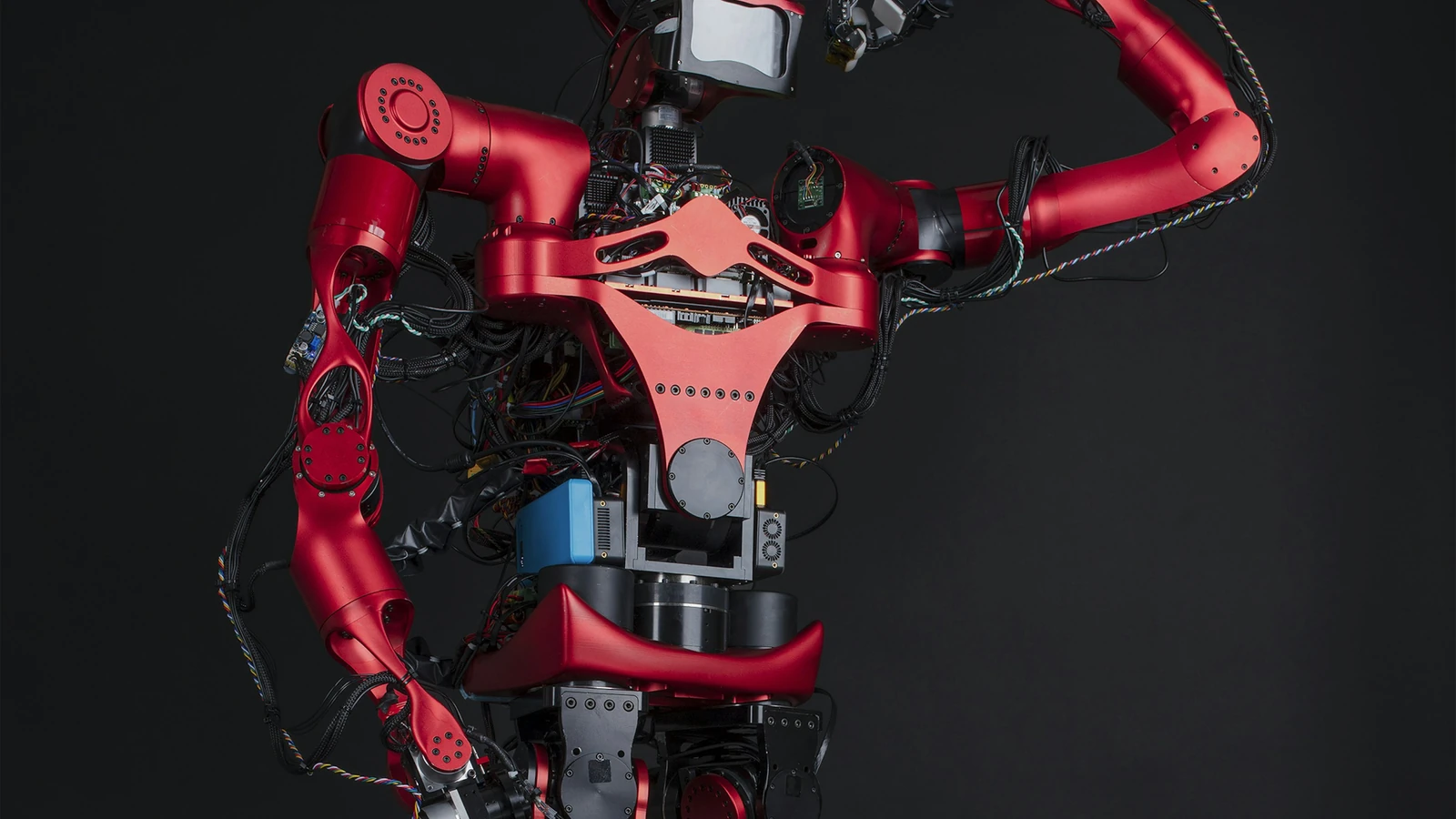
The cover shows TOCABI, a different humanoid robot, as a representative example.
A full-size humanoid robot in a lab can do far more than demonstrate basic walking. It can serve as a research platform for locomotion, balance control, manipulation, perception, human-robot interaction, and embodied AI experiments. Because its body dimensions, joint structure, and movement patterns are closer to a human’s, researchers can test algorithms in realistic tasks such as navigating corridors, reaching shelves, carrying tools, or responding to spoken commands. That makes a full-size humanoid robot useful for studying how sensing, planning, and actuation work together in real environments. In practice, it becomes both a machine for experimentation and a benchmark for system integration, helping laboratories move from isolated software models to repeatable physical tests that reveal real performance limits and improvement opportunities.
Core Capabilities of Full-Size Humanoid Robots
Walking, Balance, and Whole-Body Movement
One of the most important abilities of a full size humanoid robot is coordinated whole-body movement. In a lab, researchers use it to study bipedal walking, dynamic balance, turning, standing recovery, and motion over uneven surfaces. These experiments help validate gait planning, state estimation, and feedback control under realistic physical constraints. A humanoid form also allows testing of arm swing, torso compensation, and foot placement together rather than as isolated motions. Because the robot must stabilize its entire body while moving, it becomes a strong platform for analyzing disturbance rejection and fall prevention. This makes it valuable for developing controllers that can handle cluttered spaces, changing terrain, and task-driven movement instead of scripted demonstrations alone.
Object Handling and Dexterous Manipulation
A full-size humanoid robot also supports hands-on research in grasping, tool use, and coordinated manipulation. In laboratory settings, it can reach for objects on tables, pick up containers, press buttons, open simple fixtures, and move items between locations. These tasks help researchers evaluate arm kinematics, grasp planning, force-aware motion, and visual servoing. Because the robot operates at human scale, it can interact with benches, shelves, carts, and equipment designed for people without extensive workspace redesign. That makes experiments more practical and representative of real deployment conditions. Manipulation studies often combine perception and locomotion as well, since the robot may need to approach an object, stabilize its posture, and adjust its arms continuously while executing the task safely.
How Humanoid Robots Support Laboratory Research
Perception, AI, and Human-Robot Interaction
Laboratories use humanoid robots to connect perception and decision-making with physical action. A full-size platform can test scene understanding, obstacle detection, body tracking, speech interaction, and multimodal AI in the same system. Researchers can study how the robot interprets depth data, identifies reachable objects, recognizes people nearby, and responds to spoken instructions while maintaining safe behavior. Human-robot interaction becomes especially meaningful when the robot shares similar height and workspace with human users, because distance, visibility, and gesture timing matter more in realistic settings. These experiments support research on collaborative assistance, social communication, and embodied intelligence. They also reveal practical issues such as sensor occlusion, latency, and ambiguous commands that simulations often fail to capture fully.
Motion Control, Simulation, and Real-World Testing
A lab-ready humanoid robot is valuable because it closes the gap between simulation and hardware validation. Researchers can first develop controllers in a simulator, then transfer them to the physical robot to evaluate stability, tracking accuracy, and safety. This process helps identify modeling errors, actuator limits, contact uncertainties, and timing issues that only appear during real execution. Full-size humanoids are especially useful for testing integrated pipelines where perception, planning, and motion control must run together in real time. They also support iterative experimentation: collect data, refine the model, update control parameters, and test again under comparable conditions. As a result, the robot becomes a repeatable research instrument for benchmarking performance across locomotion, manipulation, autonomy, and interaction studies.
LimX Oli: A Full-Size Humanoid Robot for Lab Research
Hardware and Physical Capabilities of LimX Oli
LimX Oli is a full-size humanoid robot built for laboratory research and experimentation. It stands 165 cm tall and offers 31 body degrees of freedom, supporting human-like posture control and a broad range of motion studies. Oli uses independent compute for motion control and perception, which helps researchers run advanced algorithms across sensing and actuation pipelines. Its onboard sensing includes a self-developed 6-axis IMU with improved anti-interference performance, a head-mounted Intel® RealSense™ D435i for wide-range perception and navigation, and a chest-mounted Intel® RealSense™ D435i for close-range manipulation and safe interaction. It also provides USB 3.0 and 3.2 interfaces for integrating external sensors such as LiDAR and additional cameras.
Development and Experimental Applications
For lab teams, LimX Oli supports both technical development and practical experimental workflows. Its sensing and compute architecture makes it suitable for research in locomotion control, autonomous navigation, manipulation, and multimodal interaction. The platform is designed for easier deployment as well, with a foldable seated storage design that enables compact transport and single-person operation without complex setup. Researchers can also explore voice-based interaction through its self-developed bilingual system, which supports Chinese and English conversation and command input. Custom knowledge bases can be uploaded for task-specific studies. Beyond research, the robot includes preloaded interactive actions and OTA-updatable dance routines, while Studio software provides a no-code choreography tool for demonstration and engagement scenarios.
Conclusion
A full-size humanoid robot in a lab can walk, balance, manipulate objects, perceive its surroundings, and interact with people in ways that make robotics research more realistic and integrated. It gives researchers a practical platform for testing how sensing, AI, control, and mechanics perform together under real physical conditions. That matters because many important challenges only appear when a robot must move its whole body, handle uncertainty, and operate in human-centered spaces. Platforms such as LimX Oli extend that value by combining full-size embodiment, rich sensing, expandable interfaces, and dedicated compute for research workflows. For laboratories working on embodied intelligence, motion control, or human-robot interaction, a full-size humanoid robot is not just a demonstration machine; it is a serious experimental tool.
